
Executive Summary
The world of work is undergoing rapid transformation, driven by AI and automation. These technologies, once considered futuristic, are already disrupting industries and reshaping the workforce. As we approach 2026, the future of work is becoming increasingly clear—AI and automation will play a dominant role in driving productivity and innovation. However, this shift also brings critical challenges, including job displacement, economic inequality, and ethical concerns surrounding automation.
This blog will explore five key policy challenges that governments and businesses must address to ensure a fair, inclusive, and productive workforce in the age of AI. These challenges include ensuring the equitable distribution of automation’s benefits, preparing the workforce for future demands through reskilling, and addressing global disparities in automation adoption. The decisions made today will shape the workforce of tomorrow, and it is essential to navigate these issues thoughtfully and strategically.
1. Introduction
The world of work is being reshaped right before our eyes. AI and automation in jobs are no longer futuristic concepts—they are already disrupting industries and altering the very fabric of the workforce. From self-driving cars to AI-powered assistants, technology is rapidly automating tasks that once required human effort, and the impact is profound. As we approach 2026, it’s clear that the future of work will not look like the past. These technological advancements present enormous opportunities—but also critical challenges that could determine the fate of millions of workers.
Job displacement, economic inequality, ethical concerns, and global disparities in technology adoption are now the top topics of debate across government halls, corporate boardrooms, and newsrooms. These issues are not abstract or distant—they are happening today, and the decisions made now will have lasting consequences for future generations.
But here’s the question: How will we respond? The future of work isn’t just about embracing AI and automation—it’s about navigating the disruption and ensuring that the benefits are shared equitably. The question we must ask is not whether AI and automation will shape our workforce—but how we can shape them to work for everyone.
In this blog, we’ll delve into the 5 key policy challenges that governments and businesses must address in the coming years to ensure that AI-driven change doesn’t leave people behind. These challenges are not theoretical—they are urgent, real, and require immediate action to secure a fair, productive, and inclusive workforce. We’ll explore:
- Job Displacement and Economic Inequality: The rise of automation threatens to displace workers across industries. But how do we ensure that the benefits of AI are distributed fairly?
- Reskilling and Workforce Development: As technology evolves, so must our workforce. How can we prepare workers for the future of work?
- Ethical Concerns and AI Governance: AI decision-making is pervasive, but is it ethical? How do we ensure fairness and transparency in automation?
- Balancing Innovation with Worker Protection: How do we foster innovation while safeguarding workers from the risks of automation?
- Addressing Global Disparities in Automation Adoption: Automation is advancing differently across the globe. How can we ensure developing countries aren’t left behind?
As AI and automation continue to dominate headlines, the stakes have never been higher. The future of work is not a distant reality—it is unfolding right now. And the decisions we make today will define what tomorrow’s workforce looks like.
1. Job Displacement and Economic Inequality
One of the biggest concerns surrounding AI and automation is the potential for widespread job displacement. The rise of automation threatens many routine and manual jobs, particularly in sectors like manufacturing, transportation, and retail. According to the World Economic Forum’s Future of Jobs Report 2025, 40% of employers expect to reduce their workforce as AI automates tasks traditionally performed by humans (World Economic Forum, 2025).
The economic inequality that could result from job losses is also a major concern. The displaced workers, particularly those in low-wage jobs, may struggle to find new employment, exacerbating the gap between the haves and have-nots. The PwC study suggests that workers in AI-exposed sectors could face a 56% wage premium if they reskill (PwC, 2025).
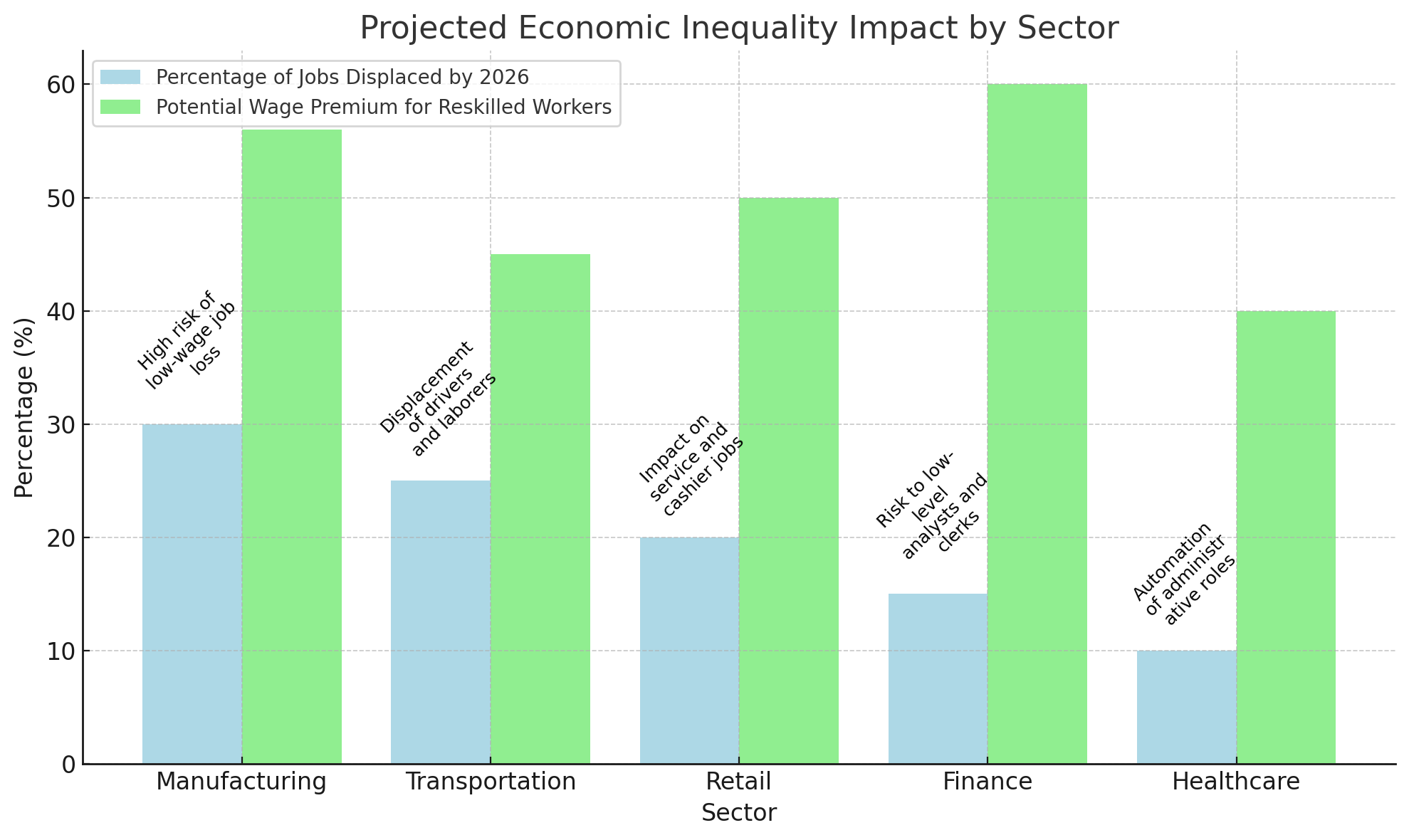
Note: Percentages reflect industry-specific projections for AI-driven job displacement, based on available forecasts. Wage premiums represent potential increases for workers who reskill to meet the demands of the digital economy.
The economic inequality associated with automation comes from the uneven distribution of reskilling opportunities. Workers in AI-exposed industries have the potential to earn significantly more after reskilling, but access to training and investment in retraining programs will play a major role in determining how widely these wage premiums are distributed.
Policy Action Needed:
Governments must implement policies that not only protect workers from displacement but also create pathways for reskilling and job transition. Universal Basic Income (UBI) and automation taxes could be explored to ensure that the wealth generated by automation is shared more equally.
“While automation threatens job stability, there’s also potential for massive wage growth for workers who adapt.”
But how can we ensure that reskilling opportunities are available to everyone? Let’s explore the next challenge: Reskilling and Workforce Development.
2. Reskilling and Workforce Development
With job displacement looming, the need for reskilling has become more urgent. The rapid pace of technological advancement requires workers to continuously upgrade their skills to stay competitive in the evolving labor market. A report from PwC shows that 66% of skill change is happening faster in AI-exposed jobs compared to traditional roles (PwC, 2025).
For example, India’s rapid tech sector growth has been driven by an increasing demand for AI-related skills, while manufacturing jobs have been particularly vulnerable to automation.
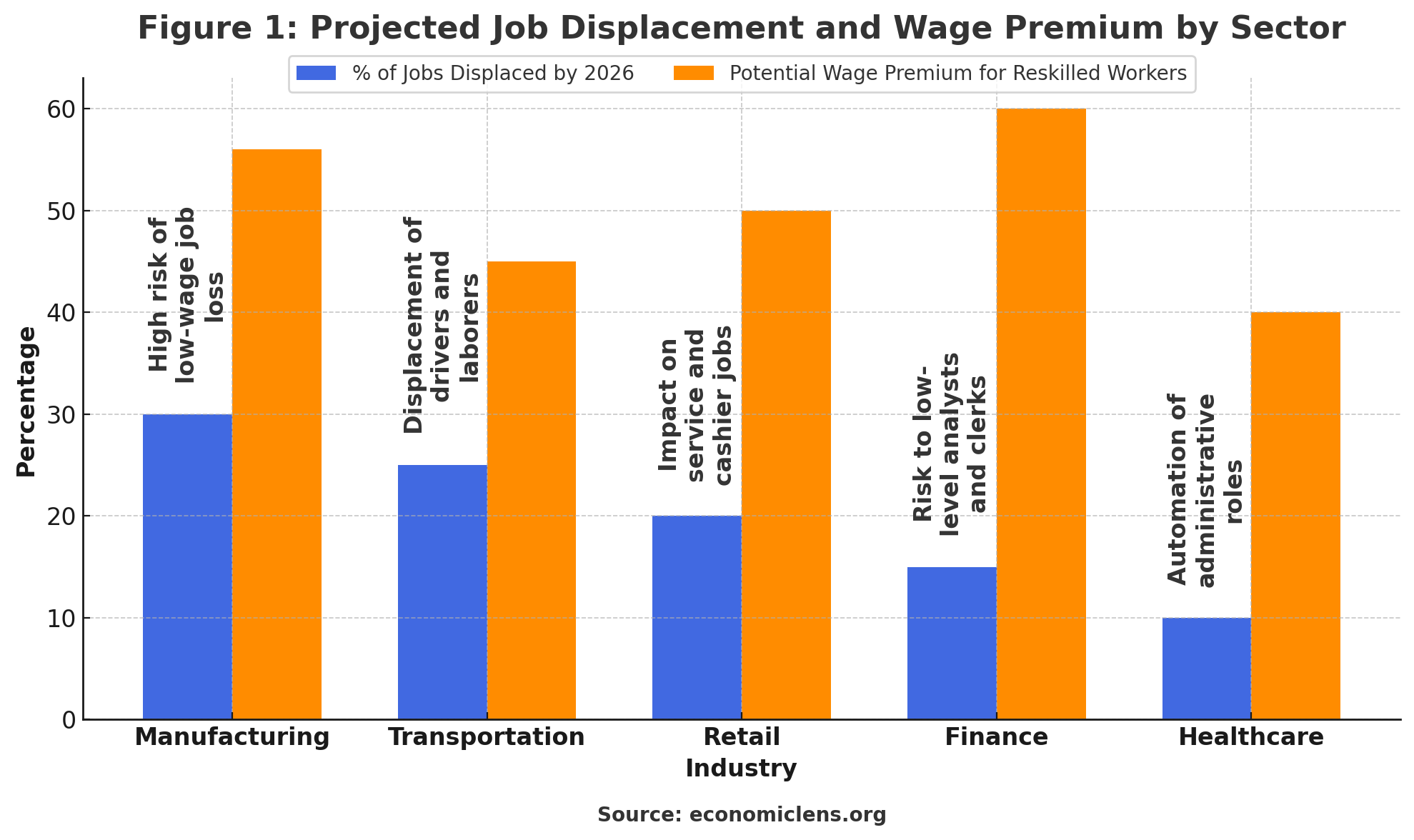
Note: These figures are illustrative based on public announcements and policy proposals rather than exact numbers.
Policy Action Needed:
Governments must invest in reskilling programs, making sure that displaced workers can transition into new roles. Private sector partnerships with educational institutions can also help design training programs that focus on the skills of the future, such as AI, robotics, and data science.
“As the demand for new skills grows, who will bear the responsibility for reskilling workers?”
We need to explore the role of AI governance in ensuring fair practices. Let’s dive into the next challenge: Ethical Concerns and AI Governance.
3. Ethical Concerns and AI Governance
As AI and automation take on more decision-making roles in the workplace, ethical concerns are becoming increasingly important. From algorithmic bias to privacy issues, AI’s growing role raises many questions about fairness and transparency in decision-making.
For instance, AI-driven hiring systems can perpetuate gender or racial biases if the data they’re trained on is biased. Ethical considerations also include how data privacy is handled and ensuring that automation does not exacerbate social inequalities.
Dr. Shoshana Zuboff, a leading expert on AI ethics, argues that unaccountable AI could lead to surveillance capitalism and widespread social harm, especially if companies and governments fail to regulate AI properly (Harvard Business Review, 2025).
Policy Action Needed:
Governments must regulate AI and ensure ethical standards are met, including transparency, accountability, and fairness in AI deployment. Strict rules on data protection and algorithmic accountability must be enforced, particularly in hiring, criminal justice, and healthcare systems.
“As we deploy more AI, the line between ethical and unethical use becomes blurred.”
How can we ensure that AI works fairly for all? Next, let’s discuss the importance of balancing innovation with worker protection.
4. Balancing Innovation with Worker Protection
Policymakers are tasked with fostering technological innovation while ensuring that workers are protected from job losses or exploitation. Over-regulation could stifle innovation, while under-regulation could lead to unfair labor practices.
For instance, although automation increases productivity, only 1% of companies consider themselves fully mature in their AI deployment (McKinsey, 2025).
Policy Action Needed:
Governments must strike a balance between innovation and regulation. This includes policies that encourage AI adoption while also protecting workers from job displacement. Regulatory measures, such as automation taxes or robot taxes, could help fund worker retraining programs and mitigate the effects of job loss.
“Innovation shouldn’t come at the expense of workers’ livelihoods.”
So, how do we regulate AI to protect jobs without stifling progress? The next challenge focuses on global disparities in automation—let’s see how this plays out.
5. Addressing Global Disparities in Automation Adoption
The adoption of automation and AI technologies is not occurring at the same rate worldwide. While developed economies like the U.S. and Europe are leading the way, developing countries often struggle to access the technologies and resources required to implement automation effectively.
Summary of the Global Disparities in Automation Adoption
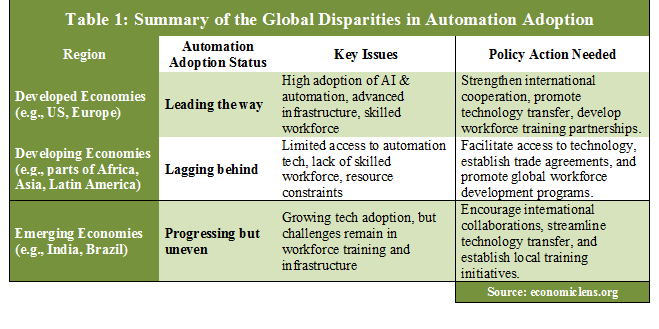
According to Professor Klaus Schwab, the Fourth Industrial Revolution could widen the gap between developed and developing countries unless international cooperation ensures that emerging economies are not left behind (World Economic Forum, 2025).
Policy Action Needed:
Global collaboration is necessary to support developing nations in adopting automation technologies. Initiatives such as technology transfer, international trade agreements, and partnerships for workforce development are key to ensuring that all countries benefit from automation, not just those with advanced infrastructures.
“With automation advancing differently across borders, the global workforce faces a new divide.”
Can we ensure a level playing field? Let’s look ahead at the future of work and what lies in store.
6. The Future of Work: What Lies Ahead?
Looking ahead, the future of work AI is likely to be characterized by:
- Partnerships between humans and machines rather than wholesale replacement;
- Growth in roles that focus on uniquely human skills—creativity, interpersonal relations, ethics, strategic thinking;
- Expansion of gig-style and remote work arrangements, driven by automation and digital platforms;
- Sectoral shifts: some sectors (e.g., knowledge work, services) may transform faster than manufacturing or manual labor, where the automation payoff is slower;
- A premium on lifelong learning, adaptability, and mobility across roles and sectors.
Yes, automation and job displacement are real risks—but they are also part of a transformation. If managed well, the workforce of 2030 could be more productive, more flexible, and more engaged. If mismanaged, the risk is entrenched unemployment, widening inequality, and social strain.
The future of work is upon us. The decisions we make today will determine whether AI and automation become the building blocks of a more prosperous society or the foundation for growing inequality. Let’s take action now.
7. Conclusion: Preparing for the Future of Work
The era of AI and automation in jobs has already begun. For the Western labor market, 2026 marks a turning point: productivity gains are being realized, but the policy responses have not caught up. The five key challenges—reskilling the workforce, redesigning social safety nets, balancing innovation with regulation, managing job displacement, and directing workforce transformation—must be addressed now if we are to shape a future of work that is inclusive, resilient, and forward-looking.
Call to Action
Governments, businesses, and workers must collaborate. Employers need to invest in their workforce, educators must evolve curricula, and policymakers must design adaptive, evidence-based frameworks to guide the transition. Only then can automation become a force for broad prosperity—not narrow disruption.
“The time to act is now. The decisions we make today will shape tomorrow’s workforce—let’s ensure it’s one that’s fair, innovative, and inclusive.”