
The global food security crisis is accelerating as extreme heatwaves, droughts, export bans, water shortages and supply disruptions combine to destabilize markets worldwide. Rising food inflation, crop losses, shipping delays and volatile grain prices are placing millions at risk. This blog explains the drivers, impacts and policy options shaping this global food emergency.
INTRODUCTION
The global food security crisis is rising faster than international institutions can respond. Climate shocks, water shortages, export bans and collapsing supply chains are converging, creating one of the most severe global food disruptions in decades. These pressures are pushing food prices higher across continents, weakening vulnerable markets and increasing hunger and malnutrition in regions already under stress.
As extreme heat, unpredictable rainfall and depleted water resources damage major harvests, export restrictions in key producing nations are further tightening global availability. Meanwhile, shipping disruptions, fertilizer shortages and geopolitical tensions are blocking the movement of food from surplus regions to deficit areas. As a result, import-dependent countries face rising uncertainty, fiscal pressure and social tension.
This analysis examines the climate volatility, market failures, production losses, structural vulnerabilities and policy risks that define the global food security crisis today. It offers data, expert insight and actionable pathways to understand and address the escalating global food emergency.
1. Climate Shocks and the Global Food Crisis
Climate shocks are now the strongest force shaping the global food crisis, disrupting crop cycles and weakening long-standing agricultural systems. Rising temperatures, prolonged droughts, unexpected floods and severe storms are degrading soil quality and reducing yields across regions. These climate pressures are appearing simultaneously in multiple food-producing zones, leaving supply chains without sufficient time to recover. As climate volatility intensifies, it amplifies production gaps and contributes directly to the global food security crisis.
Expert Insight & Global Report Signals
FAO climate researcher Dr. Maria Hollister notes that repeated climate shocks now hit agriculture at every stage, from seed germination to harvest. She explains that farmers are struggling to adapt because temperature spikes and water stress arrive unpredictably, weakening even resilient crops and reducing output across entire regions. The IPCC Agricultural Assessment 2024 (https://www.ipcc.ch/report/ar6/wg2/) finds that recurring heatwaves and shifting rainfall patterns may cause yield losses of up to 23 percent in wheat, 18 percent in maize and 15 percent in rice by 2035. The report stresses that adaptation measures are far too slow to counter the speed of rising temperatures, creating a widening global supply gap.
Recent FAO Heat Stress Monitoring 2025 shows South Asia and the Middle East recording the highest agricultural heat index values in history. Pakistan and India endured consecutive 45 to 48 degree Celsius heatwaves during the 2024 crop cycle, damaging wheat and rice at flowering stages. East Africa continues to suffer climate-induced drought emergencies, while South America faces El Niño-linked crop failures in maize and soybeans, adding new volatility to global supply.
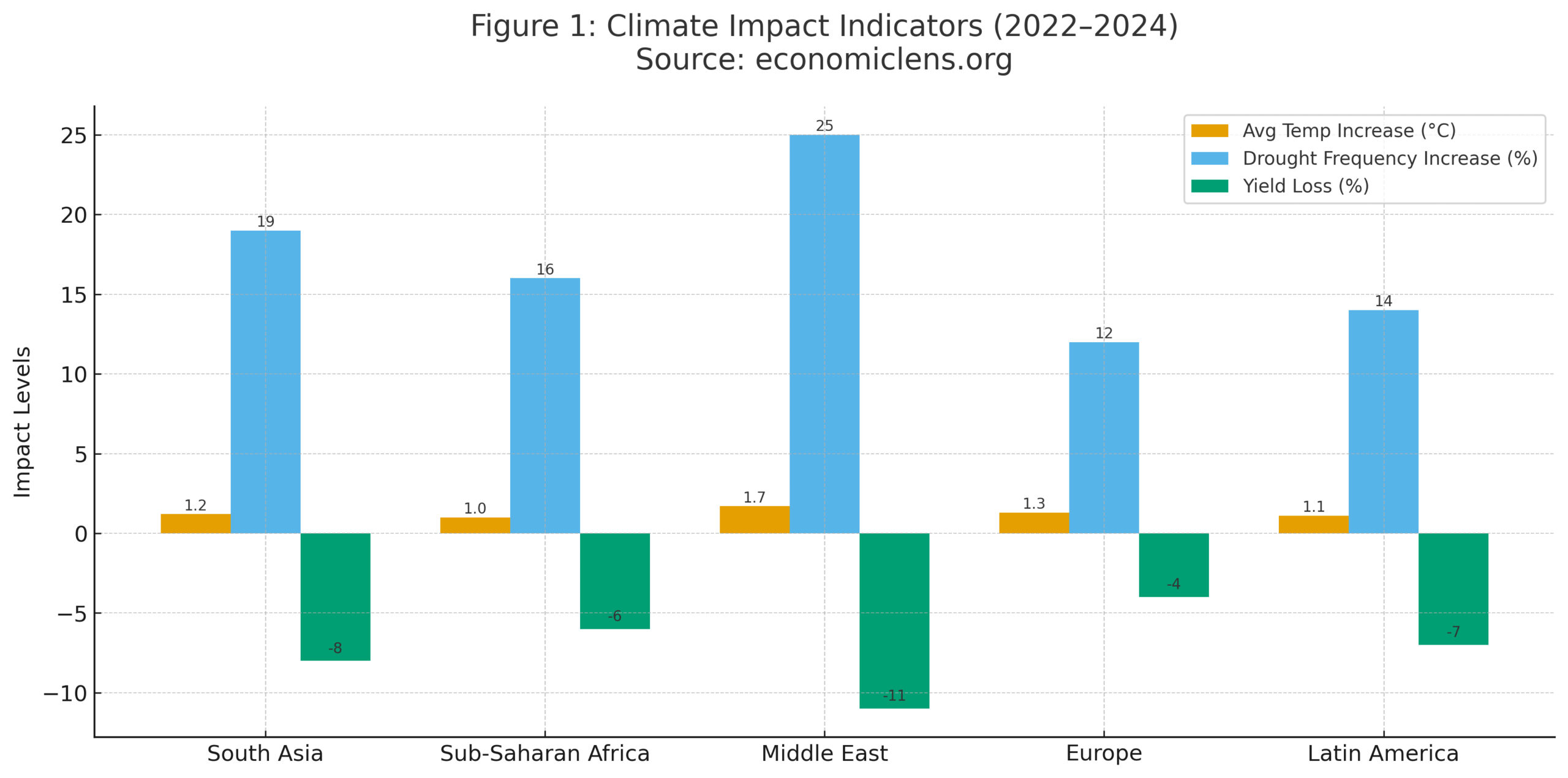
Rising temperatures and drought frequency are clearly linked to declining yields, especially where heat and water shortages converge. The Middle East and South Asia show the steepest losses, revealing how climate shocks deepen regional instability and worsen the global food security crisis.
For broader context on how climate stress and agricultural fragility shape the global food security crisis, see “Food Security Stress Test: Agriculture Under Climate and Conflict Strain” (https://economiclens.org/food-security-stress-test-agriculture-under-climate-and-conflict-strain/).
“Every degree of warming magnifies risks for farmers and consumers. Building climate-smart agriculture is essential for avoiding deeper losses in a world where every harvest now matters.”
2. Export Restrictions and The Global Food Crisis
Export bans are tightening global supply at a time when production is already weakened by climate stress. Countries facing domestic inflation are restricting grain shipments to protect local markets. These policies, however, shrink global availability and raise international prices. When combined with climate shocks, export restrictions accelerate the global food security crisis and increase volatility for import-dependent economies.
India’s rice export ban has pushed regional markets into severe volatility, affecting Bangladesh, Nepal and African importers. Russia’s wheat export quotas reduced available Black Sea wheat for the Middle East. Pakistan’s onion export fluctuations created temporary shortages in Gulf markets. These examples show how national inflation concerns trigger ripple effects across continents.
Expert Insight & Global Report Signals
WFP economist Arif Mahmood explains that export bans are often politically motivated responses to domestic inflation. He argues that these restrictions reduce international supply, destabilize markets and push fragile importing nations toward deeper dependence and emergency food programs. The World Bank Food Trade Monitor 2024 (https://www.worldbank.org/en/topic/agriculture/brief/food-security-update) reports that rice export bans from major Asian producers removed nearly 18 percent of expected global supply from the market. The study shows that such restrictions added between 12 and 22 percent to international grain prices, intensifying the impact of climate-related production losses.
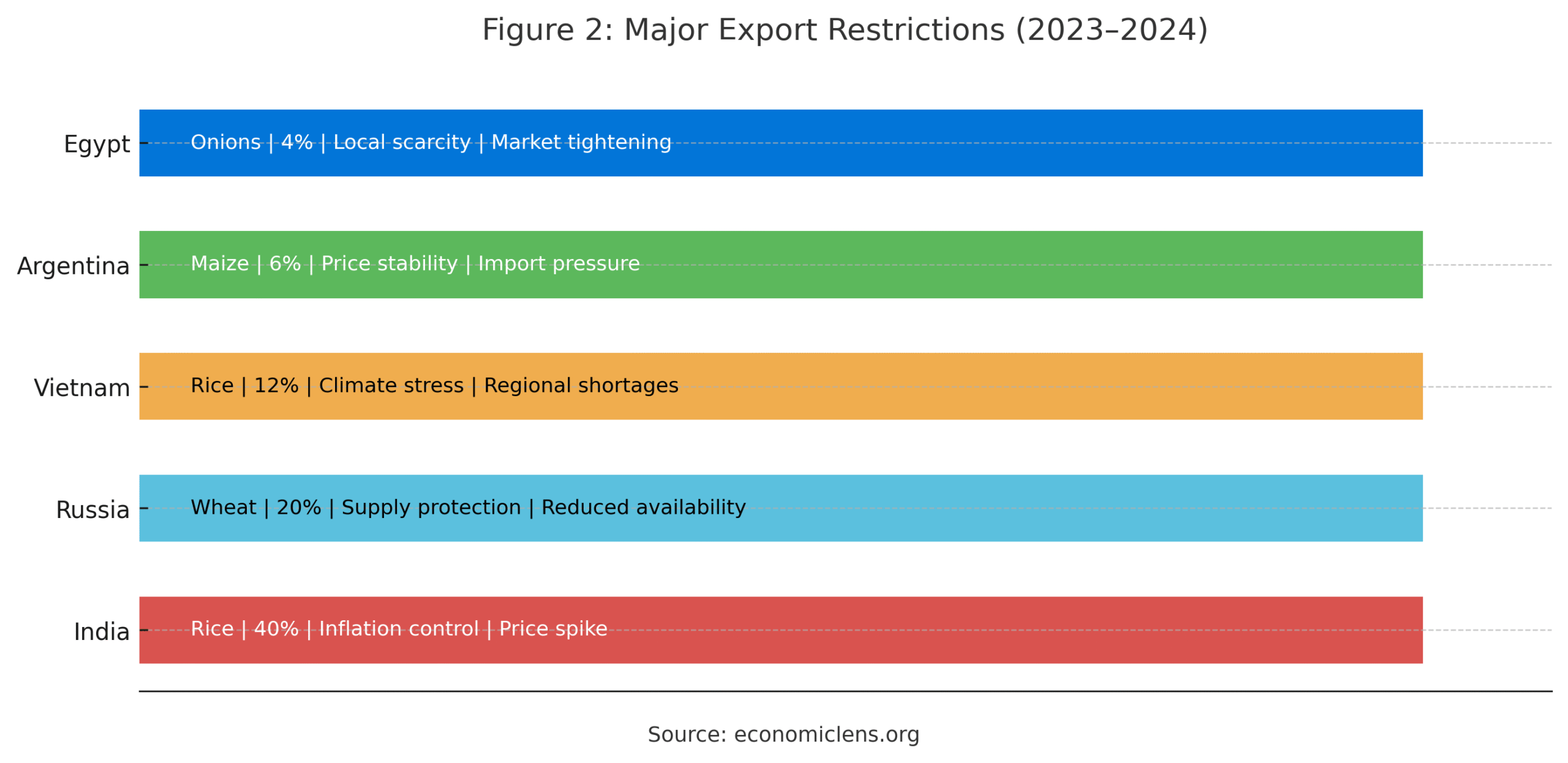
Export restrictions from major suppliers create significant global ripple effects. When countries controlling large shares of key commodities limit exports, global buyers face higher prices and limited alternatives, increasing the vulnerability of low-income importers.
IMF inflation surveillance warns that export bans contribute to a 1.4 to 2.7 percent rise in global food inflation. These restrictions combine with climate shocks to push essential foods beyond the reach of poor households. For broader context on how climate shocks, export bans and global supply tightening interact to intensify food shortages, see “Global Food Supply Crunch: Climate Shocks, Export Bans and Inflation Risk” (https://economiclens.org/global-food-supply-crunch-climate-shocks-export-bans-and-inflation-risk/).
“When nations block their harvests from crossing borders, global hunger rises. Cooperation in trade is a lifeline in a world where climate and conflict already strain food access.”
3. Supply Chain Disruptions and The Food Supply Chain Crisis
Global food supply chains are increasingly fragile due to a combination of climate shocks, shipping disruptions, high fuel prices and geopolitical tensions. Key maritime routes have experienced delays that push transportation costs higher, shrinking the availability of imported food. These disruptions intensify the global food security crisis by weakening the flow of essential commodities across continents.
Red Sea shipping disruptions, caused by attacks on commercial vessels, forced global carriers to reroute shipments around the Cape of Good Hope. This increased travel time by 10 to 14 days and raised insurance premiums significantly. Suez Canal traffic declines hurt Egypt’s revenue and squeeze import-dependent Middle Eastern and African nations that rely on timely wheat shipments.
Expert Insight & Global Report Signals
IFPRI trade specialist Dr. Daniel Quinn states that modern food systems rely heavily on smooth maritime logistics. He warns that repeated shipping delays, especially in the Red Sea and Indian Ocean, reduce the predictability of grain flows and raise import costs for vulnerable regions. The FAO Food Logistics Outlook 2024 (https://www.fao.org/worldfoodsituation/en/) reveals that shipping costs for grain have increased by 34 percent due to rerouting around conflict zones. The report notes that such cost increases are absorbed into final retail prices, disproportionately affecting low-income consumers in import-reliant nations.
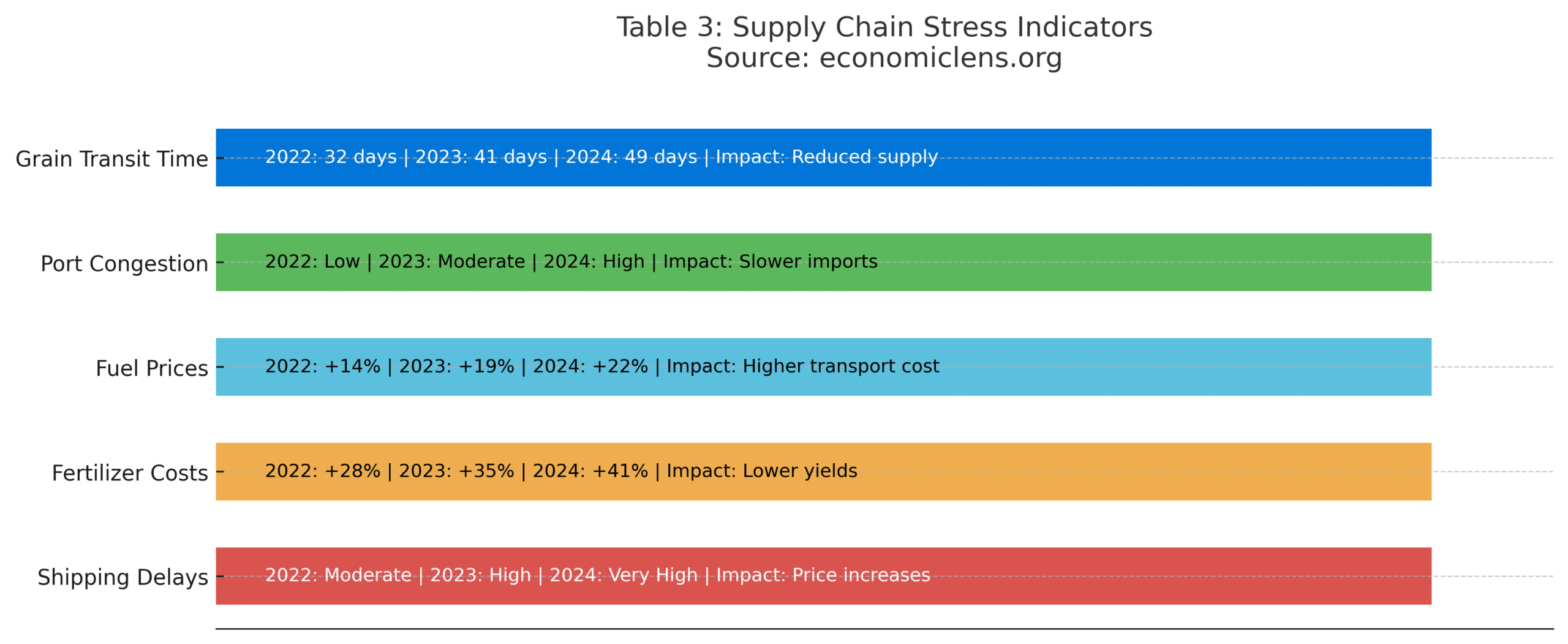
All key indicators show rising stress across logistics, from fertilizer access to transit delays. Higher fuel and shipping costs directly affect food prices, forcing vulnerable countries to pay more for less, thereby worsening the global food security crisis.
“Every delay in the supply chain becomes a delay in feeding communities. Strengthening logistics is essential for protecting access to food in a disrupted world.”
4. Food Market Instability and Climate Linked Food Shortages
Food markets today face persistent volatility driven by climate shocks, export restrictions and unstable logistics. Prices for wheat, maize, rice and vegetables have fluctuated sharply, creating uncertainty for both producers and consumers. This instability hurts low-income households the most and places significant pressure on government budgets.
Expert Insight & Global Report Signals
FAO’s Global Food Price Index shows sharp spikes in wheat and rice prices. OECD inflation data highlights Egypt experiencing wheat inflation above 32 percent, Kenya facing maize inflation near 28 percent and Bangladesh dealing with rice inflation exceeding 24 percent. Futures markets for wheat and rice show unusually high volatility, a sign of deep uncertainty.
Economist Dr. Lina Ortega emphasizes that food price volatility is now structural rather than temporary. She explains that climate and supply chain disruptions have created ongoing unpredictability, weakening household purchasing power and increasing economic vulnerability. The IMF Commodity Outlook 2024 (https://www.imf.org/en/Topics/commodity-prices) indicates that global food prices rose by an average of 17 percent, with even higher increases for cereals. The report warns that countries with large import bills face greater fiscal strain, deepening poverty and economic instability.
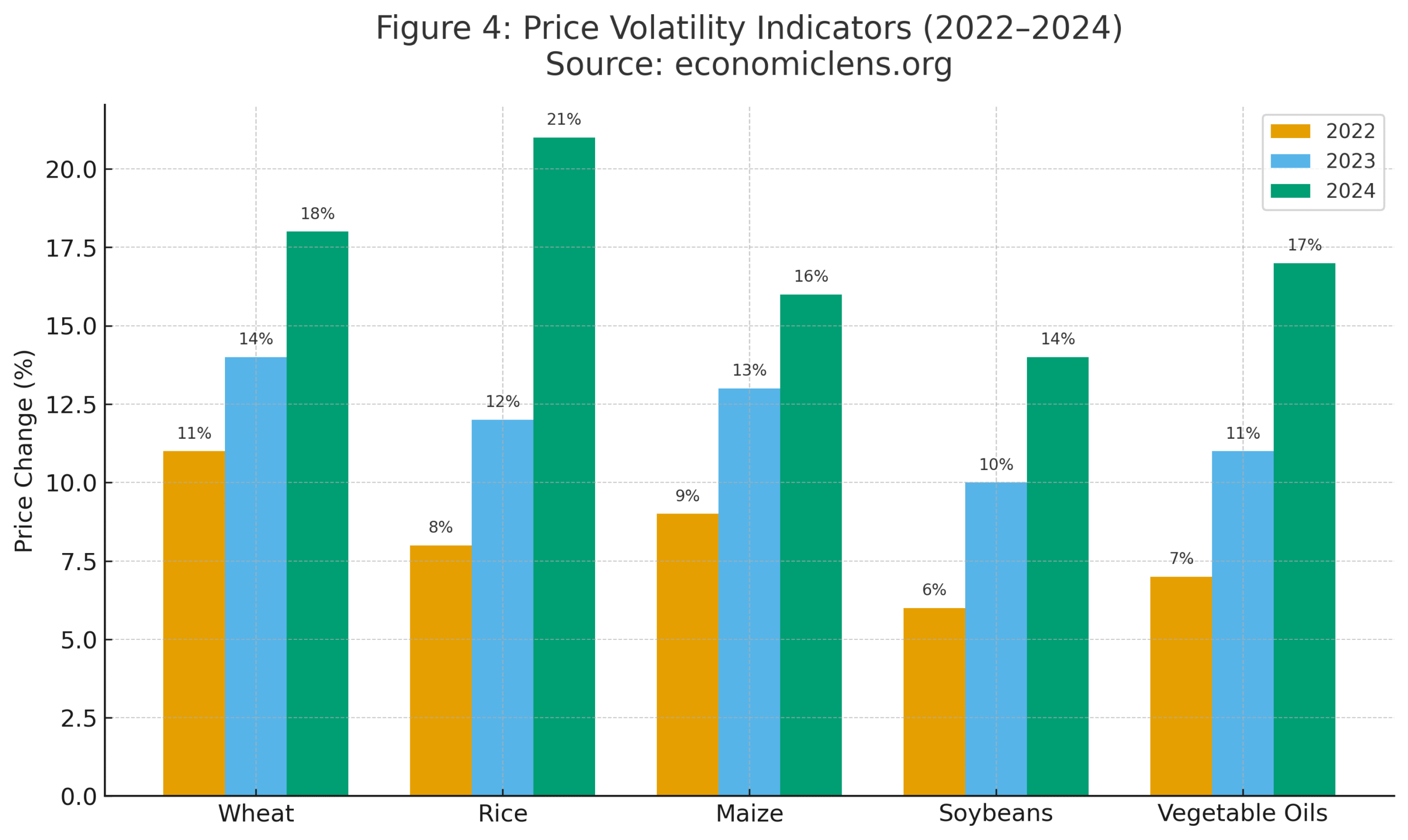
Rising and unpredictable food prices impact both consumers and governments. The sharp increase in cereal and oil prices reflects how climate and supply stress worsen the global food security crisis by making essential food items increasingly unaffordable. For broader context on how climate pressure and supply disruption drive food price inflation worldwide, see “Climate-Induced Food Inflation: Climate Shocks, Food Price Surge and Global Risk” (https://economiclens.org/climate-induced-food-inflation-climate-shocks-food-price-surge-global-risk/).
“Stable food prices are essential for stable societies. When markets shake, families struggle and nations face rising social and economic risks.”
5. Crop Production in the Global Food Security Crisis
Crop production is becoming more volatile due to climate stress, water shortages and unpredictable weather patterns. Major agricultural regions now face simultaneous risks that reduce harvest stability. This volatility tightens global supply, raises prices and increases the overall severity of the global food security crisis.
Expert Insight & Global Report Signals
Agronomist Dr. Peter Salazar notes that crop cycles are shifting unpredictably, with early heatwaves damaging flowering stages and sudden rainfall affecting harvests. He stresses that farmers require better forecasting and support to stabilize production. The FAO Global Harvest Review 2024 (https://www.fao.org/worldfoodsituation/en/) warns that climate-induced variability has reduced harvest predictability in Asia, Africa and Latin America. The report highlights that yield fluctuations are expected to worsen unless major investments in irrigation and soil management are made.
Pakistan’s floods created volatility in rice production cycles. Argentina’s soybeans are affected by alternating drought and heavy rainfall. Thailand’s rice crop suffers from erratic water availability. West African millet shows instability due to recurring drought. FAO’s variability index for 2024 highlights increasing crop unpredictability globally.
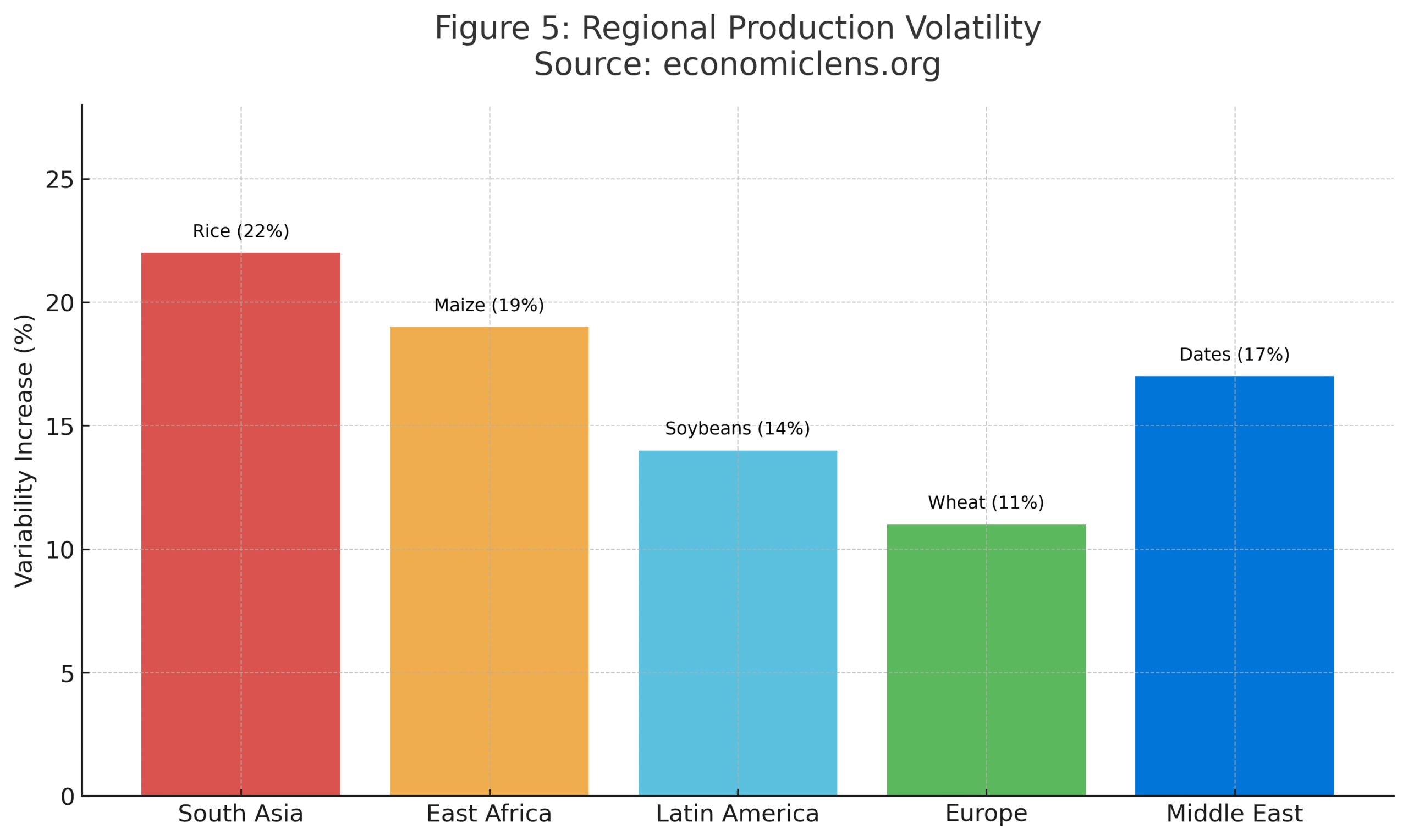
Production volatility is rising across all regions due to diverse climate pressures. Increased variability reduces predictability in global food markets and complicates long-term planning for import-dependent nations.
“When harvests become unpredictable, entire economies become unstable. Strengthening production resilience is vital for global food security.”
6. Import Dependency and the Climate Driven Food Crisis
Import dependency exposes countries to global market fluctuations, climate shocks and rising transportation costs. Nations reliant on external food supplies face significant risks when global availability tightens. As climate and supply disruptions intensify, import-dependent economies are among the most affected by the global food security crisis.
Expert Insight & Global Report Signals
UNCTAD trade analyst Dr. Sophia Karim explains that high import dependency magnifies exposure to global shocks. She emphasizes that such countries face rising costs, deeper inflation and greater food insecurity when markets tighten. The UN Food Dependency Index 2024 shows that more than 62 percent of developing nations depend on imports for key staples. The report highlights that global shocks disproportionately harm these nations due to limited storage, low reserves and weak trade negotiation power.
Egypt relies heavily on imported wheat and faces pressure due to Red Sea delays. Bangladesh depends on rice imports affected by Asian export bans. Sri Lanka faces water shortages and currency issues. Kenya struggles with import costs for maize. Lebanon’s heavy grain import dependency puts it at extreme risk.
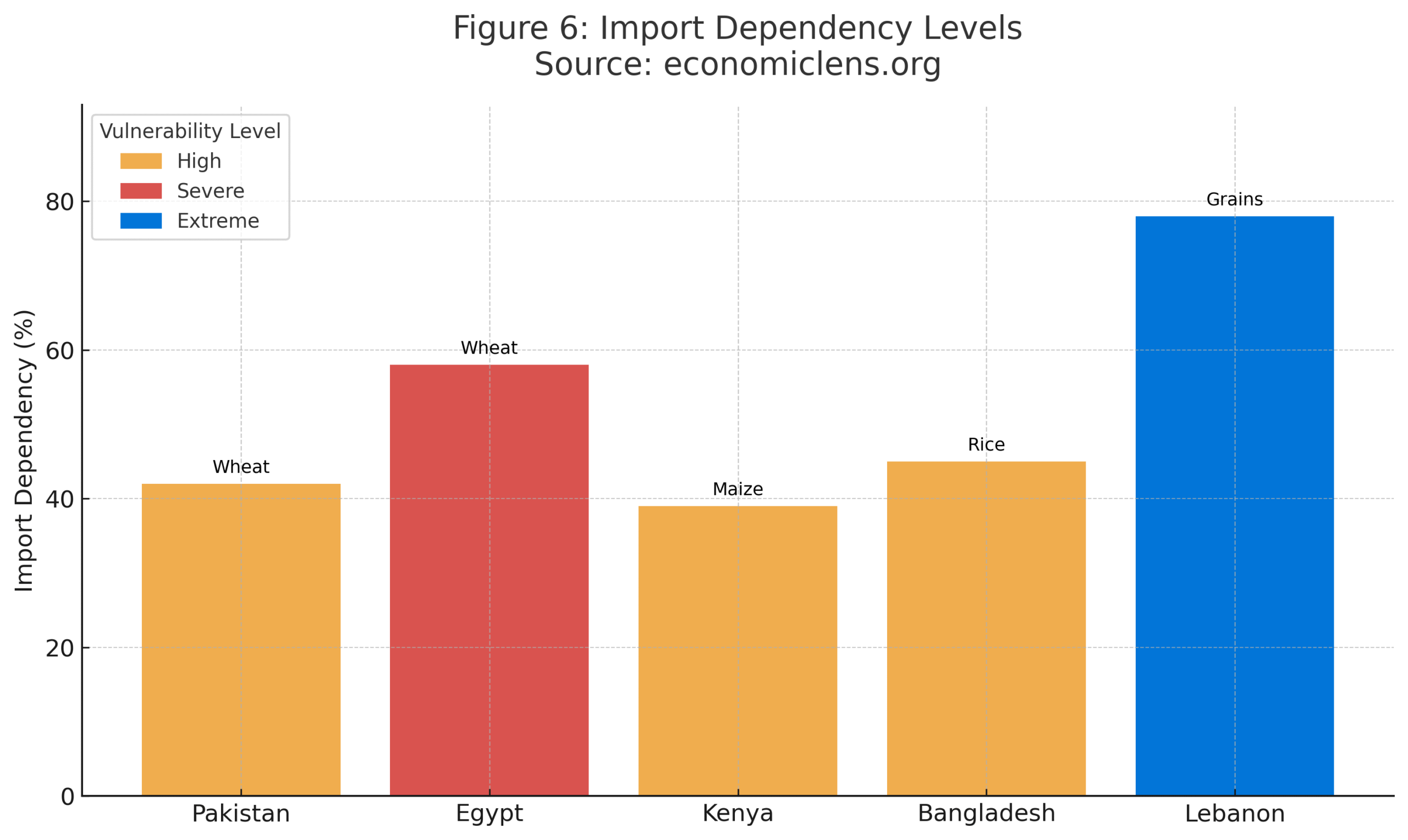
Countries with high import dependency face the greatest threats from global disruptions. Rising costs and limited alternatives deepen economic stress, especially when domestic production cannot compensate for losses.
“Import dependence turns global shocks into national crises. Building food self-sufficiency must become a strategic priority for vulnerable nations.”
7. Policy Pathways to Reduce the Global Food Security Crisis
Strengthening agricultural resilience is essential for stabilizing food systems. Investments in climate-smart practices, improved water management and diversified supply chains can reduce the impact of future shocks. Effective policies must align with climate realities to slow the progression of the global food security crisis.
CGIAR policy expert Dr. Helen Forde argues that resilience requires coordinated action from governments, donors and the private sector. She emphasizes that long-term planning is needed to avoid repeating cycles of crisis response. The UN Food Systems Roadmap 2030 highlights the need for expanded irrigation, drought-tolerant seeds, digital monitoring and improved storage. The report concludes that strategic investment today can reduce future losses by up to 35 percent.
IMF’s Climate Adaptation Financing stresses budget diversification and climate investment buffers. World Bank’s Crisis Response Window offers support for climate-smart agriculture. India’s MSP framework stabilizes farmer incomes. Pakistan’s climate-smart agriculture pilot program boosts water efficiency. Kenya’s water harvesting initiative enhances supply stability. Global food reserve coordination reduces vulnerability.
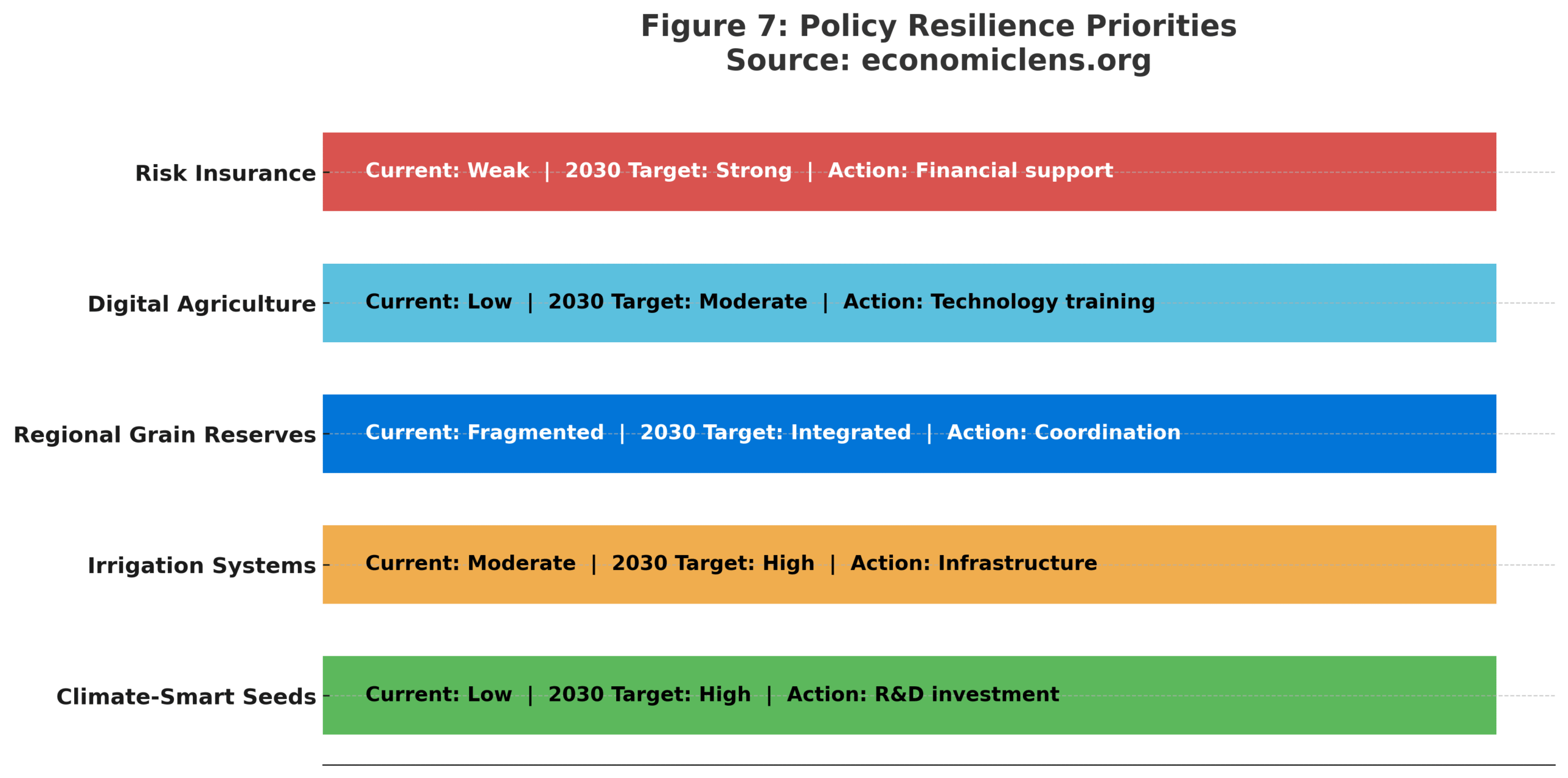
Most countries remain far behind in key areas of resilience, especially in climate-smart seeds and regional reserves. Coordinated investment is required to reduce vulnerability and stabilize global food systems.
“Resilience is not built during crisis; it is built before it. Investing in strong structures today prevents deeper food insecurity tomorrow.”
CONCLUSION
The global food security crisis is the result of converging climate shocks, export restrictions, market volatility, supply chain disruptions and deep structural weaknesses. As climate extremes intensify and global markets tighten, millions face rising food insecurity, and governments confront escalating economic and political pressure. Without urgent action, these overlapping shocks will push global food systems toward further instability and deepen vulnerabilities for the world’s poorest populations.
Additional macroeconomic analysis shows that rising import bills, higher inflation and increased fiscal pressure are pushing fragile economies toward debt risks. WHO nutrition assessments warn of rising malnutrition, particularly among children and women in low-income regions. Unless structural investments and coordinated policy actions accelerate, this crisis may evolve into a long-term humanitarian emergency.
CALL TO ACTION
Governments, institutions and international organizations must shift from reactive emergency responses to proactive resilience-building strategies. Investments in climate adaptation, improved logistics, diversified supply chains and stronger regional coordination can help stabilize global food systems. Collective action is essential for preventing deeper, prolonged food insecurity.



1 thought on “Global Food Security Crisis: Climate Shocks, Export Bans & Supply Chain Breakdown”
Excellent 👌👍