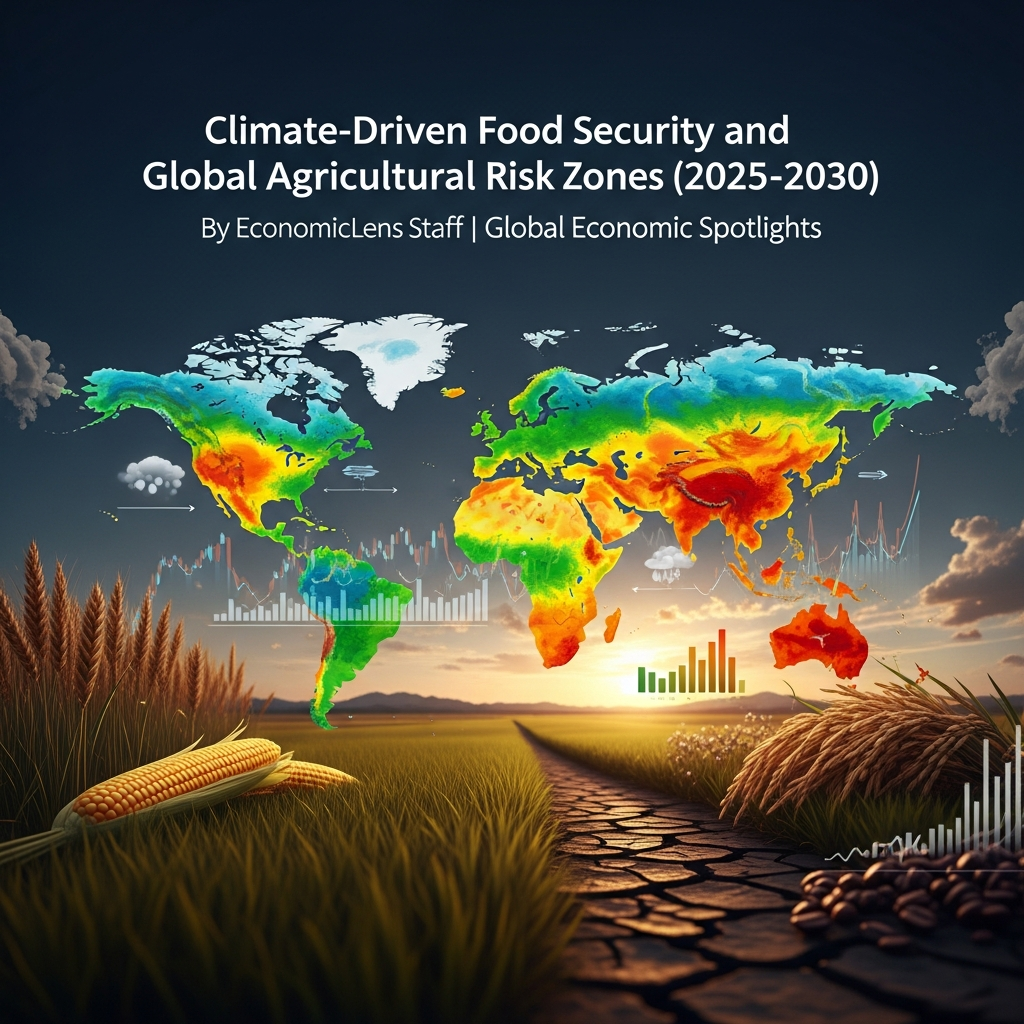
Climate-driven food security is emerging as a global crisis between 2025 and 2030. Across regions, heatwaves, droughts, floods, and conflict are destabilizing agriculture, thereby driving food inflation and ultimately increasing hunger across vulnerable regions and global markets. In this context, this analysis explains how climate stress is reshaping global food systems by first identifying high-risk agricultural zones, then tracing the transmission of climate shocks from farms to prices, and finally assessing the policy failures that allow temporary climate events to become persistent food crises.
Introduction: climate-induced food insecurity is entering a critical phase
Climate-driven food security is emerging as one of the most significant global risks between 2025 and 2030. Historically, food systems were destabilized by isolated climate events. However, this is no longer the case. Instead, repeated and overlapping shocks now weaken production, access, and affordability at the same time.
At the same time, heatwaves, droughts, floods, fertilizer disruptions, and trade restrictions increasingly interact across regions. As a result, these pressures spread food insecurity through prices, markets, and fiscal systems. Notably, this shift is already visible in rising hunger trends and costly diets, as documented in
https://economiclens.org/global-food-insecurity-2025-hunger-trends-costly-diets-the-fertilizer-shock/
Meanwhile, the IPCC confirms that climate impacts on agriculture are intensifying faster than adaptation in many regions. Consequently, this mismatch raises the probability of synchronized stress across multiple food-producing zones (https://www.ipcc.ch/report/ar6/wg2/).
1. Climate risk to food systems across global zones (2025–2030)
Climate-driven food security does not collapse because global calories disappear. Rather, access and affordability fail first. In practice, vulnerable households feel these effects well before national shortages emerge.
Moreover, extreme weather increasingly damages crops, storage facilities, transport networks, and energy systems at the same time. As a result, climate disasters now evolve into prolonged food crises rather than short-term shocks. Importantly, this pattern has already caused large economic losses and infrastructure damage, as shown in
https://economiclens.org/climate-disaster-food-crisis-global-economic-loss-and-infrastructure-collapse/
In addition, the FAO identifies climate variability as a leading driver of yield volatility and rural income loss. These effects are further amplified when market shocks occur simultaneously (https://www.fao.org/climate-change/en).
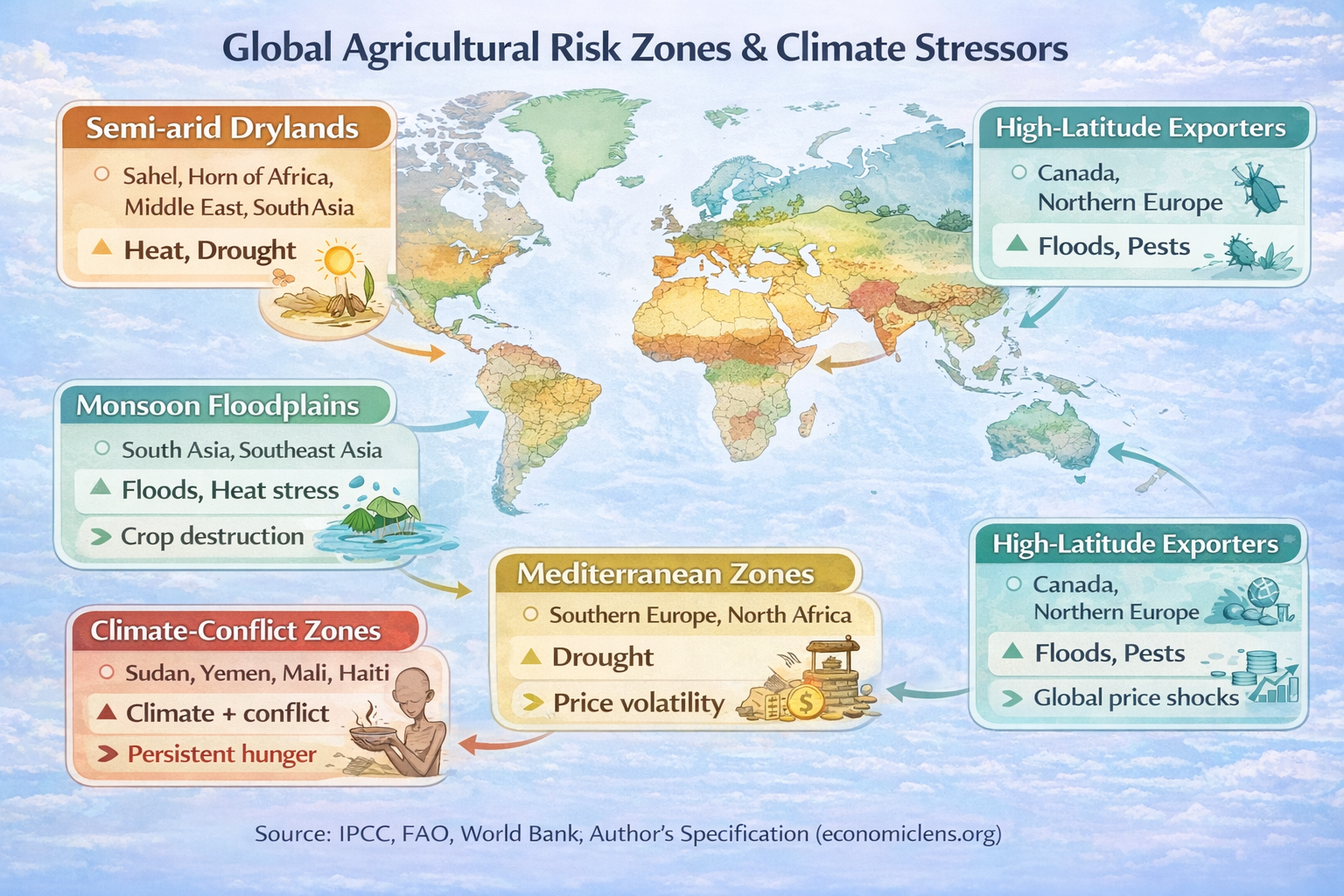
2. Global agricultural risk zones under climate stress (2025–2030)
Between 2025 and 2030, food system risk will cluster geographically. Vulnerability rises where climate hazards intersect with water stress, poverty, weak infrastructure, and political instability.
2.1 Semi-arid regions and climate-induced food insecurity
Semi-arid regions face rising temperatures and declining soil moisture. At the same time, groundwater depletion further reduces irrigation reliability. As a result, repeated crop failures limit recovery between seasons.
Consequently, livestock losses intensify poverty and increase migration pressure. Over time, these effects accumulate rather than resetting after one bad year.
In this context, Pakistan illustrates how climate risk combines with weak financing systems. In particular, floods exposed major gaps in climate finance delivery and recovery capacity, as explained in https://economiclens.org/pakistan-floods-show-why-climate-finance-must-deliver-now/
Consistent with this pattern, the World Bank classifies drylands as among the highest-risk zones for climate-driven poverty and food insecurity (https://www.worldbank.org/en/topic/climatechange).
2.2 Monsoon agriculture and climate risk to food systems
Monsoon-dependent agriculture is becoming increasingly unstable. In particular, floods destroy standing crops and rural infrastructure. At the same time, heatwaves reduce yields during critical flowering stages.
As a result, these shocks raise food prices and strain public budgets. Moreover, they increase dependence on food imports during crisis years.
Compounding these pressures, climate finance gaps magnify these risks, as discussed in https://economiclens.org/climate-finance-and-the-global-food-challenge/
Reinforcing this assessment, the Asian Development Bank reports that climate-driven flooding already causes billions of dollars in annual agricultural losses across monsoon Asia (https://www.adb.org/what-we-do/topics/climate-change).
2.3 Mediterranean systems and climate-related food stress
Mediterranean agricultural systems face worsening drought conditions. At the same time, rainfall reliability is declining across multiple growing seasons. Meanwhile, water competition between agriculture, cities, and industry is intensifying.
Nevertheless, while adaptive capacity remains higher than in low-income regions, output volatility is rising. As a result, these pressures affect both domestic food prices and export availability.
In parallel, climate shocks increasingly interact with export bans and trade restrictions, as analyzed in
https://economiclens.org/global-food-security-crisis-climate-shocks-export-bans-supply-chain-breakdown/
Consistent with this trend, the OECD warns that water scarcity is becoming a binding constraint on agricultural productivity in Mediterranean economies (https://www.oecd.org/environment/resources/water-security.htm).
2.4 Climate–conflict overlap and climate shock food insecurity
In fragile states, climate shocks rarely act alone. They reduce planting, disrupt trade routes, and damage storage facilities. Conflict then blocks recovery and market access.
Food crises in these contexts become persistent rather than cyclical. Humanitarian needs rise while domestic production capacity continues to weaken.
These dynamics are examined in https://economiclens.org/food-security-stress-test-agriculture-under-climate-and-conflict-strain/.
The World Food Programme identifies climate shocks as a major threat multiplier in active hunger emergencies (https://www.wfp.org/global-hunger-crisis)
2.5 High-latitude producers and climate-driven food crisis spillovers
High-latitude regions may benefit from longer growing seasons. However, flood risk, wildfires, and pest expansion introduce new volatility. These regions anchor global grain exports.
Even modest production shocks can trigger global price spikes. These spillovers affect import-dependent economies most severely.
This redistribution of climate risk mirrors broader carbon dividend debates, as discussed in
https://economiclens.org/the-100-billion-carbon-dividend-who-gains-who-loses-and-what-comes-next/
The IEA notes that climate volatility increasingly affects food, fertilizer, and energy markets simultaneously (https://www.iea.org/topics/climate-change).
3. Climate shock transmission channels in food systems
Climate stress translates into food insecurity through clear transmission mechanisms.
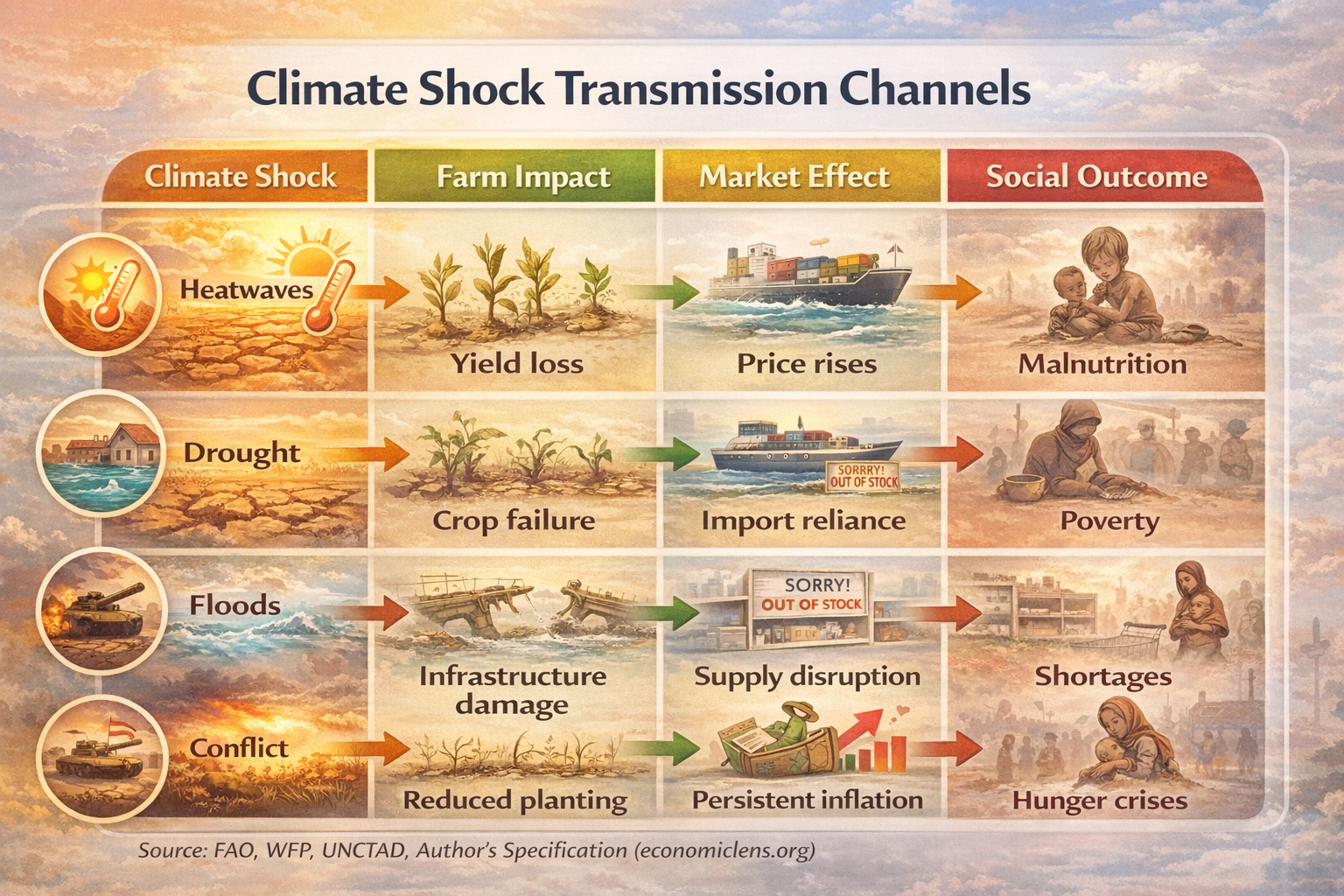
These channels are already driving food price volatility and inflation, as discussed in https://economiclens.org/climate-driven-food-inflation/
3. Policy priorities for managing food system climate risk (2025–2030)
Governments must shift from yield maximization to risk management. Climate-resilient crops reduce exposure to heat and drought. Water efficiency investments improve resilience.
Storage, logistics, and early warning systems reduce volatility. Food security must sit at the core of climate finance design rather than downstream humanitarian responses.
Without reform, climate-driven food security risks will deepen inequality and macroeconomic instability.
Conclusion
Climate-driven food security will define the global risk landscape between 2025 and 2030. Repeated climate shocks will overwhelm weak systems. Even advanced economies will face spillovers through prices, trade, and fiscal pressure.