
Gold silver price surge in 2025 highlights rising geopolitical tensions, Federal Reserve rate cut expectations, and growing safe-haven demand. This policy note explains record gold and silver prices and what they signal for monetary policy credibility, financial stability, and investor behavior.
Introduction
Precious metals price surge dominated global commodity markets this week as investors reacted to escalating geopolitical tensions and shifting monetary expectations. Both metals reached record or near-record levels before easing slightly due to profit-taking. However, the scale and persistence of the rally point to deeper macroeconomic stress rather than short-term speculation.
Moreover, the precious metals price surge is unfolding alongside falling real yields and growing doubts about global policy stability. As a result, precious metals are once again acting as real-time indicators of risk perception and financial confidence.
Gold Silver Price Surge in 2025: What the Data Shows
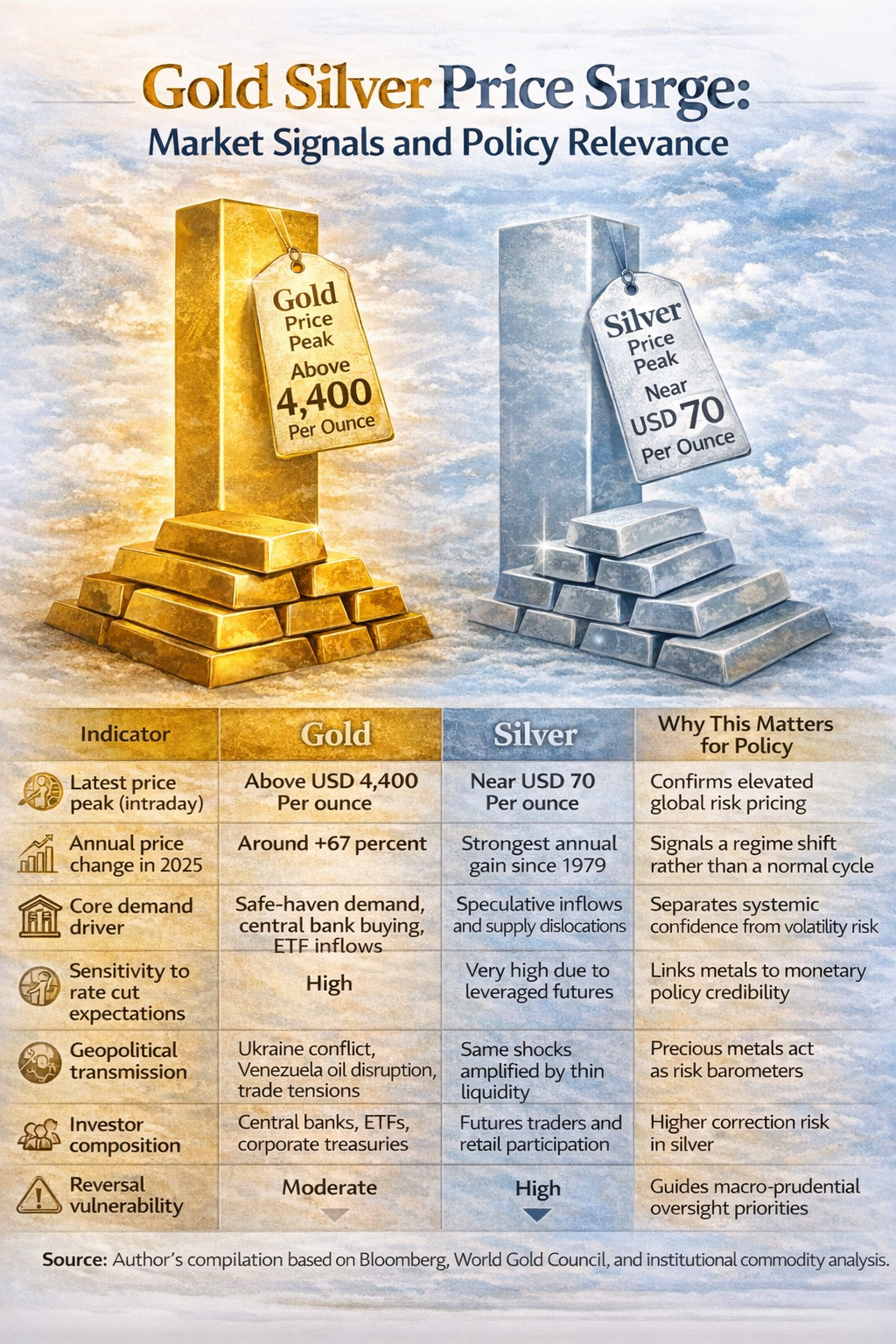
precious metals price surge to historic intraday levels during the past week. Gold briefly traded above USD 4,400 per ounce, while silver approached USD 70 per ounce. Both metals are now on track for their strongest annual performance since 1979, according to Bloomberg commodity data (https://www.bloomberg.com).
Importantly, this rally is not driven by a single shock. Instead, it reflects the interaction of monetary policy expectations, geopolitical stress, and structural shifts in investor demand.
Why the Gold Silver Price Surge Reflects Monetary Policy Expectations
Gold silver price surge is closely linked to expectations of lower interest rates. Markets increasingly anticipate multiple US Federal Reserve rate cuts in 2026 following softer inflation and labor market data (https://www.federalreserve.gov).
Lower real yields reduce the opportunity cost of holding non-yielding assets. Consequently, gold attracts longer-term capital flows, while silver reacts more sharply due to speculative positioning. Therefore, precious metals are responding more to future policy expectations than to current rate levels.
Gold Silver Price Surge and Rising Geopolitical Risk
Rising geopolitical tensions have reinforced the safe-haven appeal of precious metals. Recent developments involving Ukraine, Middle Eastern shipping risks, and energy supply disruptions have increased global risk aversion, as documented by the International Energy Agency (https://www.iea.org) and UNCTAD (https://unctad.org).
Gold remains the preferred hedge against sovereign risk and currency debasement. Silver shares this role, although thinner liquidity magnifies price swings. As a result, silver often overshoots during periods of global stress.
Industrial Linkages and the Broader Metals Ecosystem
Precious metals do not exist in isolation from broader mineral markets. For example, the green metals boom is reshaping demand patterns for critical minerals across energy, transportation, and ICT supply chains (https://economiclens.org/the-green-metals-boom-why-critical-minerals-are-fueling-the-next-climate-gold-rush/). Understanding these linkages helps clarify why silver, with its industrial use in electronics and renewable technologies, can react more strongly than gold during periods of stress.
Moreover, major mining and resource governance projects, such as the Reko Diq copper-gold project in Pakistan, highlight how supply chain and governance gaps can affect global metal prices and investment flows (https://economiclens.org/reko-diq-copper-gold-project-wealth-potential-governance-gaps-pakistans-resource-paradox/). Similarly, Pakistan’s broader critical minerals landscape underscores the importance of strategic policy frameworks for metals with both economic and strategic value (https://economiclens.org/pakistan-critical-minerals-economy-risks-gaps-and-growth-potential/).
These internal linkages deepen understanding of how the gold silver price surge is connected not only to monetary and risk dynamics but also to industrial demand and mineral policy.
Financial Stability Risks Behind the Gold Silver Price Surge
From a policy perspective, gold silver price surge raises important financial stability concerns. Rapid price increases often attract leveraged and retail participation. When prices reverse, losses can spill into broader financial markets.
Silver presents greater short-term risk due to concentrated futures positioning and past short-squeeze dynamics. Gold appears more stable, supported by central bank purchases and sustained ETF inflows, according to World Gold Council data (https://www.gold.org).
Policy Implications of the Gold Silver Price Surge
First, regulators should strengthen monitoring of precious-metal derivatives markets, particularly silver-linked instruments. Position concentration and liquidity conditions require close attention.
Second, central banks should treat gold price dynamics as complementary indicators when assessing inflation expectations and policy credibility. However, commodity prices alone should not dictate monetary decisions.
Third, governments should support recycling and diversified supply chains for silver, given its role in electronics and renewable energy technologies, as highlighted by the International Energy Agency (https://www.iea.org). This intersects with broader mineral policy debates explored in our analysis of the green metals boom and the critical minerals economy.
Finally, investor protection frameworks should improve disclosure requirements for retail commodity products. Clear communication can reduce losses during sharp market corrections.
Conclusion
Gold silver price surge is not an isolated commodity event. Instead, it reflects rising geopolitical risk, declining confidence in real yields, and growing concern about global policy stability. Gold signals long-term demand for financial safety, while silver exposes rising leverage and volatility.
Together, record gold and silver prices serve as early warning indicators of macro-financial stress. Policymakers should respond with targeted oversight, clear monetary communication, and enhanced market surveillance rather than blunt intervention.



1 thought on “Gold and Silver at All-Time Highs: Signals for Global Monetary and Financial Policy”
Hi, just required you to know I he added your site to my Google bookmarks due to your layout. But seriously, I believe your internet site has 1 in the freshest theme I??ve came across. It extremely helps make reading your blog significantly easier.