
India has overtaken Japan to become the world’s fourth largest economy by nominal GDP. This milestone reflects long term structural forces rather than a temporary output fluctuation.
More importantly, the shift highlights how growth momentum, demographics, and scale are reshaping global economic rankings at a time when the global economy is already experiencing slower trend growth and rising uncertainty.
The Global GDP Ranking Shift
Global GDP rankings are based on nominal output measured at current prices and market exchange rates, as compiled by the International Monetary Fund (https://www.imf.org).
While purchasing power parity measures have long placed India among the largest economies, nominal GDP rankings carry greater financial and geopolitical relevance. This transition also aligns with broader debates on whether emerging economies can reshape global growth leadership, as explored in EconomicLens analysis on emerging markets challenging China’s economic dominance (https://economiclens.org/global-economic-growth-can-emerging-economies-challenge-chinas-economic-dominance/).
As a result, India overtaking Japan represents a visible shift in global economic weight rather than a statistical adjustment.
India Overtakes Japan Economy Through Sustained Growth Momentum
India’s rise is primarily driven by sustained real GDP growth combined with moderate inflation. According to the World Bank, India has remained among the fastest growing major economies in recent years (https://www.worldbank.org).
Moreover, strong domestic demand and expanding investment have reinforced growth resilience. Public infrastructure spending has supported private sector expansion across manufacturing and services.
Consequently, nominal output has increased faster than in most advanced economies, even as global growth remains subdued and uneven, as highlighted in the EconomicLens global economic outlook for 2025–2026 (https://economiclens.org/global-economic-outlook-2025-2026-slow-growth-sticky-inflation-rising-debt/).
Data Snapshot
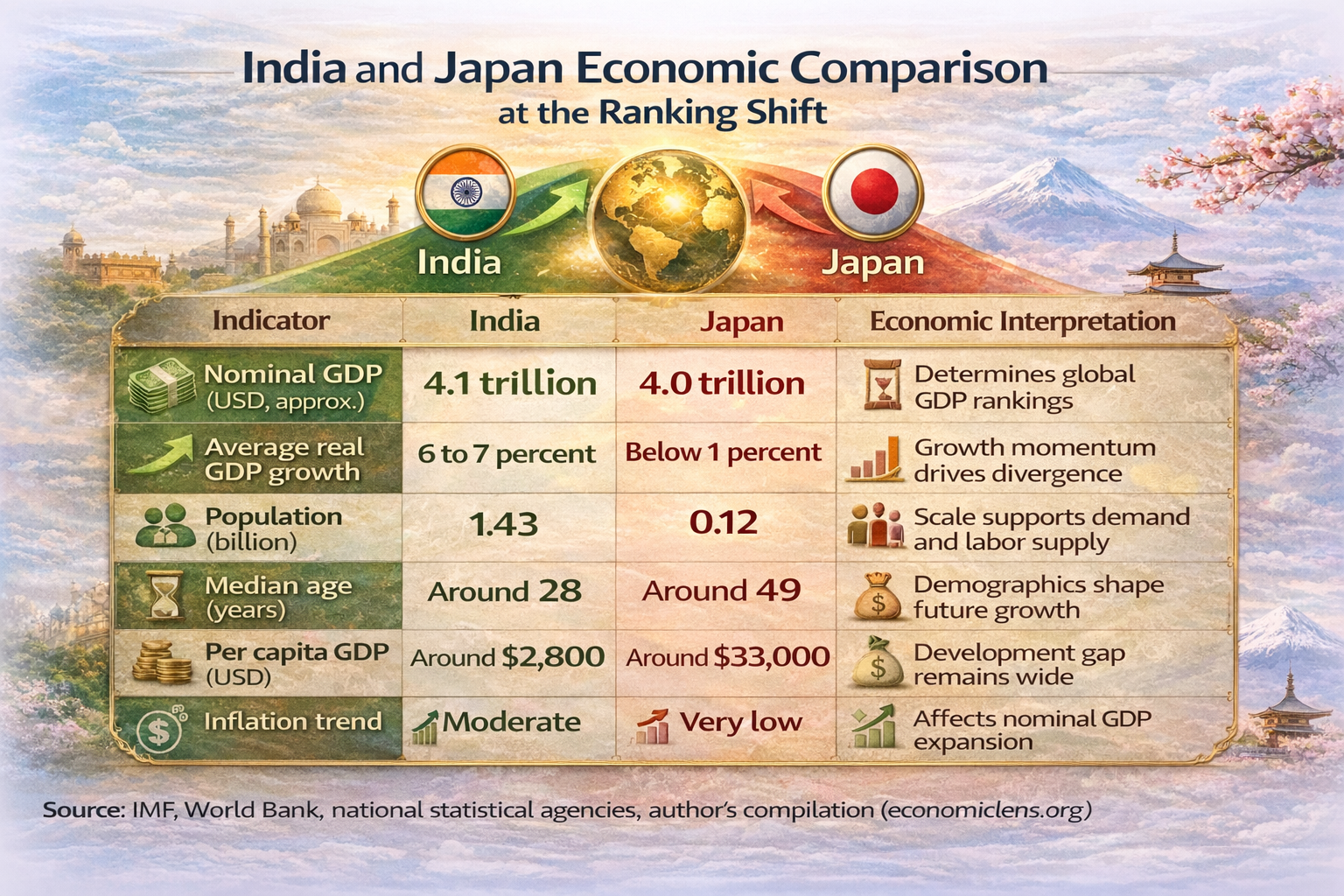
The structural contrast between the two economies becomes clear when key indicators are compared.
India Fourth Largest Economy and the Role of Demographics
Demographics play a central role in India’s economic ascent. India has one of the youngest labor forces among major economies, according to United Nations population data (https://www.un.org). As a result, labor supply growth and consumption demand remain strong. This demographic advantage supports higher potential growth over time.
In contrast, Japan faces a shrinking workforce and rising dependency ratios, as documented by the OECD (https://www.oecd.org).
Structural Constraints Behind Japan’s Economic Slowdown
Japan remains a technologically advanced and institutionally strong economy. However, long term constraints continue to limit growth.
First, population aging has reduced labor force participation and dampened domestic demand. Second, productivity growth in services has remained modest, despite strength in advanced manufacturing.
Furthermore, persistent low inflation has constrained nominal GDP expansion, affecting Japan’s relative position in global rankings, as noted by the Bank for International Settlements (https://www.bis.org).
What the Global Economic Rankings Shift Does and Does Not Mean
India overtaking Japan does not imply convergence in living standards. Japan’s per capita income, infrastructure quality, and technological depth remain far higher.
However, the ranking shift does signal a redistribution of global economic scale. Large emerging economies are gaining influence due to population size and growth rates.
Therefore, global economic power is becoming increasingly multipolar.
Global Economic Implications of India Overtakes Japan Economy
India’s rise will influence global trade, investment flows, and energy demand. Its growing market size strengthens its role in global supply chains.
At the same time, advanced economies face increasing pressure to adapt growth models to aging populations and slower productivity growth. According to UNCTAD, these shifts are already reshaping global investment patterns (https://unctad.org).
Can the India Fourth Largest Economy Position Be Sustained
Sustaining high growth will require continued productivity improvements. Education outcomes, urban infrastructure, and job quality will be critical.
Moreover, environmental constraints and regional inequality must be managed carefully as the economy scales further.
Thus, demographics provide opportunity, but policy execution will determine long term outcomes.
Conclusion
India overtaking Japan as the world’s fourth largest economy marks a structural turning point in the global economy. The shift reflects differences in growth momentum, demographics, and scale rather than economic maturity.
Ultimately, the milestone underscores how global economic gravity is gradually moving toward large emerging economies with sustained growth potential.