
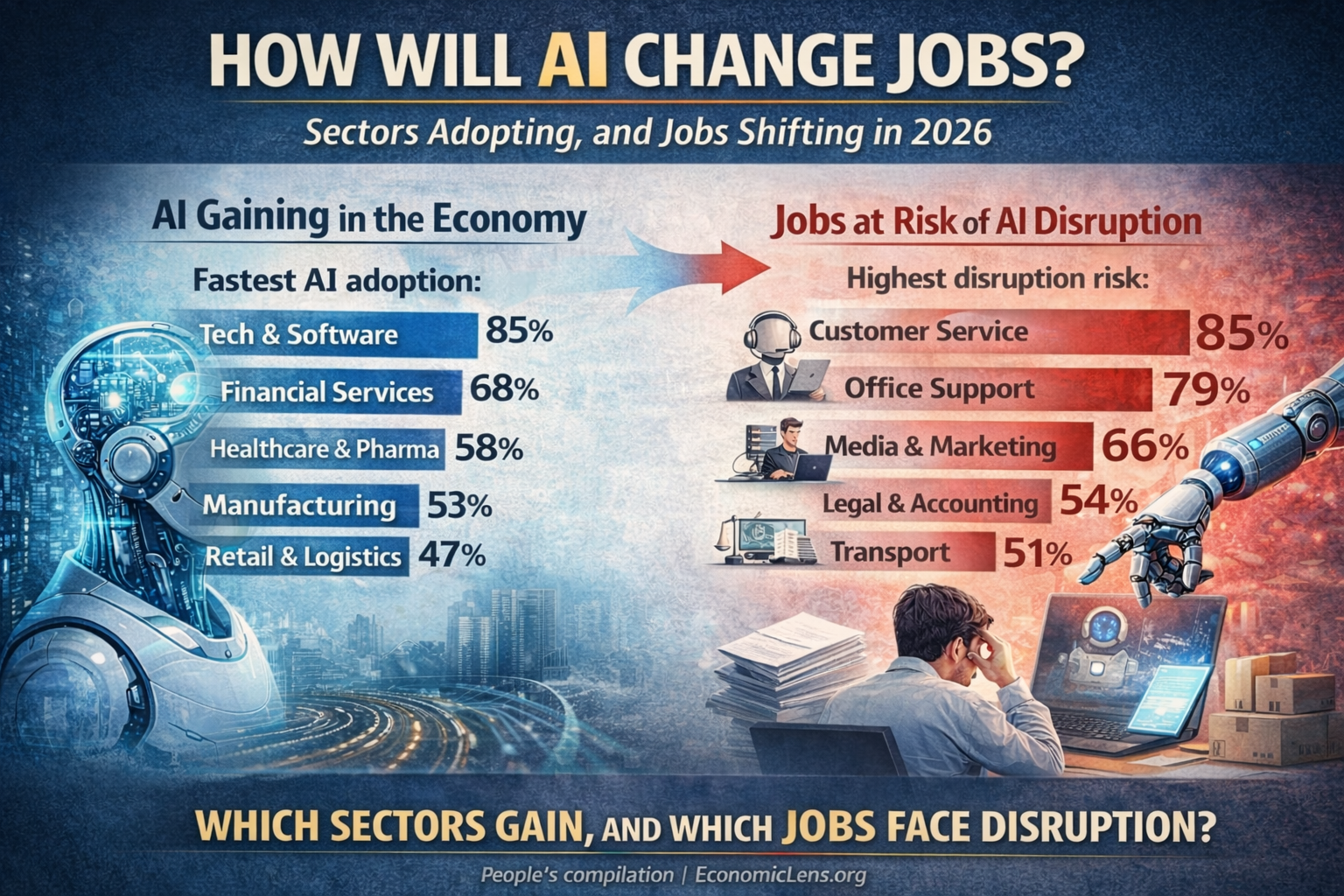
AI job disruption 2026 highlights how artificial intelligence is reshaping employment patterns. While technology, finance, and healthcare accelerate AI adoption, roles in customer service, office support, and media face rising automation risk. The visual explains where jobs are shifting rather than disappearing.
Introduction
AI job disruption 2026 is not a story of sudden mass unemployment. Instead, it reflects a rapid reallocation of tasks, skills, and sectoral demand as artificial intelligence spreads unevenly across the economy. This adjustment is already visible in youth labor markets, as highlighted in EconomicLens analysis on global youth unemployment and AI driven skills gaps (https://economiclens.org/global-youth-unemployment-2025-ai-disruption-skills-gaps-the-gen-z-jobs-crunch/), and aligns with global assessments from the International Labour Organization on technology induced employment shifts (https://www.ilo.org).
AI job disruption 2026 and sectoral adoption
On the left side of the visual, AI employment transition 2026 coincides with strong adoption momentum. Tech and software lead, followed by financial services and healthcare. These sectors deploy AI to raise productivity, automate routine analysis, and scale decision making. According to the World Economic Forum’s Future of Jobs framework, AI adoption tends to expand demand for analytical and digital roles rather than eliminate employment outright (https://www.weforum.org). As a result, labor demand shifts toward AI complementary skills.
AI employment transition 2026 and jobs at risk
On the right side, AI employment transition 2026 highlights occupational exposure instead of sectoral collapse. Customer service, office support, and media roles face the highest disruption risk because tasks are repetitive, text based, or rules driven. This pattern mirrors empirical findings from OECD research on automation exposure across occupations (https://www.oecd.org), and reinforces EconomicLens research on AI, automation, and job displacement in 2026 (https://economiclens.org/ai-and-automation-navigating-job-displacement-economic-inequality-in-2026/).
Why AI job disruption 2026 feels uneven
Importantly, AI employment transition 2026 does not affect all workers equally. High adoption sectors often generate new roles in data oversight, AI governance, and system integration. Meanwhile, vulnerable occupations experience pressure through slower wage growth or skill redundancy. Consequently, labor market stress reflects mismatches between skills and technology, a dynamic also emphasized in World Bank assessments of digital transformation and employment (https://www.worldbank.org).
Policy and workforce implication
Therefore, AI job disruption 2026 strengthens the case for coordinated reskilling systems, adaptive education pathways, and labor market institutions that support transition. Without these responses, productivity gains risk widening inequality. With them, artificial intelligence can act as a stabilizing force in long term employment transformation.




2 thoughts on “How Will AI Disrupt Jobs in 2026? Sectoral Shifts and Labor Market Risk”
My neighbor Lonnie has one of these. She works as a hobbit and she says it looks microscopic.
This product works excessively well. It mortally improves my golf by a lot.