
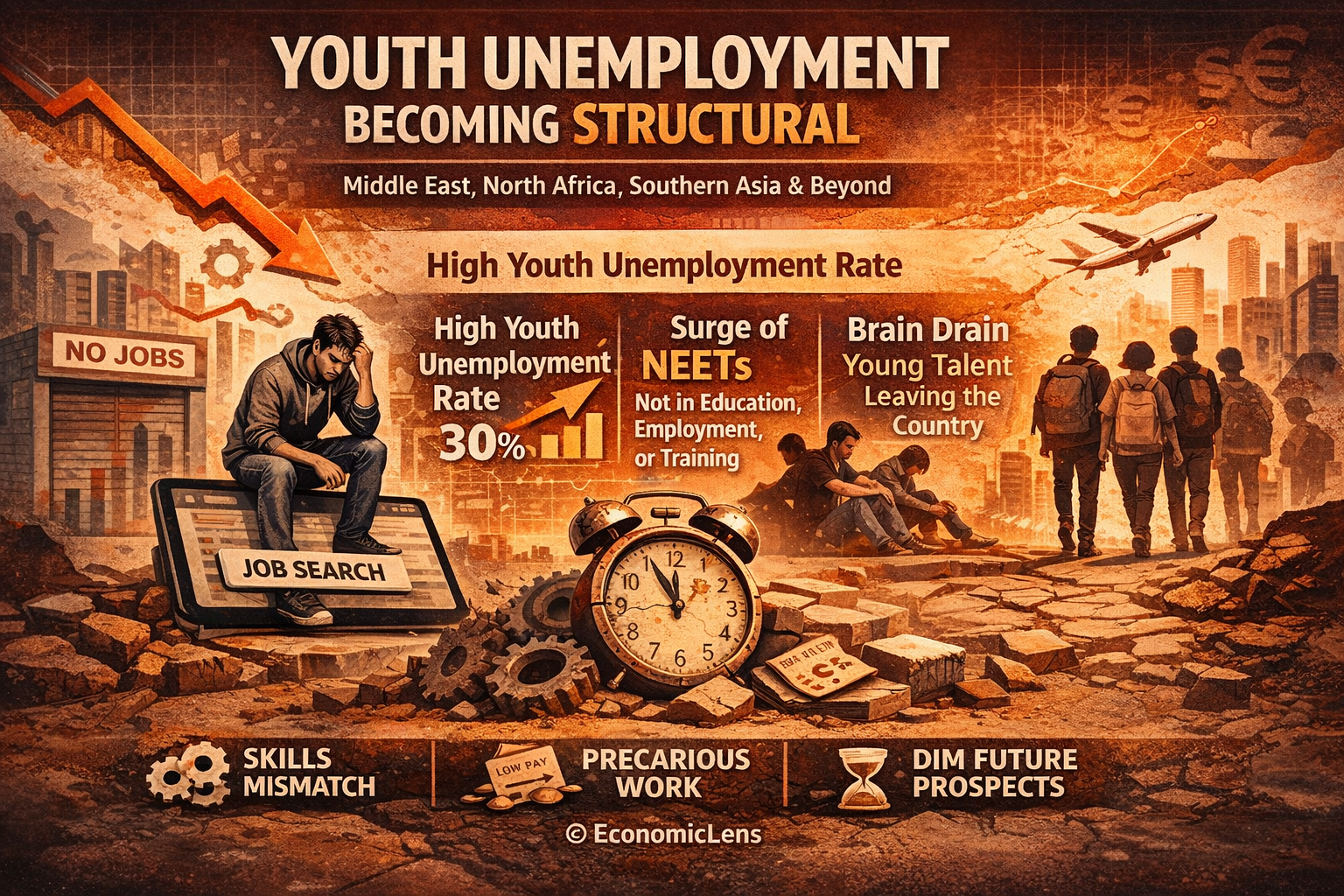
Structural youth unemployment examines why youth joblessness is becoming entrenched across emerging and developing economies. Skills mismatch, AI disruption, weak labor demand, and rising NEET populations are driving long term employment scarring, brain drain, and fragile income prospects for young workers.
Introduction
youth unemployment crisis has become one of the most persistent challenges facing the global labor market. Youth joblessness is no longer driven only by economic cycles. Instead, it reflects deep structural failures in education systems, labor demand, and economic transformation. Structural youth unemployment explains why growth is no longer translating into jobs for young people.
Structural youth unemployment and persistently high joblessness
In many regions, youth unemployment rates remain exceptionally high. Parts of the Middle East, North Africa, and South Asia continue to report youth joblessness above 25 to 30 percent. These levels persist even during periods of economic recovery.
According to the International Labour Organization, young workers face longer job search durations and lower hiring rates than older cohorts (https://www.ilo.org). As a result, youth unemployment crisis reflects exclusion from opportunity rather than a lack of willingness to work.
NEETs and the deepening youth unemployment crisis
One visible outcome of youth unemployment crisis is the rapid expansion of NEETs. Young people not in education, employment, or training experience declining skills and weaker attachment to the labor market.
EconomicLens analysis shows how AI disruption and skills gaps are intensifying the global youth unemployment crisis (https://economiclens.org/global-youth-unemployment-2025-ai-disruption-skills-gaps-the-gen-z-jobs-crunch/). Over time, prolonged inactivity increases labor market scarring and reduces lifetime earnings potential.
Skills mismatch driving youth unemployment crisis
Skills mismatch sits at the core of youth unemployment crisis. Education systems often produce qualifications that do not align with evolving labor market needs. Meanwhile, demand is shifting toward digital, technical, and cognitive skills.
World Bank research highlights that skills gaps are among the strongest predictors of youth unemployment in developing economies (https://www.worldbank.org). Consequently, many young workers remain excluded from available jobs despite formal education.
AI, automation, and youth unemployment crisis
At the same time, artificial intelligence and automation are reshaping entry-level employment. Routine tasks are increasingly automated, while firms demand higher skill intensity from new hires. This transition disproportionately affects young job seekers.
EconomicLens coverage on AI driven labor market change explains how sectoral adoption patterns are raising youth employment risk (https://economiclens.org/how-will-ai-disrupt-jobs-in-2026-sectoral-shifts-and-labor-market-risk/). Therefore, youth unemployment crisis is closely linked to technological change rather than short term shocks.
Brain drain and precarious work outcomes
When domestic opportunities remain limited, young workers respond through migration or acceptance of precarious employment. Brain drain accelerates as skilled youth leave in search of stability. Those who remain often enter informal or low pay jobs.
OECD analysis shows that early career instability reduces productivity and lifetime earnings (https://www.oecd.org). As a result, youth unemployment crisis generates long lasting economic and social costs.
Why structural youth unemployment is becoming entrenched
Importantly, structural youth unemployment persists because multiple forces reinforce each other. Weak labor demand limits hiring. Skills mismatch blocks entry. Automation reduces low skill opportunities. Migration drains human capital.
Together, these dynamics create a self sustaining cycle of exclusion that growth alone cannot resolve.
Policy implications of structural youth unemployment
Addressing youth unemployment crisis requires coordinated reform rather than short term stimulus. Education systems must align with labor market demand. Active labor market policies should prioritize first job placement. Digital and vocational training need expansion at scale.
Without these measures, youth unemployment crisis will remain a drag on growth, social cohesion, and political stability.
Key takeaway
Structural youth unemployment is not a temporary disruption. It is a systemic failure to integrate young workers into transforming economies. Solving it requires structural reform, skills alignment, and labor market adaptation.




1 thought on “Structural Youth Unemployment: Why Jobs Are Vanishing?”
I have been checking out a few of your articles and i must say clever stuff. I will make sure to bookmark your site.