
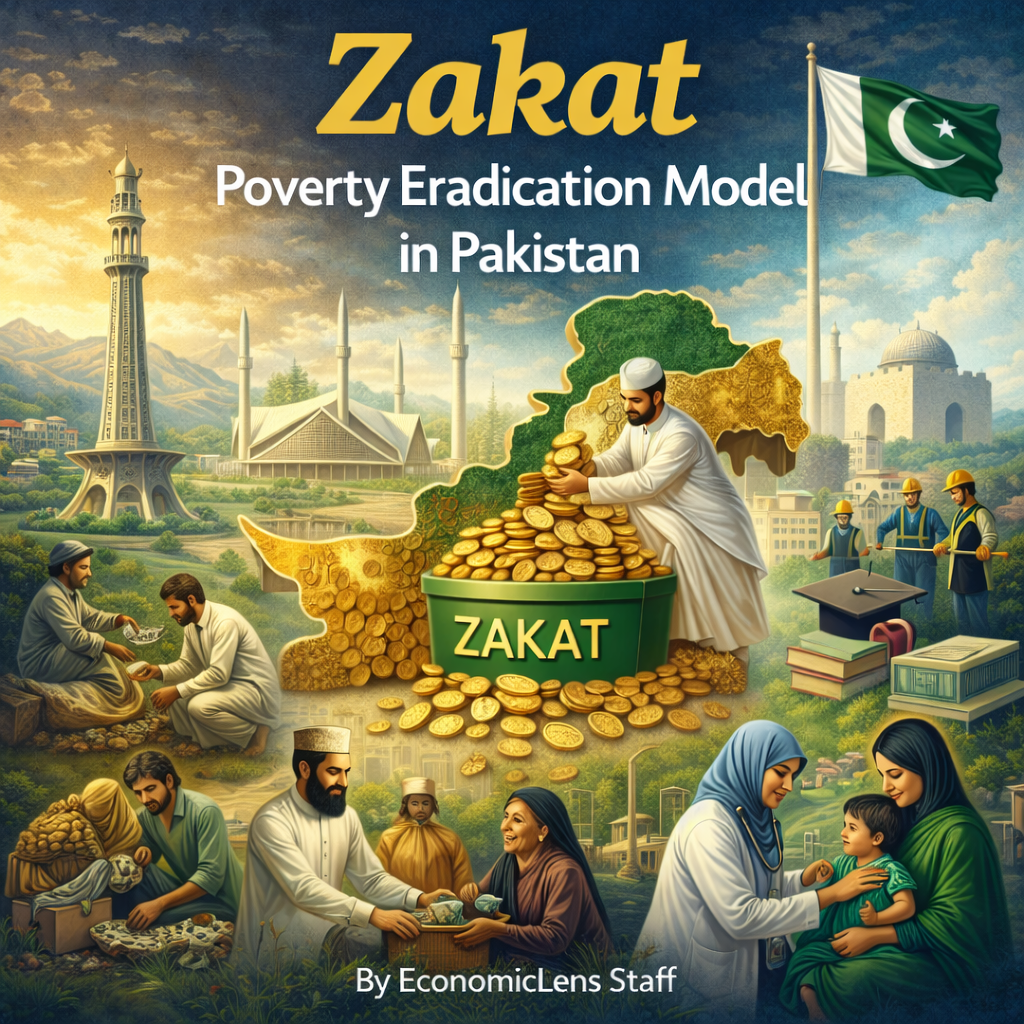
Poverty Eradication Model presents a Qur’an-based and fiqhi framework for using zakat to eliminate poverty in Pakistan through employment, entrepreneurship, ownership transfer, and baitul mal governance. The analysis moves beyond relief toward structural economic transformation.
Poverty Eradication Model in Pakistan
A central strength of the Poverty Eradication Model lies in its independence from modern reinterpretations or external development theories. Instead, it draws directly from classical Islamic jurisprudence across all four Sunni schools. When scholars examine the juristic record carefully, Hanafi, Maliki, Shafi‘i, and Hanbali authorities converge on a decisive principle. Zakat does not confine itself to short-term subsistence when long-term sufficiency remains achievable.
In the Hanafi tradition, jurists consistently stress that zakat may take a form that permanently removes poverty. Imam Abu Yusuf, in Kitab al-Kharaj, explicitly argues that zakat may provide a poor person with enough resources to attain self-sufficiency, even when this amount exceeds immediate consumption needs. Effectiveness in outcome, not moderation in quantity, defines the governing criterion.
Maliki jurists advance the same reasoning. Imam Al-Qarafi explains in Al-Dhakhira that zakat seeks ighna’, meaning freedom from need. When this objective requires capital, tools, or productive means, juristic doctrine validates such allocation. The Shafi‘i school reinforces this position through Imam Al-Nawawi, who states in Al-Majmu‘ that zakat may establish a trade or profession for a poor person so that lasting income replaces repeated dependency.
The Hanbali school completes this consensus. Ibn Qudamah, in Al-Mughni, permits zakat spending on tools, equipment, or assets that allow a poor person to earn independently. Across all schools, jurists apply a consistent logic. They judge zakat by its capacity to eliminate poverty, not by the delivery form. The Zakat Poverty Eradication Model therefore rests firmly within classical Islamic law.
Productive Zakat, Tamlik, and Permanent Exit from Poverty in Islamic Law
A frequent objection to productive zakat models concerns tamlik, the requirement that ownership transfer to the zakat recipient. Critics often assume that institutional or programmatic zakat use violates this condition. In reality, tamlik strengthens the case for productive zakat rather than undermining it.
Islamic jurists clearly require zakat to place recipients in full ownership of what they receive. Cash given for consumption fulfills tamlik only briefly. Once recipients spend it, need reappears. By contrast, when zakat establishes an enterprise, provides tools, or funds a productive asset and ownership transfers fully to the recipient, tamlik operates in a deeper and more durable form. The recipient does not merely consume zakat. Instead, the recipient acquires an economic position.
Classical fiqh consistently links ownership with permanent exit from poverty. Jurists emphasize that once a person becomes ghani, meaning self-sufficient, that individual no longer qualifies as a zakat recipient. This principle does not punish success. Rather, it signals zakat’s fulfillment. Islamic law does not intend poverty to repeat endlessly. It intends poverty to disappear.
Moreover, productive tamlik aligns with the broader Islamic rule that gain follows responsibility and effort. Ownership assigns responsibility and directs incentives toward productivity. The Zakat Poverty Eradication Model formalizes this juristic insight. By guaranteeing ownership transfer and defining clear graduation criteria, the model converts zakat from recurring relief into a structured pathway out of poverty that Islamic law not only permits but actively encourages.
Pakistan’s Zakat System and the Structural Limits of Relief-Based Distribution
Pakistan operates one of the most extensive zakat collection mechanisms in the Muslim world by combining state-administered deductions with widespread private contributions. Despite this scale, poverty remains deeply entrenched across many districts. This persistence exposes a structural weakness that policymakers often misunderstand. The problem does not lie in the absence of zakat resources. Instead, it lies in how institutions deploy these resources.
Under the existing framework, authorities channel zakat funds primarily toward cash stipends, health assistance, educational support, and marriage grants. These interventions undoubtedly ease immediate hardship. However, they rarely change how recipient households earn income, participate in markets, or build resilience against future shocks. Development literature consistently demonstrates that transfer-heavy welfare systems reduce poverty intensity but seldom eliminate poverty structurally, particularly where labor markets remain informal and access to credit stays limited (https://www.worldbank.org/en/topic/poverty).
From an economic perspective, this outcome mirrors a broader pattern observed in financial systems where nominal compliance conceals structural failure. Contemporary Islamic finance exhibits similar contradictions. Institutions claim risk-sharing yet fail to realize it in practice, as analyzed in (https://economiclens.org/interest-free-in-name-or-in-practice-the-reality-of-islamic-banking/). In both contexts, institutions preserve form while substance steadily erodes.
Pakistan’s legal and administrative architecture already treats zakat as an institutional responsibility through public mechanisms and local committees. This structure provides a solid foundation for reform. What remains absent is a utilization logic that prioritizes eradication rather than mere alleviation.
Zakat Poverty Eradication Model Applied to a District Economy in Pakistan
To translate principle into practice, the Zakat Poverty Eradication Model must operate at a scale where administrators can align data, monitoring, and local demand effectively. The district level offers this scale. Consider a district such as Dir Lower in Khyber Pakhtunkhwa, where limited industrial activity, high labor informality, and reliance on small-scale services and trades dominate the local economy.
Assume that roughly five hundred thousand individuals qualify for zakat eligibility, while ten thousand households contribute zakat annually. With an average contribution of one hundred thousand rupees per payer, the district-level zakat pool reaches one billion rupees each year. The strategic question therefore shifts. Policymakers must ask not how evenly they can distribute this amount, but how effectively they can deploy it to eliminate eligibility itself over time.
Under this model, institutions treat zakat funds as local development capital. Administrators allocate a substantial share toward productive integration rather than recurring stipends. Households with existing skills receive targeted support to stabilize and expand income through enterprise ownership or service provision. Households without marketable skills enter structured training and apprenticeship pathways aligned with local demand. Zakat finances the transition period, not permanent dependency.
The model functions through cohorts over a five-year horizon. Each year targets a defined segment of recipients, prioritizing households closest to productive readiness. Once households achieve stable income, they exit the zakat recipient category. Administrators record, monitor, and classify this exit as program success.
By progressively decomposing the recipient population, the district converts zakat from a queue into a pipeline. Poverty does not shift elsewhere. Instead, the system reduces poverty cohort by cohort until structural deprivation disappears.
Mapping Masarif-e-Zakat Through Skills, Capacity, and Local Economic Demand
A poverty eradication strategy cannot rely on assumptions about what the poor can or cannot do. Therefore, the Zakat Poverty Eradication Model begins its operational phase by conducting a structured mapping of masarif-e-zakat at the district level. This mapping moves beyond income thresholds and household size. It concentrates on skills, physical capacity, learning ability, gender-specific opportunities, and alignment with local economic demand. Without this information, zakat distribution ignores productive potential and reinforces inefficiency.
In many districts, a large share of zakat-eligible households already possess usable skills that remain underutilized because they lack capital, tools, or market access. Carpenters, masons, barbers, tailors, mechanics, drivers, cobblers, tutors, and informal service providers appear frequently among poor households. Their poverty does not arise from an inability to work. Instead, it emerges from unstable income structures and missing inputs. Mapping allows administrators to identify these gaps with precision.
At the same time, the model differentiates clearly between skill possession and skill capacity. Individuals without immediate skills do not face exclusion. Instead, the system places them on a defined training track. Administrators select apprenticeship-based learning, vocational centers, and supervised skill development programs according to district demand rather than generic training menus. Zakat finances the learning period so households can sustain themselves while building productive capability.
Gender-sensitive mapping plays a critical role. Program designers structure women’s participation around safe, home-based, or community-based economic activities that respect local norms while enabling income generation. When mapping follows demand rather than assumption, tailoring, embroidery, handicrafts, food preparation, tutoring, and service provision emerge organically.
This data-driven approach ensures that zakat funds follow economic logic. By aligning recipient capacity with local demand, the model reduces failure risk and maximizes the probability of permanent poverty exit.
Productive Zakat as Employment and Entrepreneurship Policy
Once administrators map recipient capacity and local demand, the Zakat Poverty Eradication Model functions as a targeted employment and entrepreneurship policy. In districts with limited formal employment, small and micro enterprises offer the most reliable pathway to income stability. Global labor evidence confirms that micro and small enterprises absorb the majority of employment in low-income and developing economies (https://www.ilo.org/global/topics/employment-promotion/small-enterprises/lang–en/index.htm).
This approach contrasts sharply with modern financial arrangements where institutions protect capital while labor bears risk. Contemporary Islamic banking contracts labeled as mudarabah often reproduce this imbalance, as critically examined in (https://economiclens.org/mudarabah-in-name-or-in-practice-the-reality-of-islamic-banks/). Zakat-based enterprise creation, by contrast, restores the Islamic principle that ownership, effort, and outcome must move together.
Under this model, employment takes two clear forms. First, zakat facilitates direct placement into existing service and production environments where learning and earning occur simultaneously. Second, zakat enables enterprise creation in areas where such environments do not exist. In both cases, policymakers emphasize sustainability rather than speed. The objective remains stable earning capacity, not short-lived income spikes.
The model treats entrepreneurship pragmatically rather than idealistically. It does not assume high-growth startups. Instead, it supports low-capital, high-demand activities aligned with local consumption patterns. Small retail outlets, repair services, tailoring units, service kiosks, home-based production, and neighborhood workshops form the backbone of this approach. Individually, these enterprises may appear modest. Collectively, they generate broad-based employment and continuous income circulation.
Ownership stands at the center of the model. Zakat funds establish enterprises, but institutions transfer full legal and economic ownership to eligible recipients. This transfer reshapes behavior. Beneficiaries act as decision-makers rather than dependents. Effort intensifies because rewards flow directly. Responsibility deepens because outcomes carry personal consequences.
From a policy perspective, this framework aligns zakat with labor market development. It expands employment without requiring large-scale infrastructure spending. It also stabilizes local supply, which helps moderate price pressures. In this way, productive zakat functions simultaneously as a poverty eradication instrument and a grassroots economic development policy.
Zakat-Based SMEs, Microenterprises, and Ownership Transfer Mechanisms
The effectiveness of the Zakat Poverty Eradication Model depends on how institutions design productive units and transfer ownership. Small and microenterprises play a central role because they align naturally with district-level demand and absorb labor efficiently. Unlike large projects, these enterprises require modest capital, rely on local skills, and generate income quickly without complex infrastructure. Their cumulative impact, however, remains substantial.
Under this model, administrators select zakat-funded enterprises based on feasibility rather than symbolism. Activities such as small retail shops, tailoring units, barber services, repair workshops, masonry service groups, cobbler units, home-based food processing, and other neighborhood services reflect actual consumption patterns. These enterprises do not pursue national scale. Instead, they stabilize households locally. This focus lowers risk and improves survival rates.
Ownership transfer serves as the defining mechanism. Zakat funds establish enterprises, procure tools, or supply initial inventory, but institutions transfer full legal and economic ownership to the zakat recipient. This transfer satisfies the juristic requirement of tamlik and anchors the enterprise in personal responsibility. The beneficiary does not manage donated assets on behalf of an authority. He or she owns the enterprise outright.
This distinction produces profound behavioral effects. Ownership encourages maintenance, innovation, and effort because outcomes link directly to personal welfare. It also triggers a psychological shift from dependence to agency. Beneficiaries begin to plan, reinvest, and build reputations within their communities.
From a governance perspective, ownership transfer clarifies accountability. Once the enterprise stabilizes, the zakat authority withdraws from operations and shifts its role to oversight. This separation prevents paternalism and reinforces independence. In this way, zakat-based enterprises function not as prolonged projects but as launchpads for economic self-reliance.
Monitoring, Graduation, and the Five-Year Exit Strategy from Zakat Dependency
Many observers misunderstand monitoring as control. Within the Zakat Poverty Eradication Model, monitoring serves a different function. It protects both zakat funds and beneficiaries during the most vulnerable transition phase. Early-stage enterprises face predictable challenges such as cash flow gaps, inventory mismanagement, pricing errors, and weak market access. Without guidance, these obstacles can undermine otherwise viable livelihoods.
Monitoring teams therefore act as mentors rather than inspectors. They ensure continuity, identify emerging risks, and provide corrective support. This support may include basic bookkeeping guidance, supplier coordination, quality control, or linkage to local markets. Monitoring also generates feedback that improves future program design, allowing the model to evolve rather than repeat errors.
Graduation forms the second pillar of this phase. Program designers establish clear exit criteria at the outset. Once a household demonstrates stable income above the zakat eligibility threshold for a defined period, it exits the recipient category. Administrators record this exit formally and treat it as program success. Graduation does not face delay for precautionary reasons. Authorities enforce it to preserve targeting integrity.
The five-year horizon structures this process. Each year integrates a new cohort while earlier cohorts graduate. The system compounds progress instead of recycling dependency. Over time, the recipient pool contracts while the contributor base expands.
For policymakers, this exit strategy proves decisive. It transforms zakat from an open-ended liability into a measurable transition mechanism. The system does not conceal or postpone poverty. Instead, it reduces poverty systematically, year after year, until structural dependence disappears.
Non-Working Beneficiaries and Why Islamic Justice Requires Permanent Social Support
A credible poverty eradication strategy must distinguish clearly between inability and unemployment. The Zakat Poverty Eradication Model does not assume that every zakat recipient can or should enter productive activity. Islamic justice recognizes that some individuals face permanent constraints that prevent meaningful economic participation. Elderly persons, the severely disabled, the chronically ill, and those with irreversible physical or mental limitations fall within this category. Labeling such individuals as failed participants in a productivity framework would violate both Islamic ethics and economic rationality.
In Islamic law, zakat functions not only as a development instrument but also as a guaranteed right for those who cannot sustain themselves. The Qur’an frames zakat as a claim of the vulnerable on social wealth rather than as discretionary charity. Therefore, permanent social support does not weaken the Zakat Poverty Eradication Model. It strengthens its moral foundation.
For non-working beneficiaries, administrators structure zakat as ongoing maintenance rather than transitional support. Monthly rations, healthcare assistance, housing stability, and basic needs coverage preserve dignity without imposing unrealistic expectations. Importantly, institutions deliver this support through formal Baitul Mal mechanisms with clear records and periodic eligibility reviews. This structure preserves accountability while avoiding stigma.
Economically, separating non-working beneficiaries from the productive pipeline strengthens the overall system. It prevents distortion in employment outcomes and ensures that productivity metrics remain meaningful. It also protects limited zakat resources from dilution across incompatible objectives.
From a policy perspective, this distinction clarifies allocation logic. Productive zakat targets households with transition capacity. Maintenance zakat protects those without such capacity. Both functions operate simultaneously yet distinctly. In doing so, the model preserves compassion without sacrificing effectiveness and upholds Islamic justice without compromising economic discipline.
Why Zakat Must Be Paid to Baitul Mal and Not Distributed Privately
The success of the Zakat Poverty Eradication Model depends fundamentally on institutional integrity. In Islamic law, zakat does not operate as a collection of private charitable choices. It functions as a public obligation embedded within governance. When individuals fragment zakat across personal preferences, its ability to eliminate poverty weakens sharply. Planning becomes unworkable, monitoring breaks down, and structural outcomes vanish.
The Qur’an explicitly recognizes appointed administrators of zakat, confirming that collection and disbursement constitute institutional responsibilities rather than personal discretion (Surah At-Tawbah 9:60). Early Islamic governance enforced this principle decisively. After the Prophet ﷺ, several tribes acknowledged zakat as an obligation yet refused to pay it to the state. Abu Bakr Siddiq confronted this position directly. He established that zakat belongs to the public order of Islam, not to individual choice.
Private distribution, though often well-intentioned, undermines eradication objectives. It prioritizes visibility over impact, emotion over data, and immediacy over sustainability. Some households receive repeated assistance without any pathway out of poverty, while others remain invisible to informal networks.
Baitul Mal provides the institutional platform required for transformation. Centralized collection enables scale. Local administration enables targeting. Recordkeeping enables monitoring. Accountability enables trust. Together, these elements allow zakat to function as an economic system rather than a series of charitable acts.
For policymakers, this distinction is decisive. Zakat paid through Baitul Mal can align with development planning, labor markets, and social protection systems. Zakat paid privately cannot. Poverty eradication requires coordination, not fragmentation. Islam recognized this reality centuries ago. Modern policy must reclaim it.
Historical Evidence That Zakat Can Eliminate Poverty
Many dismiss the claim that zakat can eliminate poverty as idealistic. Islamic history, however, offers concrete evidence that disciplined zakat governance can reduce poverty to the point of near disappearance. These outcomes did not arise from extraordinary resources or miraculous conditions. They emerged from strong governance, centralized collection, and purposeful utilization.
Early Islamic administrations treated zakat as an instrument of social restructuring rather than episodic relief. This orientation shaped policy choices, enforcement decisions, and administrative priorities. Authorities did not allow zakat revenues to dissipate through fragmented generosity. Instead, they mobilized resources to secure sufficiency across society. Over time, the number of eligible recipients declined.
Two historical periods illustrate this reality clearly. The first followed the Prophet Muhammad ﷺ, when leaders defended zakat’s institutional character. The second occurred during the rule of Umar ibn Abd al-Aziz, when zakat administration reached a level of effectiveness that challenged assumptions about permanent poverty.
These episodes demonstrate feasibility rather than nostalgia. They show that poverty eradication through zakat depends on governance choices, enforcement clarity, and economic intent. When authorities treat zakat as a systemic tool instead of a moral gesture, outcomes change decisively.
For contemporary policymakers, these precedents provide proof of concept. They confirm that the Zakat Poverty Eradication Model rests on tested principles that once reshaped societies under far tighter economic constraints than those faced today.
Zakat as a State Obligation Under Abu Bakr Siddiq
The first major test of zakat governance emerged immediately after the death of the Prophet Muhammad ﷺ. Several tribes declared that they would continue prayer but would no longer pay zakat to the state. They did not deny zakat’s obligation. Instead, they rejected its institutional collection. This distinction intensified the challenge. It threatened to reduce zakat to voluntary charity detached from governance.
Abu Bakr Siddiq responded with clarity and resolve. He declared that zakat could not be separated from Islam’s public order. If authorities allowed zakat to fragment into private discretion, its economic and social function would collapse. Abu Bakr famously stated that he would fight those who separated prayer from zakat, even if they withheld something as small as what they previously gave.
This position did not reflect coercion for its own sake. It reflected an understanding that zakat represents a collective right tied to social justice and public welfare. Without centralized collection, authorities cannot plan. Without planning, poverty becomes unmanaged and persistent.
The Companions ultimately affirmed Abu Bakr’s stance. Zakat remained a state-administered obligation rather than a negotiable practice. This decision preserved zakat’s institutional character and laid the foundation for later poverty reduction.
For modern contexts, the lesson remains direct. Zakat cannot eradicate poverty when individuals treat it as a private choice. It must operate within public administration, accountability, and enforcement.
Poverty Disappearance During the Rule of Umar ibn Abd al-Aziz
The clearest historical demonstration of zakat’s poverty-eradicating capacity appeared during the rule of Umar ibn Abd al-Aziz. Scholars cite his short reign not for rhetorical reforms but for measurable social outcomes. Historical accounts report that zakat administrators struggled to locate eligible recipients. Funds accumulated, and officials expanded welfare initiatives beyond basic subsistence.
Umar ibn Abd al-Aziz pursued disciplined public finance. Administrators collected zakat rigorously and distributed it purposefully. Authorities did not deny relief, yet they refused to allow habitual dependency. They prioritized productive capacity, debt relief, and sufficiency. As a result, many households exited poverty permanently.
This outcome did not result from exceptional growth or sudden resource discovery. Governance choices produced it. By enforcing justice, transparency, and purposeful distribution, the administration reduced inequality and expanded participation in economic life.
Historians may debate details, but sources consistently report the same pattern. Poverty declined to the extent that zakat shifted from survival assistance to broader welfare support. This trajectory mirrors the logic of the Zakat Poverty Eradication Model.
For contemporary policymakers, the implication is profound. Poverty does not represent an immutable social condition. Disciplined zakat governance can reduce it dramatically within a generation. History confirms what theory predicts. When authorities treat zakat as an economic institution, its impact extends far beyond relief.
Macroeconomic Effects of the Zakat Poverty Eradication Model
Beyond its moral and juristic foundations, the Zakat Poverty Eradication Model carries significant macroeconomic implications. When policymakers redirect zakat from repeated consumption toward productive integration, its effects extend beyond individual households. It reshapes labor markets, production structures, and local price dynamics.
First, the model expands employment through decentralized mechanisms. By financing small enterprises and service-based livelihoods, zakat absorbs labor that would otherwise remain underemployed or informal. This expansion occurs without large fiscal spending on infrastructure or public-sector hiring. Employment growth therefore becomes more resilient and locally anchored.
Second, productive zakat strengthens supply-side capacity. As thousands of small producers and service providers enter markets, local availability of goods and services increases. This expansion moderates inflationary pressure, particularly in basic services, repairs, tailoring, food processing, and neighborhood retail. Unlike demand-side subsidies, which often fuel inflation, productive zakat counterbalances price pressure by expanding output.
Third, the model contributes to GDP growth and rising per capita income. Each enterprise adds value, circulates income locally, and generates multiplier effects through procurement and consumption. Over time, districts transition from transfer dependence to income generation. This shift reduces pressure on welfare budgets and improves fiscal efficiency.
Fourth, ownership expansion strengthens the middle-income segment. Former zakat recipients move into stable income brackets, increasing savings, investment, and tax capacity. This transition enhances social stability and reduces inequality-driven tensions.
Taken together, these effects position zakat as a complementary economic policy instrument rather than a marginal welfare tool. When aligned with labor markets and local demand, zakat reinforces growth, stability, and resilience while advancing social justice.
From Poverty Elimination to Welfare Expansion Over a Ten-Year Horizon
A defining strength of the Zakat Poverty Eradication Model lies in its long-term vision. The model does not stop at poverty removal. Instead, it anticipates a structural transition in zakat utilization once deprivation declines. Over a ten-year horizon, as productive integration expands and recipient lists shrink, zakat evolves from a rescue mechanism into a broader welfare and development instrument.
In the early years, authorities direct most zakat resources toward eliminating poverty through ownership, skills, and employment. As this objective advances, zakat expenditure gradually shifts. Fewer households require subsistence support. More resources become available for higher-order social needs that enhance quality of life rather than prevent destitution.
At this stage, zakat can support marriages among low-income families, housing construction and repair, continuity of education, and access to healthcare beyond emergencies. Community infrastructure, including service centers and welfare facilities, also becomes a legitimate focus. These uses do not depart from zakat’s purpose. They represent its natural extension after structural poverty reduction.
This transition follows historical precedent. When poverty declined under just zakat governance, administrators expanded welfare spending because basic-need eligibility had diminished. The same logic applies today. Effective eradication frees zakat to play a civilizational role.
For policymakers, this horizon matters deeply. Investing zakat in eradication today multiplies social returns tomorrow. Zakat ceases to function as a recurring emergency expense and becomes a long-term asset for social development, stability, and dignity. Ultimately, zakat succeeds not by counting how many receive it, but by counting how many no longer need it.
Note: For the Urdu version of this blog, read Pakistan mein Zakat ke Zariye Ghurbat Khatma:
https://economiclens.org/pakistan-mein-zakat-ke-zariye-ghurbat-khatma/

2 thoughts on “Poverty Eradication Model in Pakistan”
Great job Sir 👍👏
Great