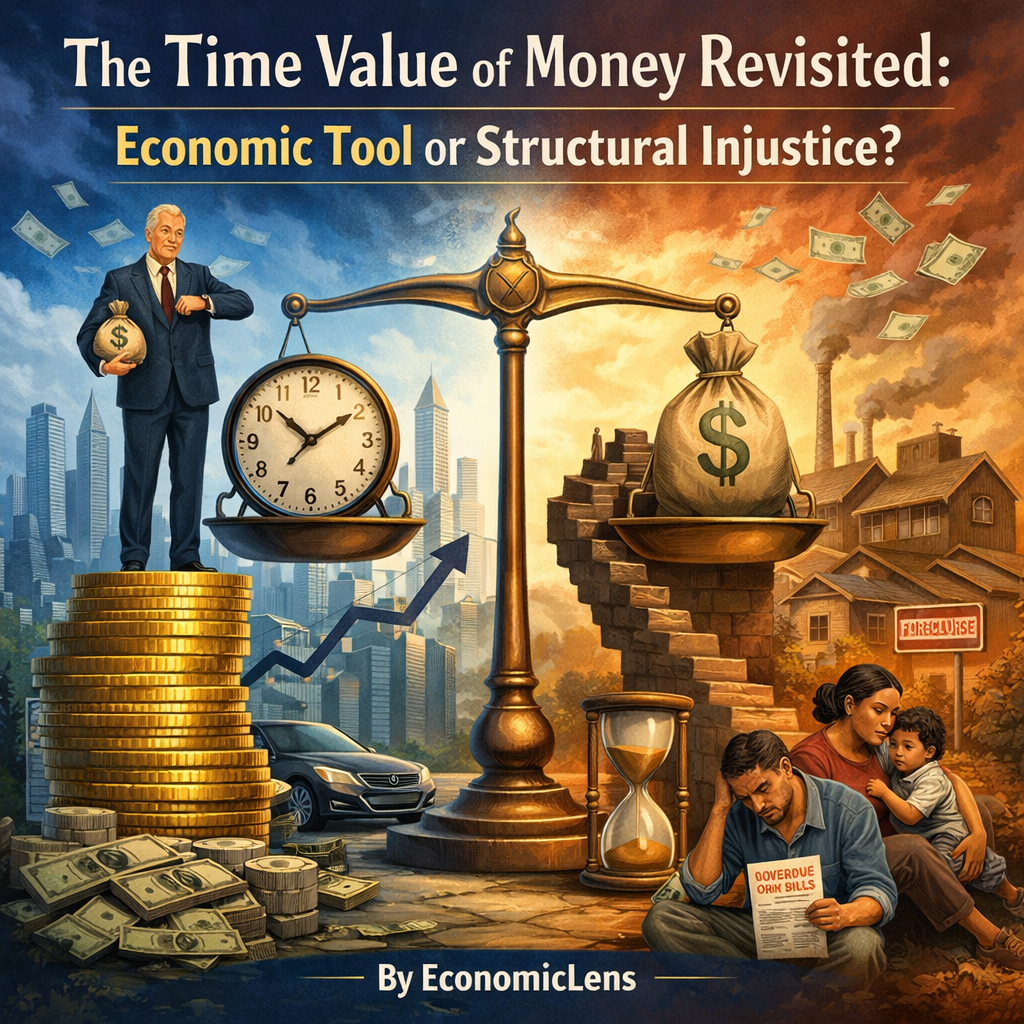
Structural Injustice of TVM analyzes how the time value of money transforms time into guaranteed income, producing inequality, debt dependence, and financial instability. It contrasts this framework with Islamic economic principles that link profit to risk, ownership, and real economic activity.
Overview of the Structural Injustice of TVM
The time value of money (TVM) constitutes a foundational principle of modern financial economics. It underlies interest rate determination, asset valuation models, intertemporal choice theory, banking operations, and public debt management. These applications appear prominently in macro-financial frameworks used by the International Monetary Fund (https://www.imf.org). Mainstream economic theory treats TVM as a neutral and rational mechanism that reflects a preference for present consumption over future consumption, adjusted for inflation and uncertainty.
However, a political economy perspective reveals that TVM carries distributional and systemic implications beyond technical valuation. Rather than operating only as an efficiency-enhancing pricing tool, TVM functions as an institutional rule. It systematically privileges creditors over debtors, financial capital over productive activity, and legally protected claims over uncertain real output. In this sense, the Structural Injustice of TVM arises not from mispricing but from embedding time into enforceable financial contracts.
Moreover, TVM shapes how societies allocate economic risk. Prevailing systems transfer uncertainty disproportionately to borrowers, workers, and taxpayers. Meanwhile, holders of financial claims enjoy insulated returns. Global inequality research by the World Bank (https://www.worldbank.org) documents this asymmetric risk allocation and its long-term effects on income distribution, macroeconomic resilience, and social cohesion.
Consequently, debates on the Structural Injustice of TVM extend beyond efficiency or capital allocation. They raise questions of fairness, responsibility, and the social purpose of finance. Understanding TVM as a structural rule, rather than a neutral abstraction, remains essential for evaluating its role in inequality and systemic fragility.
Structural Injustice of TVM in Contemporary Financial Architecture
In standard economic theory, interest compensates lenders for delayed consumption, inflation risk, and uncertainty. In contemporary financial systems, institutions mitigate these risks through collateralization, legal enforcement, credit intermediation, deposit insurance, and central bank backstops. These mechanisms dominate advanced economies supervised by the Bank for International Settlements (https://www.bis.org). As a result, lenders face substantially reduced exposure to real economic loss.
Under these conditions, time becomes the dominant determinant of financial return. Capital generates income mainly by persisting across time rather than engaging directly with productive risk. Financial returns increasingly detach from real economic performance. Meanwhile, borrowers remain fully exposed to income volatility, market fluctuations, and macroeconomic shocks. This imbalance lies at the core of the Structural Injustice of TVM.
This institutional configuration shifts finance from facilitating production to enforcing time-based claims on future income. Credit contracts guarantee returns regardless of productive value creation. When borrowers fail to meet time-bound obligations, penalties, restructuring, or exclusion from financial access follow. These outcomes reinforce creditor dominance within the economic hierarchy.
Additionally, this architecture rewards financial engineering over productive investment. Returns from leverage, arbitrage, and interest spreads often exceed those from real-sector activity. OECD research on financialization (https://www.oecd.org) shows capital concentrating increasingly in financial assets rather than productive enterprises. Over time, financial claims dominate economic decision-making, confirming that TVM reflects institutional power rather than neutral efficiency.
Distributional Consequences and Inequality
Interest-based financial systems generate persistently asymmetric distributional outcomes. Agents with surplus capital receive predictable and contractually protected income streams. In contrast, households, firms, and sovereign entities assume fixed obligations in exchange for liquidity. Over time, these obligations function as institutional channels of wealth transfer from debtors to creditors, reinforcing the Structural Injustice of TVM.
Because legal frameworks prioritize interest payments, extraction continues regardless of economic conditions. During contractions, economies adjust through wage compression, employment losses, and fiscal austerity. Financial claims, however, rarely absorb losses. This asymmetry accelerates wealth concentration and expands rentier income relative to productive earnings.
Debt-servicing burdens fall disproportionately on lower-income households and developing economies. Limited bargaining power forces these actors to accept unfavorable terms. As a result, long-term payment structures restrict mobility, investment, and social spending. Inequality therefore becomes cumulative rather than cyclical.
Empirical evidence across advanced and developing economies confirms that rising debt servicing increasingly crowds out consumption, investment, and fiscal capacity. IMF debt sustainability analyses (https://www.imf.org/en/Topics/debt) show that growing interest obligations constrain public spending on infrastructure, health, and education. When income growth lags behind debt growth, further borrowing becomes unavoidable, deepening dependency.
Under these conditions, TVM functions not merely as a pricing mechanism but as a structural driver of inequality. Ownership of financial assets gains priority over participation in real economic production.
Financial Instability and Debt Dynamics
TVM-based financial systems depend inherently on sustained debt expansion. By monetizing future income in the present, they require continuous growth to preserve solvency. When growth slows, debt obligations become unsustainable. Defaults, financial crises, or large-scale policy interventions then follow.
The rigidity of interest obligations contrasts sharply with uncertain economic output. This mismatch amplifies downturns as declining incomes collide with fixed repayment schedules. Borrowers respond through austerity, asset liquidation, or bankruptcy. These responses deepen contractions and reinforce the Structural Injustice of TVM.
Monetary authorities respond with liquidity provision, asset purchases, and interest-rate suppression. While these measures stabilize financial institutions, they often inflate asset prices and transfer costs to society. Inflation, fiscal strain, or reduced public services absorb the adjustment. Financial claims remain protected.
Historical crisis patterns analyzed by the Bank for International Settlements (https://www.bis.org/statistics) show how leverage cycles amplify systemic risk. IMF Global Financial Stability Reports (https://www.imf.org/en/Publications/GFSR) similarly emphasize that financial instability often emerges endogenously.
Thus, financial instability appears not as an accidental shock but as a structural outcome of time-based financial claims. Cycles of leverage, crisis, and intervention become normalized, undermining long-term stability and reinforcing systemic fragility.
Islamic Economics and the Structural Injustice of TVM
Islamic economic theory offers a structural critique of monetizing time that closely aligns with the concept of Structural Injustice of TVM. The prohibition of riba does not oppose profit, trade, or capital accumulation. Instead, it rejects returns generated solely through the passage of time without ownership risk, productive effort, or uncertainty. This critique appears in Bayʿ al-Salam and the Time Value of Money: A Fundamental Misconception (https://economiclens.org/bay-al-salam-and-the-time-value-of-money-a-fundamental-misconception/).
Classical Islamic jurisprudence defines riba al-nasi’ah as an increment arising exclusively from deferment. The operative cause, described as al-ajal maʿa al-ziyada, concerns justification by time alone rather than the size of the increment. This analysis is developed further in Time Value of Money and the True Nature of Riba al-Nasi’ah (https://economiclens.org/time-value-of-money-and-true-nature-of-riba-al-nasiah/) and Riba al-Nasi’ah: The Time Value of Money (https://economiclens.org/riba-al-nasiah-the-time-value-of-money/).
Within this framework, time does not constitute an independent economic asset. It serves as the environment in which real economic activity unfolds. The principle of al-kharaj bil-daman establishes that profit entitlement requires exposure to liability. Guaranteed returns without risk break the link between reward and responsibility.
This logic extends beyond loan contracts to monetary exchange itself. Deferred exchanges, dual pricing, and conditional sales that embed delay-based increments remain restricted because they commodify time. Islamic economics therefore identifies time-based gain as structural injustice rather than technical efficiency.
TVM as an Institutional Choice, Not a Natural Law
TVM is often portrayed as economically inevitable. Islamic economic theory, along with other risk-sharing frameworks, demonstrates that this portrayal reflects institutional design rather than immutable economic law.
Alternative arrangements such as profit-and-loss sharing, equity participation, and asset-backed finance align returns with actual economic performance. Capital shares gains and losses, which constrains leverage and discourages speculative debt accumulation. Development finance literature from the OECD (https://www.oecd.org/finance) increasingly discusses these approaches.
Such models promote financial discipline by tying income to productivity instead of time. Incentives shift toward investment, innovation, and effective risk management. Shared-risk mechanisms distribute uncertainty across participants rather than concentrating it on debtors.
The central issue is not whether time influences economic decisions. The issue is whether time alone should generate legally guaranteed income independent of real outcomes. Recognizing the Structural Injustice of TVM as a policy choice opens space for alternative financial architectures grounded in shared responsibility.
Conclusion
Reassessing the time value of money exposes a fundamental tension between financial efficiency and distributive justice. When systems commodify time as a guaranteed income source, finance shifts from enabling production to extracting value. These dynamics intensify inequality, generate recurrent instability, and subordinate real economic activity to financial preservation.
The Islamic economic critique reinforces this conclusion by identifying time-based gain without risk as structural injustice. By insisting on the linkage between profit, ownership, and liability, it presents a coherent alternative to debt-centered financial systems.
Addressing inequality and instability therefore requires institutional reform that reconnects financial returns to real economic activity. Global policy debates within the IMF and World Bank (https://www.worldbank.org) increasingly echo this concern. In this sense, the Structural Injustice of TVM is not a technical anomaly but a foundational issue shaping the legitimacy, stability, and moral coherence of modern economic systems.