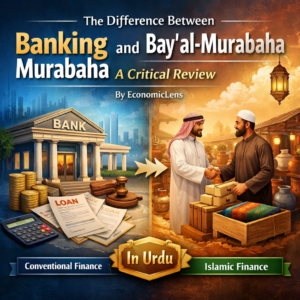
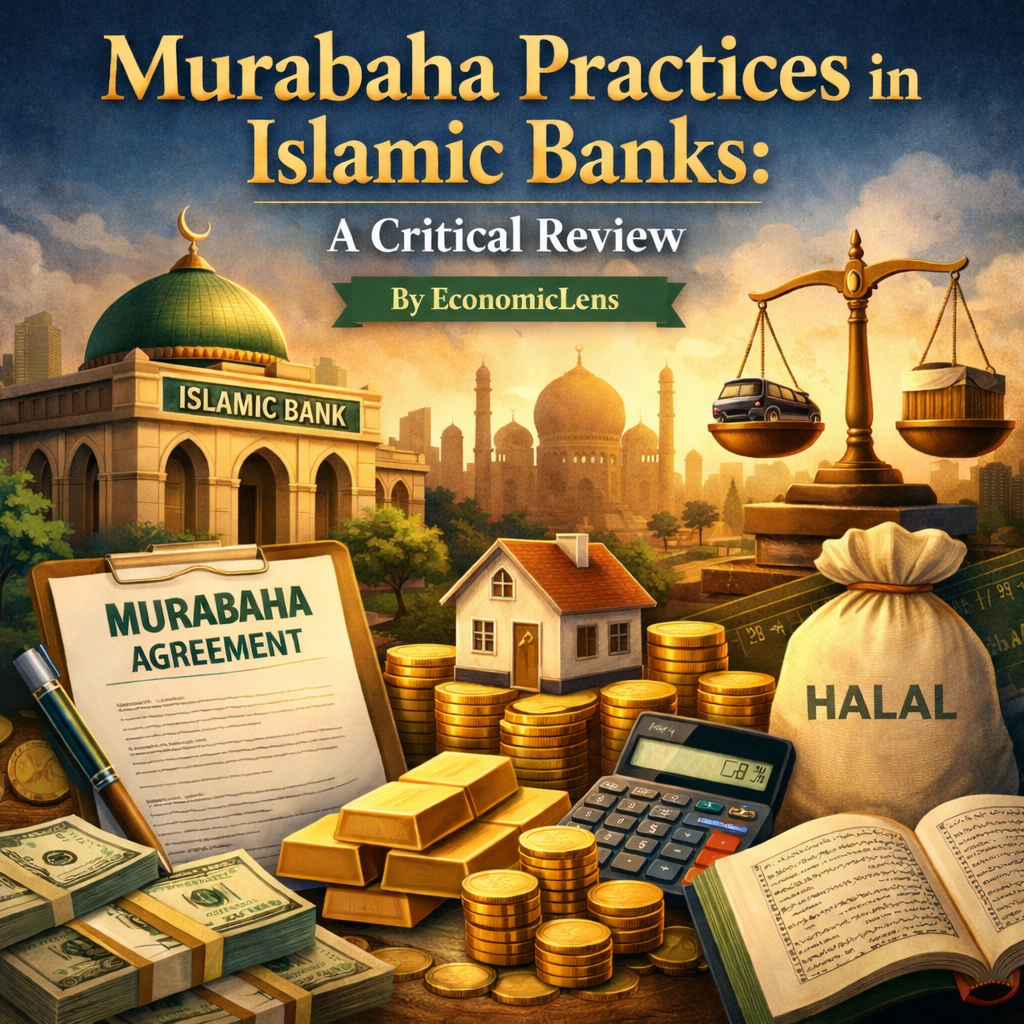
This critical review analyzes Murabaha Practices in Islamic Banks by comparing classical Baiʿ Murabaha with modern Banking Murabaha. It evaluates whether institutional structures preserve real ownership, liability, and risk, or whether time-linked pricing and enforcement mechanisms replicate the operative cause of Riba al-Nasi’ah.
Introduction
The dispute is substantive, not terminological
The contemporary debate on Banking Murabaha and Baiʿ Murabaha is often reduced to questions of contractual form or Islamic nomenclature. However, this framing obscures the real issue. The disagreement is not about what the contract is called. Rather, it concerns what actually generates profit within the contract, a concern that also arises in discussions on Murabaha Practices in Islamic Banking.
Islamic banking presents Murabaha as a Shariah-compliant alternative to interest-based lending. Yet Islamic economic thought does not treat money as a self-generating asset. Money functions as a medium of exchange, not as an independent source of lawful growth. It becomes entitled to increase only when it participates in real economic activity, accompanied by ownership, liability, and exposure to risk, principles that equally underpin Murabaha Practices in Islamic Banks.
For this reason, Islamic law does not identify Riba al-Nasīʾah merely by numerical excess. Instead, it focuses on its operative cause, namely al-ajal maʿa al-ziyādah, an increase that arises solely because time is extended. When deferment itself becomes the justification for profit, the transaction moves away from trade and toward the logic of riba, even if the increase is fixed at the outset. This distinction is critical for understanding why the time value of money framework itself conflicts with Islamic commercial ethics, as explained in detail in Time Value of Money and the True Nature of Riba al-Nasīʾah (https://economiclens.org/time-value-of-money-and-true-nature-of-riba-al-nasiah/).
This distinction is made explicit in the Qur’anic separation between sale and riba: وَأَحَلَّ اللَّهُ الْبَيْعَ وَحَرَّمَ الرِّبَا
Allah has permitted trade and prohibited riba. (Al-Baqarah 2:275, https://quran.com/2/275)
The verse does not merely contrast two labels. It contrasts two economic logics. Trade is legitimized because it involves exchange, risk, and responsibility. Riba is prohibited because it produces gain through temporal advantage without productive participation.
Accordingly, this study does not challenge the juristic legitimacy of classical Baiʿ Murabaha as recognized in fiqh. Baiʿ Murabaha remains a valid mode of sale when its essential conditions are fulfilled. The purpose of this analysis is narrower and more precise. It asks whether modern Banking Murabaha preserves the substance of Murabaha, or whether its institutional structure embeds the time value of money into pricing while insulating profit from genuine risk.
Islamic law prioritizes substance over form. Therefore, if profit is contractually secured through deferment while liability and risk are neutralized, the prohibition’s underlying cause remains operative. This principle will serve as the analytical lens throughout the discussion that follows.
Section One: Bayʿ al-Musāwamah, Baiʿ Murabaha, and the Juristic Basis of Profit
-
Bayʿ al-Musāwamah
Bayʿ al-Musāwamah refers to a sale in which the final price is disclosed, while the seller’s original cost and profit margin remain undisclosed. This form of sale rests on negotiation and mutual consent rather than cost transparency. Islamic law permits Bayʿ al-Musāwamah on the condition that it remains free from deception, excessive uncertainty, and coercion.
In this structure, the seller is not obliged to reveal acquisition cost or profit. Consent is grounded in perceived value rather than accounting disclosure. As long as both parties agree voluntarily and no injustice is involved, the Shariah does not intervene in pricing mechanics.
-
Baiʿ Murabaha
Baiʿ Murabaha differs fundamentally in its ethical structure. It is classified as a trust-based sale (bayʿ al-amānah). The seller must disclose both the original cost and the profit margin. Knowledge of these elements is a condition for validity, not a procedural preference.
If cost disclosure is inaccurate or deceptive, Murabaha loses its moral and juristic foundation. The buyer’s consent then becomes uninformed, and the sale is rendered defective. For this reason, classical jurists treated Murabaha with heightened scrutiny compared to Musāwamah.
-
The shared principle: profit is inseparable from liability
Despite their procedural differences, Bayʿ al-Musāwamah and Baiʿ Murabaha share a foundational rule that governs all lawful profit in Islamic commercial law. Profit is justified only when the seller bears the possibility of loss. This relationship is expressed in the well-established juristic maxim: «الْخَرَاجُ بِالضَّمَانِ» Entitlement to gain follows liability.
This maxim establishes that return cannot be detached from responsibility. When a party secures profit while transferring or eliminating risk, the ethical justification for that profit collapses. Islamic law therefore resists contractual structures that allow time, rather than liability, to become the basis of gain.
It is precisely at this point that the tension between Banking Murabaha and classical Baiʿ Murabaha begins to emerge. In many institutional applications, risk is minimized or displaced, while profit remains fixed and time-linked. As a result, the classical alignment between ownership, liability, and profit becomes distorted.
Section Two: Bayʿ al-Salam and the Time Value of Money, a Foundational Misunderstanding
In defending modern Banking Murabaha, Bayʿ al-Salam is frequently cited as evidence that Islamic law permits price differentiation based on time. However, this reasoning rests on a fundamental misunderstanding. Bayʿ al-Salam does not validate the time value of money. Rather, it was structured precisely to block it by requiring full advance payment and shifting risk onto the seller. Treating Salam as proof that time alone justifies higher prices reverses its legal purpose, a misconception examined in detail in Bayʿ al-Salam aur Waqt ki Qeemat-e-Zar: Aik Bunyadi Mughalta (https://economiclens.org/bai-salam-aur-waqt-ki-qeemat-e-zar-aik-bunyadi-mughalta/).
1. The structural logic of Bayʿ al-Salam
Bayʿ al-Salam is a sale in which the entire price is paid in full at the time of contract, while the delivery of the specified commodity is deferred to a future date. This requirement of immediate payment is not incidental. It is the central mechanism through which Islamic law blocks the monetization of time, a principle equally emphasized in Murabaha Practices in Islamic Banks.
In Salam, the buyer receives no financial deferment or liquidity advantage. On the contrary, the buyer parts with capital immediately. The seller, meanwhile, receives instant liquidity and assumes full responsibility for future delivery, including production risk, market fluctuation, storage, and timely fulfillment. Profit or loss therefore arises from real economic exposure, not from the passage of time.
For this reason, classical jurists treated Salam as an exception permitted due to genuine commercial need, particularly for producers, while simultaneously enclosing it within strict conditions to prevent riba.
2. Why Salam cannot justify deferred monetary increase
The critical distinction lies in what is deferred. In Bayʿ al-Salam, the deferred element is the commodity, not the money. The monetary obligation is extinguished immediately. This design ensures that no increase can accrue merely because time passes.
By contrast, in Banking Murabaha, the deferred element is often the payment itself, while the price increases in direct proportion to the length of deferment. When monetary obligation is postponed and increment is contractually attached to that postponement, the operative cause of Riba al-Nasīʾah becomes present, a concern that mirrors critiques raised in Murabaha Practices in Islamic Banks.
Islamic law does not deny the relevance of the future. Rather, it draws a sharp boundary between deferred delivery and deferred monetary entitlement. Salam occupies the first category. Interest-based logic occupies the second.
3. Economic factors versus temporal entitlement
Price determination in Salam is linked to concrete economic factors. These include uncertainty of production, volatility of supply, delivery risk, and opportunity cost borne by the seller. Any discount or pricing adjustment reflects these risks, not an assumption that money naturally grows over time.
Treating Salam as proof of the time value of money therefore reverses its legal purpose. Salam was permitted to facilitate real trade under constraint, while safeguarding the prohibition of al-ajal maʿa al-ziyādah, increase caused by delay.
This distinction explains why Islamic law required full prepayment in Salam. If payment were deferred, Salam would collapse into a structure indistinguishable from a loan with interest.
4. Substance over form in Islamic commercial law
Islamic jurisprudence evaluates transactions by their economic substance, not by the moment at which a price is fixed. Even if an increment is agreed upon at the outset, it remains impermissible if its sole justification is deferment.
The Prophet ﷺ prohibited arrangements that disguise riba within contractual form, including structures that monetize delay while avoiding explicit interest language. The decisive factor is causality. If time itself generates entitlement, the prohibition remains operative.
5. Implications for Banking Murabaha
When Banking Murabaha invokes Salam to legitimize higher deferred prices, it conflates two opposite logics. Salam allows the future to apply to goods, while closing the door on monetary growth through time. Banking Murabaha, in many practical forms, does the reverse. It delivers goods immediately or near-immediately, while stretching monetary obligation and attaching increment to duration.
This inversion reveals the weakness of the Salam-based defense. Rather than supporting the time value of money, Salam stands as evidence that Islamic law carefully distinguishes between commercial risk and temporal entitlement.
Section Three: The operational structure of Banking Murabaha
To evaluate Banking Murabaha meaningfully, it is necessary to move beyond abstract definitions and examine how the contract operates in practice. While documentation and terminology may vary across institutions, the operational structure of Banking Murabaha follows a largely standardized sequence. This structure is crucial, because Shariah compliance depends not only on contractual wording, but on how ownership, liability, and risk unfold at each stage.
-
Stage one: purchase request and binding promise
The process typically begins when a customer approaches the bank with a request to acquire a specific asset that the bank does not own. At this point, the customer submits a purchase order, often accompanied by a binding promise to purchase once the bank acquires the asset.
Although this step is frequently presented as a non-binding arrangement in theory, it functions as a binding commitment in practice. The customer’s promise is structured in a way that makes withdrawal costly or impractical. This promise becomes the foundation upon which the entire transaction rests.
From a juristic perspective, this stage already raises concern. A sale has not yet occurred, but the customer’s economic freedom is substantially constrained. The transaction’s outcome begins to look predetermined rather than contingent on a future, independent sale.
-
Stage two: acquisition through direct purchase or agency
In the second stage, the bank proceeds to acquire the asset. This acquisition occurs in one of two ways. Either the bank purchases the asset directly from the supplier, or it appoints the customer as its agent to purchase the asset on its behalf.
Agency-based acquisition is particularly common because it minimizes operational burden for the bank. However, it also introduces structural tension. When the customer acts as the bank’s agent while simultaneously intending to become the final buyer, the separation between ownership and liability becomes blurred.
At this stage, the key Shariah question is not whether ownership is recorded, but whether liability genuinely transfers to the bank. If the asset is damaged, defective, or depreciates during this period, does the bank actually bear the loss, or is the risk contractually shifted back to the customer?
-
Stage three: Murabaha sale with deferred price
Once the asset is deemed to have been acquired, the bank executes a Murabaha sale to the customer. The price is fixed in advance and payable on a deferred basis, often through installments over an extended period. The bank’s profit margin is embedded in this deferred price and remains unaffected by subsequent events.
At this point, the transaction formally takes the shape of a sale. However, economically, the outcome has already been determined. The bank’s return is fixed, the customer’s obligation is locked in, and market uncertainty no longer affects the bank’s position.
The crucial issue here is the relationship between the increment and time. If the deferred price exceeds the spot price primarily because of duration, rather than because of real commercial exposure, the pricing logic begins to mirror the time value of money.
-
Stage four: penalties for delay and enforcement mechanisms
In the event of late payment, most Banking Murabaha contracts impose penalties. These penalties are often described as charitable contributions to avoid direct benefit to the bank. Nonetheless, from the customer’s perspective, delay results in additional financial burden.
This stage reinforces a time-based structure. As duration increases, monetary obligation increases. The formal destination of the penalty does not change the economic effect. Time continues to function as a trigger for increased liability.
-
Structural observations
When viewed as a whole, the operational structure of Banking Murabaha reveals a carefully sequenced mechanism that delivers predictable return while minimizing exposure to risk. Each stage narrows uncertainty and shifts liability away from the bank, even as profit remains fixed and insulated.
This structure is not accidental. It reflects an institutional priority for certainty and enforceability. However, Islamic commercial law evaluates transactions by the distribution of risk and responsibility, not by procedural efficiency.
The significance of this structure becomes clearer when examined against classical fiqh objections. Each stage introduces elements that, when combined, move the transaction closer to a financing arrangement in which time, rather than trade, becomes the central source of return.
Section Four: Core Juristic Objections to Banking Murabaha
Having outlined the operational structure of Banking Murabaha, the analysis now turns to the substantive juristic objections that arise from this structure. These objections do not stem from isolated technicalities. Rather, they emerge from the cumulative effect of multiple elements that, when combined, alter the nature of the transaction from genuine trade to time-based financing.
Each objection below addresses a distinct structural issue, while remaining anchored to the same governing principle: profit is legitimate only when it is inseparable from ownership, liability, and real risk.
Objection One: Conditional sale and two sales in one transaction
A valid sale in Islamic law is based on clear intent, independent consent, and unambiguous terms. When multiple binding conditions are interwoven into a single financial arrangement, the sale gradually loses its independent character.
In Banking Murabaha, several elements operate together. The customer’s promise to purchase is effectively binding. The bank commits to sell only on deferred terms. Penalties are imposed for delay. Additional obligations, such as mandatory takaful and restrictive covenants, are layered onto the same structure. Although these elements may appear in separate documents, they function as a single, integrated transaction.
This structure corresponds closely to what classical jurists warned against under the concepts of bayʿatayn fī bayʿah (two sales in one sale) and bayʿ maʿa al-sharṭ (sale contingent upon conditions). The concern here is not the existence of conditions per se, but their cumulative effect. When conditions dominate the transaction, the sale becomes a predetermined financial pathway rather than an open exchange.
The Prophet ﷺ explicitly prohibited such structures: «نَهَى رَسُولُ اللَّهِ ﷺ عَنْ بَيْعَتَيْنِ فِي بَيْعَةٍ»
The Messenger of Allah ﷺ forbade two sales in one sale.
He further warned: «مَنْ بَاعَ بَيْعَتَيْنِ فِي بَيْعَةٍ فَلَهُ أَوْكَسُهُمَا أَوِ الرِّبَا»
Whoever conducts two sales in one sale will have the lesser of the two or riba.
These narrations show that the prohibition is not merely about multiple prices. It is about preventing contractual structures in which deferment becomes monetized under the appearance of trade. In Banking Murabaha, when the promise becomes practically irreversible and the sale becomes the final step in a pre-locked process, the condition overtakes the sale. The transaction’s substance begins to resemble a loan with structured repayment rather than a voluntary exchange.
Objection Two: Sale without genuine possession or liability
Islamic commercial law requires that the seller possess the subject matter of sale in a manner that entails liability. Ownership without exposure to loss is not sufficient. This rule exists to prevent speculative and artificial transactions detached from real economic responsibility.
The Prophet ﷺ stated: «لَا تَبِعْ مَا لَيْسَ عِنْدَكَ»
Do not sell what you do not possess.
In Banking Murabaha, the bank often enters the transaction without owning the asset. Ownership is later asserted through documentation, sometimes for a very brief interval. The decisive question, however, is whether this ownership carries real consequences. If the asset were to be damaged, rejected, or depreciate during the period of supposed bank ownership, would the bank genuinely bear the loss. In many institutional arrangements, risk is shifted to the customer through agency agreements, indemnities, or insurance mechanisms. As a result, possession exists in form but not in substance.
Appeals to Bayʿ al-Salam do not resolve this problem. Salam requires immediate payment and places delivery risk squarely on the seller. Banking Murabaha often combines deferred payment with risk displacement. This inversion undermines the ethical structure that Salam was designed to protect. When ownership becomes momentary and liability is neutralized, the sale loses its moral foundation. Profit then appears detached from the very exposure that justifies it.
Objection Three: Suspended sale and mutual dependency
A valid sale in Islamic law must be concluded with clarity and finality. Transactions suspended on future contingencies introduce uncertainty and compromise genuine consent.
In Banking Murabaha, the bank frequently conditions its purchase on the customer’s binding promise. The customer, in turn, conditions their purchase on the bank’s acquisition. This mutual dependency creates a suspended structure in which neither party acts independently. Once these promises are legally enforceable, the sale is effectively concluded in substance before it occurs in form. The final Murabaha contract merely executes a result that was already locked in.
Islamic law discourages such suspension because it erodes autonomy. The transaction ceases to be a market exchange and becomes a coordinated mechanism designed to deliver liquidity with predetermined return.
Objection Four: Combining agency and purchase in one person
Another recurring concern arises when the customer is appointed as the bank’s agent to acquire the asset, while also being the ultimate buyer. From a juristic perspective, this dual role creates a conflict of interest.
An agent is obligated to act in the principal’s best interest. When the agent is also the final purchaser, this fiduciary separation collapses. In practice, this arrangement allows the bank to avoid market exposure, negotiation risk, and logistical responsibility. As a result, the bank secures a fixed return while transferring commercial risk away from itself. This outcome engages the principle of profit without liability, which Islamic law does not recognize as legitimate.
The issue is not administrative convenience. It is the systematic elimination of risk from the seller’s position while preserving guaranteed gain.
Objection Five: Deferred sale with increment, time as the source of profit
This objection lies at the core of the entire critique. Modern financial systems assume that money must increase with time. Islamic law rejects this assumption. Time, by itself, does not generate value. Value arises from ownership, effort, and exposure to uncertainty.
In many Banking Murabaha arrangements, cash purchase is not meaningfully available. Only deferred pricing is offered, and the deferred price is consistently higher. When this increase corresponds directly to the length of deferment rather than to real commercial exposure, the structure embodies al-ajal maʿa al-ziyādah, the very operative cause of Riba al-Nasīʾah. This structural embedding of the time value of money within Banking Murabaha has been critically analyzed in Banking Murabaha aur Waqt ki Qeemat-e-Zar: Aik Tanqeedi Jaiza (https://economiclens.org/banking-murabaha-aur-waqt-ki-qeemat-e-zar-aik-tanqeedi-jaiza/), where the convergence between deferred-sale pricing and interest logic is examined in depth.
This is the operative cause of Riba al-Nasīʾah. The issue is not whether the price is fixed at the outset. The issue is what the increment compensates for. If it compensates for time alone, the logic of riba remains intact.
Early juristic practice confirms this understanding. In al-Muwaṭṭaʾ, reports from ʿAbdullah ibn ʿUmar رضي الله عنهما show strong disapproval of transactions structured to acquire an asset solely for resale at a higher deferred price. The objection was directed at the increase tied to deferment, not at the absence of a sale form.
This distinction reinforces a central principle. A transaction does not become permissible merely because it is labeled a sale. Permissibility depends on whether profit flows from trade or from time.
Objection Six: Delay penalties and the Qur’anic ethos of forbearance
Islamic law approaches financial hardship through the lens of mercy and restraint, not escalation and pressure. When a debtor faces difficulty, the Qur’anic response is not to increase monetary burden with time, but to grant relief and deferment according to capacity. This ethical orientation stands in direct tension with contractual mechanisms that systematically attach additional financial liability to delay.
The Qur’an establishes this principle in unequivocal terms: وَإِنْ كَانَ ذُو عُسْرَةٍ فَنَظِرَةٌ إِلَىٰ مَيْسَرَةٍ
If the debtor is in hardship, then grant him time until ease. (Al-Baqarah 2:280, https://quran.com/2/280)
The verse articulates a normative financial ethic. Delay arising from genuine difficulty is to be met with patience, not monetization. Time, in this framework, is a space for relief, not a trigger for increased entitlement.
In Banking Murabaha, however, delay penalties are commonly embedded as a structural feature. Although these penalties are often labeled as charitable contributions and excluded from the bank’s income, their economic effect remains unchanged for the customer. Delay results in additional monetary obligation. The direction of causality is clear. As time extends, liability increases.
From a Shariah perspective, the destination of penalty proceeds does not fully resolve the issue. The prohibition of unjust enrichment focuses on the act and its effect, not solely on who ultimately receives the funds. When time itself becomes the basis for extracting additional money, the transaction moves closer to the logic of riba, even if profit is not directly booked.
Murabaha Practices in Islamic Banks: juristic caution on monetary penalties
Classical jurists across the legal schools exhibited deep caution regarding financial penalties. In the Mālikī tradition, monetary extraction was not treated as a legitimate form of punishment in itself unless tied to a clearly established legal right. Imam Mālik’s approach reflects a broader reluctance to make wealth forfeiture a default enforcement tool.
Imam al-Shāfiʿī expressed similar reservations, emphasizing that punishment does not render another’s wealth lawful in the absence of explicit authorization. For him, property retained its inviolability even in the presence of wrongdoing.
Within the Ḥanbalī school, discussions of discretionary punishment (taʿzīr) exist, yet the institutionalization of monetary penalties remains a sensitive matter rather than a settled norm. The Ḥanafī school likewise displays pronounced discomfort with financial punishment, often viewing it as impermissible or at least highly discouraged.
This juristic hesitation is not incidental. It reflects an ethical concern that financial penalties blur the boundary between discipline and exploitation, particularly when applied without nuanced assessment of capacity and hardship.
In the context of Banking Murabaha, delay penalties risk entrenching a time-based escalation mechanism within a system that claims to reject the time value of money. Even if penalties are framed as deterrents, their structural role remains the same. Time becomes a priced variable.
The core question therefore persists. Does a system that increases monetary burden as time passes align with the Qur’anic ethic of forbearance, or does it reproduce, in a different form, the very logic that the prohibition of riba seeks to dismantle.
Objection Seven: Legal stratagems (ḥiyal), artificial need, and expansion beyond necessity
Islamic jurisprudence has historically recognized limited allowances for legal stratagems (ḥiyal) in situations of genuine necessity or to avert clear injustice. These allowances were never intended to normalize practices that undermine the ethical objectives of the Shariah. The permissibility of a stratagem is therefore inseparable from its purpose, scope, and consequences.
In the case of Banking Murabaha, a central concern is that mechanisms originally defended as temporary accommodations have gradually evolved into routine instruments of financing. What may once have been justified as a constrained response to transitional realities has increasingly become a dominant mode of credit provision, employed not to remove hardship, but to facilitate convenience and consumption.
This shift alters the juristic character of the transaction. When Murabaha is repeatedly used as a substitute for cash lending, the sale ceases to function as an independent commercial exchange. The asset becomes a procedural intermediary, while the real objective becomes liquidity delivery with a predetermined return. At this point, the stratagem no longer mitigates harm. Instead, it risks reproducing it under a different name.
Classical jurists tolerated certain stratagems to preserve higher objectives, such as protecting parties from exploitation or enabling trade under constraint. However, they consistently warned against turning exceptional concessions into habitual practices. When a concession becomes the norm, its justificatory basis collapses.
In Banking Murabaha, the widespread use of stratagems is often accompanied by the creation of artificial need. Financing is extended not primarily for productive enterprise or genuine commercial necessity, but for discretionary consumption. This expansion reinforces a debt-oriented economic culture that Islamic law sought to restrain.
Objection Eight: From temporary accommodation to a permanent financing model
Islamic jurisprudence draws a clear distinction between temporary accommodations permitted under constraint and permanent structures that define a financial system. When a concession is allowed due to necessity, its scope is expected to remain limited, its conditions tightly controlled, and its use proportionate to the underlying hardship. Once such a concession is elevated into a default model, its juristic character changes fundamentally.
In the context of Banking Murabaha, what was initially presented as a pragmatic accommodation has gradually been institutionalized as a core financing instrument. Murabaha is no longer treated as an exception. Instead, it functions as the backbone of Islamic banking balance sheets, supported by standardized documentation, internal product pipelines, and dedicated marketing strategies. At this stage, the justification of necessity no longer applies.
This institutionalization has important implications. A mechanism tolerated due to constraint must be evaluated differently once it becomes permanent. Temporary concessions are assessed with leniency because they are limited in scope and duration. Permanent models, by contrast, must satisfy the full ethical and structural requirements of Islamic commercial law.
When Murabaha becomes the dominant mode of financing, its internal logic begins to shape economic behavior. Banks are incentivized to design structures that maximize predictability and minimize exposure. Customers, in turn, become accustomed to deferred consumption financed through fixed obligations. Over time, certainty of return replaces participation in productive risk as the organizing principle of the system.
Murabaha Practices in Islamic Banks: permanence and procedural drift
This shift is not neutral. Islamic economic thought emphasizes real trade, shared risk, and productive enterprise. A system centered on Murabaha as a permanent financing tool gradually sidelines these objectives. The sale form remains, but the economic function increasingly resembles that of credit provision secured by time-based obligation.
Moreover, the permanence of Murabaha weakens the safeguards that originally accompanied it. As products scale, procedural shortcuts and formal compliance tend to replace substantive evaluation. The focus shifts from assessing genuine ownership and liability to ensuring documentation alignment. This transition increases the risk that form will dominate substance.
From a juristic perspective, the critical question is no longer whether Murabaha can be tolerated under necessity. The question becomes whether a system built primarily on Murabaha aligns with the Shariah’s objectives when evaluated as a normative structure, not an exception.
If a temporary accommodation evolves into a permanent architecture that systematically insulates profit from risk and ties return to time, then its continued use requires serious reassessment. At that point, the issue is not marginal non-compliance, but structural drift away from the ethical foundations of Islamic commercial law.
Objection Nine: Unjust enrichment (akl al-amwāl bil-bāṭil) and systematic extraction
Islamic law places strong emphasis on protecting property from unjust consumption. Wealth may not be taken without a valid countervalue or lawful cause. This principle is not merely contractual, but ethical and systemic. When a financial structure enables extraction of wealth without commensurate exchange, responsibility, or risk, it directly engages the prohibition of akl al-amwāl bil-bāṭil, consuming wealth wrongfully, a concern that becomes especially salient in Murabaha Practices in Islamic Banks.
The Qur’an articulates this prohibition in general terms: يَا أَيُّهَا الَّذِينَ آمَنُوا لَا تَأْكُلُوا أَمْوَالَكُم بَيْنَكُم بِالْبَاطِلِ
O you who believe, do not consume one another’s wealth unjustly. (Al-Nisāʾ 4:29)
In Banking Murabaha, the concern arises when additional monetary obligations are imposed without a corresponding transactional countervalue. Delay penalties, forfeited advances, administrative charges, and other ancillary amounts often accumulate around the core sale. While each charge may be justified individually through contractual language, their cumulative effect can result in systematic extraction rather than fair exchange.
A defining feature of unjust enrichment is that liability increases without a proportional increase in benefit received. In many Murabaha arrangements, the customer receives the asset once, while monetary obligation continues to grow due to delay, enforcement, or procedural triggers. Time, rather than new value, becomes the source of additional liability.
Objection Ten: Using interest-based benchmarks and mimicry of a prohibited logic
A further structural concern arises when profit margins in Banking Murabaha are determined by reference to interest-based benchmarks, a pattern that has become increasingly visible in Murabaha Practices in Islamic Banks. Although such benchmarks are often defended as neutral pricing tools, their use introduces a deeper conceptual problem that goes beyond technical convenience.
Islamic law does not prohibit profit. However, it does prohibit the logic through which interest operates. Interest-based benchmarks are designed to price money over time. When these benchmarks are imported into Murabaha pricing, they implicitly anchor lawful contracts to a prohibited paradigm. As a result, profit determination becomes aligned with the same temporal logic that underlies riba, even if the contract avoids explicit interest terminology.
The issue here is not external resemblance, but internal causality. If the benchmark governing profit is derived from a system in which return is guaranteed by time alone, then Murabaha pricing inevitably gravitates toward time-based entitlement. Profit becomes less responsive to actual trade costs and more responsive to fluctuations in interest rates, a tendency that critically shapes Murabaha Practices in Islamic Banks at the institutional level.
This practice also shapes institutional incentives. Banks calibrate Murabaha returns to remain competitive with conventional lending products. Consequently, Murabaha margins rise and fall in tandem with interest rates, rather than with changes in asset risk, ownership exposure, or market uncertainty. Over time, the sale form remains, but its economic logic converges with that of lending.
Objection Eleven: Khiyār al-majlis and the erosion of genuine consent
A defining feature of a valid sale in Islamic commercial law is genuine consent. Consent is not reduced to the presence of signatures or formal acknowledgment. Rather, it requires that both parties retain meaningful freedom to accept or withdraw from the transaction without coercion or disproportionate pressure. To safeguard this freedom, Islamic law recognizes khiyār al-majlis, the option to revoke a sale so long as the contracting parties have not separated.
The Prophet ﷺ stated: «الْبَيِّعَانِ بِالْخِيَارِ مَا لَمْ يَتَفَرَّقَا»
The buyer and the seller retain the option so long as they have not separated.
In institutional Banking Murabaha, this safeguard is frequently weakened by the transaction’s sequential design. The customer enters a chain of promises, agency appointments, asset acquisition steps, and contractual undertakings that progressively narrow the ability to withdraw. By the time the final Murabaha contract is executed, economic commitment has already solidified.
This erosion of choice does not usually occur through explicit prohibition. Instead, it arises through cumulative pressure. Withdrawal may trigger forfeiture of advance payments, exposure to penalties, reputational consequences, or legal enforcement. Although exit may remain theoretically possible, it becomes practically burdensome.
Islamic law does not assess consent in abstraction. It evaluates consent in light of surrounding conditions. When withdrawal carries disproportionate cost, consent is compromised, even if formal options exist. Khiyār becomes nominal rather than effective.
Objection Twelve: Risk elimination through takaful and the breakdown of the profit–liability link
A foundational rule in Islamic commercial law is that profit must remain inseparably linked to risk and liability. This linkage is not symbolic. It is the moral and legal justification for lawful gain. When a party secures profit while insulating itself from the possibility of loss, the ethical basis of that profit is undermined, a concern that becomes especially acute in contemporary Murabaha Practices in Islamic Banks.
This principle is encapsulated in the juristic maxim: «الْخَرَاجُ بِالضَّمَانِ»
Entitlement to gain follows liability.
In Banking Murabaha, takaful arrangements are frequently employed to manage risk. Takaful, as a cooperative risk-sharing mechanism, is not inherently problematic. However, concern arises when takaful is used in a manner that systematically eliminates the bank’s exposure, rather than managing it collectively.
In many practical Murabaha structures, any damage, destruction, or impairment of the asset is contractually covered so that the bank’s financial exposure becomes negligible. Loss is either absorbed by the takaful arrangement or shifted back to the customer through indemnity clauses. As a result, the bank’s ownership risk becomes nominal, while its profit remains fixed and enforceable.
Murabaha Practices in Islamic Banks: Risk management vs risk elimination
This arrangement disrupts the symmetry between gain and liability that Islamic law seeks to preserve. Ownership exists in form, but responsibility is transferred. Risk is managed away from the seller, yet return remains guaranteed. When this occurs, the transaction begins to resemble a risk-free return mechanism rather than a genuine sale.
The ethical issue here is not risk mitigation per se. Islamic law permits reasonable risk management. The issue is risk elimination for one party combined with guaranteed return. When one side bears virtually no downside while enjoying predetermined upside, the commercial balance collapses.
The objection, then, is not to takaful itself. It is to its deployment in a way that breaks the essential link between profit and liability. When that link is severed, Murabaha financing drifts away from trade and toward the logic of guaranteed return, which Islamic law has consistently sought to prevent.
Objection Thirteen: Advance payments, token money, and one-sided allocation of loss
Advance payments and token money are not foreign to Islamic commercial practice. In certain contexts, they serve legitimate purposes, such as evidencing seriousness of intent or compensating for actual, demonstrable loss. However, ethical and juristic concerns arise when these mechanisms are structured in a way that allocates loss unilaterally, while insulating one party from corresponding exposure, a pattern increasingly observed in Murabaha Practices in Islamic Banks.
In many Banking Murabaha arrangements, advance payments function asymmetrically. If the customer withdraws from the transaction, the advance amount is often forfeited to offset the bank’s presumed loss. Yet, when the transaction proceeds and market conditions shift favorably, the resulting benefit accrues entirely to the bank. The customer does not share in any upside, despite having borne preliminary downside risk.
This asymmetry raises a fundamental question rooted in Islamic commercial ethics. Why is the customer expected to absorb loss at the preliminary stage, while remaining excluded from gain once the sale is completed. Such a structure conflicts with the principle that gain and loss should follow the same direction, not diverge.
Objection Fourteen: Duration-based price escalation and uniform direction of increment
This objection synthesizes the concerns raised throughout the preceding analysis. When the duration of payment increases and the price rises accordingly, and when this relationship operates independently of genuine commercial risk, the transaction adopts the logic of the time value of money, a pattern increasingly evident in Murabaha Practices in Islamic Banks.
Islamic law does not object to price variation as such. Prices may differ due to market conditions, supply constraints, quality differences, or real commercial uncertainty. The objection arises when time itself becomes the priced variable, and when longer deferment mechanically produces higher monetary obligation.
In many Banking Murabaha structures, this relationship is uniform and directional. Longer tenure leads to higher price. Shorter tenure leads to lower price. The increment follows duration in a predictable and linear manner. This linkage is not tied to ownership exposure, market volatility, or contingent loss. It is tied to deferment alone.
This is precisely the structure that Islamic law sought to dismantle in prohibiting Riba al-Nasīʾah. The problem is not whether the price is agreed at the outset. The problem is whether the cause of the increment is deferment itself. When the answer is affirmative, the operative cause of prohibition remains present.
Conclusion
Trade is defined by risk, not by time
The analysis undertaken in this study leads to a consistent conclusion. The dividing line between lawful trade and prohibited riba is not defined by contractual labels, numerical excess, or procedural sequencing. It is defined by causality, a distinction that lies at the heart of evaluating Murabaha Practices in Islamic Banks.
In Islamic commercial law, profit becomes lawful when it arises from ownership, responsibility, and exposure to uncertainty. Loss is not an accidental byproduct of trade. It is the condition that legitimizes gain. This principle is captured succinctly in the maxim al-kharāj bil-ḍamān.
Riba, by contrast, is characterized by guaranteed return through temporal advantage. Time becomes the generator of entitlement. Risk is transferred or neutralized. Gain is secured regardless of outcome. This logic, not merely interest rates, is what Islamic law rejects, yet it increasingly informs pricing structures within Murabaha Practices in Islamic Banks.
Classical Baiʿ Murabaha operates within the framework of trade. It requires ownership, truthful disclosure, and acceptance of liability. Modern Banking Murabaha, however, often departs from this framework through institutional design. Risk is minimized, profit is fixed, and increment is attached to duration. The result is a structure that increasingly mirrors the economic function of interest-based lending, a concern central to contemporary Murabaha Practices in Islamic Banks.
This critique does not rest on isolated technical violations. It rests on the cumulative effect of multiple features that align Murabaha financing with the time value of money. Conditional structuring, binding promises, agency conflicts, risk insulation, delay penalties, benchmark mimicry, and duration-based pricing all point in the same direction.
Islamic law does not prohibit profit. It prohibits profit without risk. It does not prohibit planning. It prohibits monetizing delay. When time itself becomes a commodity, the moral economy of trade is replaced by the logic of riba, even if the contract carries a permissible name.
The Qur’anic command therefore remains decisive, not as a slogan, but as an analytical criterion: وَأَحَلَّ اللَّهُ الْبَيْعَ وَحَرَّمَ الرِّبَا
Allah permitted trade because it is grounded in real economic participation. He prohibited riba because it extracts gain from time alone.
Any system that claims Shariah compliance must be evaluated against this distinction. The question is not whether Banking Murabaha resembles interest in appearance. The question is whether it reproduces interest in substance.
Where profit flows from trade, Murabaha remains legitimate. Where profit flows from time, the name cannot rescue the reality.