
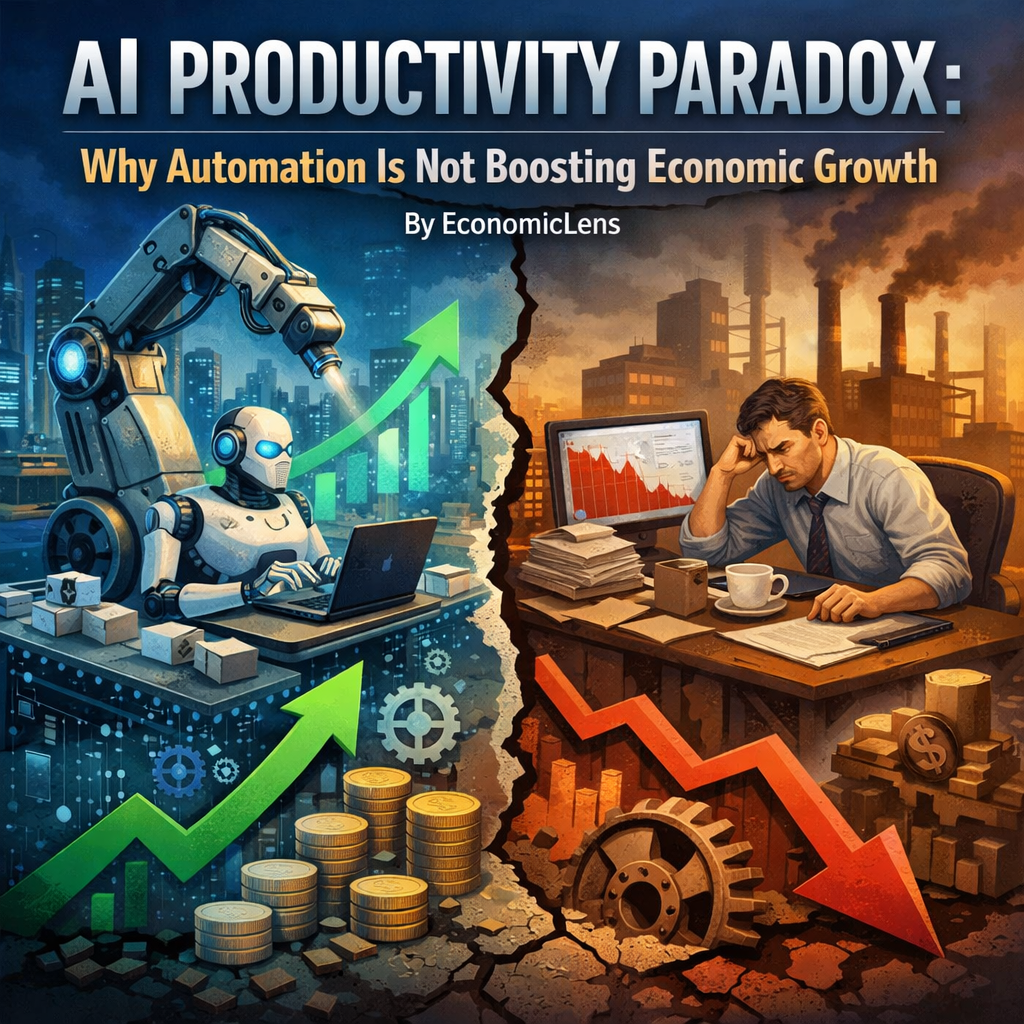
The AI productivity paradox refers to the persistent gap between rapid advances in artificial intelligence and weak aggregate productivity growth. Despite large-scale automation and digital investment, economic expansion remains subdued due to structural rigidities, unequal technology diffusion, labor displacement, and demand-side constraints within modern economies.
Introduction: Conceptualizing the AI Productivity Paradox
The AI productivity paradox represents a persistent anomaly in contemporary macroeconomic analysis. Despite rapid progress in artificial intelligence, machine learning, and automation technologies, aggregate productivity growth has remained subdued across advanced and developing economies. This divergence challenges conventional economic theory, which traditionally links technological advancement to sustained improvements in efficiency, output, and living standards.
From a macroeconomic perspective, productivity growth constitutes the primary driver of long-term economic expansion. However, since the mid-2000s, productivity growth in many OECD economies has slowed markedly, even as digital technologies have diffused rapidly across production systems (https://www.oecd.org). This temporal coincidence suggests that technological intensity alone does not guarantee positive aggregate outcomes.
Therefore, the paradox reflects deeper structural conditions. Institutional arrangements, market concentration, labor dynamics, and demand-side constraints collectively mediate the relationship between automation and economic growth.
Historical Comparison: Technology, Diffusion, and Productivity
Historically, major technological revolutions generated productivity gains only after prolonged adjustment periods. Electrification, mechanization, and information technology required complementary investments in physical infrastructure, workforce skills, and organizational transformation before their full economic benefits materialized.
In contrast, the automation productivity paradox is characterized by uneven diffusion. While frontier firms achieve significant efficiency gains through AI deployment, the majority of firms experience limited productivity improvement. This divergence creates a dual economy in which technological progress remains localized rather than systemic.
Moreover, earlier technological transitions expanded labor demand alongside productivity. Automation-driven growth, by contrast, increasingly substitutes for routine labor. Consequently, the traditional linkage between productivity, employment expansion, and income growth has weakened, limiting aggregate output gains.
Structural Explanations for the AI Productivity Paradox
-
Capital Concentration and Misallocation
A fundamental contributor to the AI productivity paradox is the concentration of capital and technological capability. Artificial intelligence adoption is dominated by large firms with access to proprietary datasets, advanced computing infrastructure, and specialized technical expertise.
This concentration inhibits competitive diffusion. Smaller firms face prohibitive entry costs, limited access to skilled labor, and restricted data availability. As a result, productivity dispersion widens across firms and sectors, weakening aggregate performance. The International Monetary Fund identifies capital misallocation and market concentration as persistent constraints on productivity growth (https://www.imf.org).
Thus, automation amplifies firm-level profitability while generating limited economy-wide productivity spillovers.
-
Labor Displacement and Weak Complementarity
Automation increasingly replaces routine cognitive and administrative tasks. However, the creation of complementary high-productivity employment has proceeded slowly. Consequently, displaced workers often transition into lower-productivity service sectors.
This employment reallocation depresses aggregate productivity metrics. While automation raises output per worker in specific firms, economy-wide averages stagnate due to sectoral composition effects. In fact, contemporary research highlights how automation and digital adoption exacerbate job displacement and income inequality across skill groups, reinforcing structural labor market challenges (https://economiclens.org/ai-and-automation-navigating-job-displacement-economic-inequality-in-2026/).
Empirical evidence from the International Labour Organization indicates that AI-intensive economies exhibit rising job polarization and constrained wage growth for middle-income workers (https://www.ilo.org).
Therefore, the labor market adjustment process weakens the productivity-enhancing potential of automation.
-
Organizational and Institutional Constraints
Technological capability alone does not ensure productivity gains. Firms must redesign workflows, managerial structures, and incentive mechanisms to fully exploit automation.
In practice, many organizations deploy AI incrementally. Automation often digitizes existing inefficiencies rather than transforming production models. Consequently, marginal efficiency improvements fail to translate into substantial productivity gains.
The OECD emphasizes that differences in managerial quality and organizational capital explain a significant share of productivity variation across firms (https://www.oecd.org). Institutional rigidity therefore remains a central obstacle.
Furthermore, educational systems and workforce training paradigms struggle to keep pace with technological acceleration, affecting human capital formation and adaptability. This phenomenon contributes to persistent productivity lags as workers lack the skills necessary to complement automated systems, creating misalignments between labor supply and technological demand (https://economiclens.org/education-disruption-decade-ai-tutors-e-learning-inequality-risks/).
Measurement Limitations and Productivity Assessment
Some economists argue that productivity gains from digital technologies are understated due to measurement limitations. Many AI-driven services generate consumer surplus that is poorly captured by traditional GDP metrics.
Nevertheless, measurement error alone cannot explain prolonged stagnation. Declining business dynamism, reduced investment spillovers, and falling labor income shares indicate structural impediments to growth (https://www.worldbank.org).
Accordingly, the AI productivity paradox reflects substantive economic constraints rather than purely statistical distortions.
Distributional Dynamics and Aggregate Demand
Automation disproportionately benefits capital owners and highly skilled workers. As income inequality rises, aggregate demand weakens. Firms, in turn, reduce incentives to expand productive capacity.
This demand-side constraint reinforces low-growth equilibria. Productivity-enhancing technologies fail to stimulate output when purchasing power remains concentrated. UNCTAD highlights rising market power and declining wage shares as structural barriers to sustainable growth (https://unctad.org).
Thus, distributional dynamics play a critical role in shaping productivity outcomes.
Policy Implications of the AI Productivity Paradox
Addressing the AI productivity paradox requires policy interventions that extend beyond technological acceleration. First, governments must promote technology diffusion through shared digital infrastructure, open data initiatives, and SME access to AI tools.
Second, labor market institutions must facilitate reskilling and mobility. Targeted education reforms and lifelong learning programs are required to ensure that workers can contribute effectively to AI-augmented production.
Third, competition policy must address excessive market concentration. Dynamic competition is essential for productivity spillovers and innovation-led growth.
Finally, public investment in human capital formation, especially through equitable access to high-quality education, remains essential to mitigate the long-term effects of automation on labor markets and productivity differentials.
Conclusion: Technology as a Conditional Growth Driver
The AI productivity paradox underscores a fundamental economic insight. Technology does not autonomously generate growth.
Automation can raise efficiency within individual firms. However, without institutional alignment, equitable distribution, and demand expansion, aggregate productivity gains remain limited.
Ultimately, artificial intelligence must be embedded within supportive economic, social, and regulatory structures to translate innovation into sustained and inclusive growth. The paradox serves as a reminder that technology’s economic effects are conditioned by broader structural forces rather than by innovation alone.