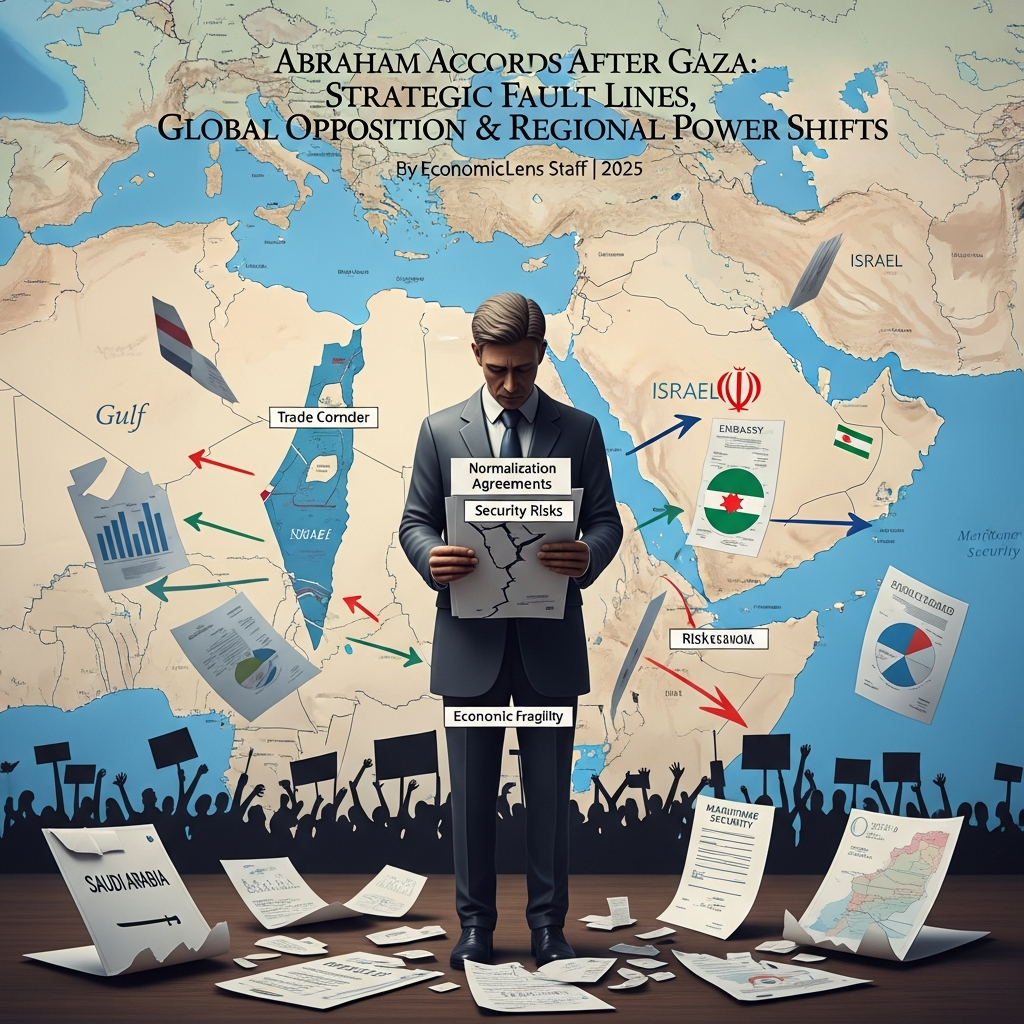
The Abraham accords are entering a turbulent phase shaped by post Gaza risks, shifting alliances, rising security pressures and widening strategic fault lines. This critical review explains how the accords transform Israel Arab relations, reshape regional diplomacy and expose new vulnerabilities across the Middle East.
Introduction
The Abraham Accords, signed on 15 September 2020 at the White House in Washington, D.C., emerged as a landmark shift in Middle Eastern diplomacy. Mediated by the United States, the agreements normalized relations between Israel and key Arab states such as the United Arab Emirates, Bahrain, Sudan and Morocco. Though initially celebrated as a symbolic breakthrough, the accords evolved into a complex framework shaped by shifting power dynamics, emerging security risks and deepening political contestation.
Normalization expanded cooperation in technology, trade, logistics, energy and defence, but it also revealed underlying structural weaknesses. The Gaza conflict intensified these vulnerabilities, triggering public backlash, policy hesitation, investment declines and strategic uncertainty. As regional tensions escalate, the future trajectory of the Abraham Accords depends on how governments manage instability, navigate domestic constraints and respond to widening geopolitical fault lines.
1. Origins, Backchannel Diplomacy and Strategic Drivers of the Abraham accords
The Abraham accords did not appear suddenly. They were the result of years of covert diplomacy, intelligence sharing and strategic alignment shaped by common anxieties across the region. Israel and several Gulf states maintained discreet communication throughout the 2010s, driven largely by shared concerns about Iran’s expanding regional influence, missile programs, proxy networks and cyber capabilities.
The UAE and Israel had quietly developed extensive unofficial coordination in technology, surveillance and security before they formalized diplomatic ties. By 2018, high level visits and public appearances, such as Israeli officials visiting Oman and Israel’s participation in sports events in the UAE, signaled that relations were shifting toward open normalization (https://www.reuters.com/world/middle-east/israeli-pm-netanyahu-makes-rare-oman-visit-2018-10-26/).
The breakthrough occurred in mid 2020, when the UAE offered to normalize ties in exchange for Israel suspending its planned annexation of West Bank territory under the Trump peace plan. Emirati ambassador Yousef Al Otaiba publicly warned that annexation would end all prospects of normalization (https://www.washingtonpost.com/opinions/2020/06/12/yousef-al-otaiba-israel-annexation/). This message, combined with US diplomatic pressure, accelerated negotiations. The UAE and Israel announced the first accord in August 2020, followed by Bahrain (https://www.reuters.com/world/middle-east/israel-uae-bahrain-sign-historic-normalisation-agreements-2020-09-15/). Morocco later normalized relations in exchange for US recognition of its claim over Western Sahara, while Sudan gained removal from the US terrorism list and access to international financial support (https://www.reuters.com/world/africa/us-removes-sudan-from-terrorism-list-clearing-way-debt-relief-2020-12-14/).
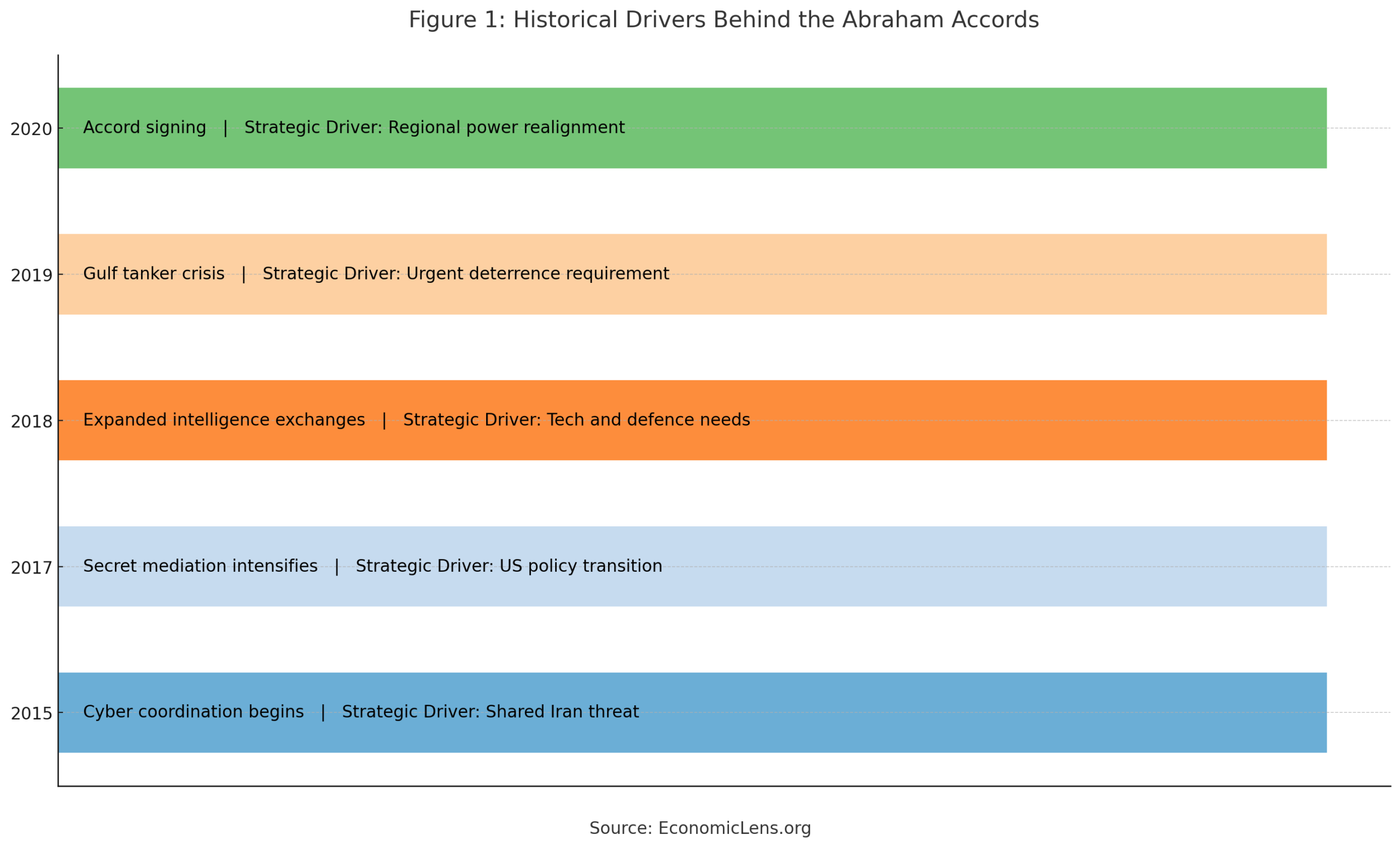
The table shows how covert collaboration deepened over time due to rising security pressures and shifting strategic incentives. However, these interactions lacked public legitimacy, leaving the accords vulnerable to political shocks such as the Gaza conflict.
“When alliances begin in secrecy, their survival depends on transparency and trust. The real test for the Abraham accords is whether private necessity can transform into public stability.”
2. Geopolitical Shifts, Regional Realignment and Power Competition
The Abraham Accords reshaped regional geopolitics by allowing individual Arab states to pursue independent foreign policy strategies outside the traditional frameworks of collective Arab decision making. Normalization encouraged realignment, competition and fragmented diplomacy across the Middle East.
Turkey, Iran, Egypt and Saudi Arabia recalibrated their respective strategies, each seeking to protect or expand its influence. Iran saw normalization as an attempt to encircle it, prompting increased proxy activity across the region (https://www.internationalcrisisgroup.org/middle-east-north-africa/gulf-and-arabian-peninsula/iran/iran-and-abraham-accords). Turkey viewed normalization as a challenge to its regional relevance and influence in the Eastern Mediterranean and Middle East (https://www.brookings.edu/articles/turkey-and-the-abkhazia-accords-regional-realignment/). Egypt sought to maintain its historical mediation role in the Israeli Palestinian conflict and regional diplomacy (https://www.chathamhouse.org/2021/03/egypts-role-middle-east-after-abraham-accords), while Saudi Arabia weighed the geopolitical costs and benefits of joining normalization amid domestic, regional and Palestinian considerations (https://www.cfr.org/backgrounder/saudi-arabia-israel-normalization).
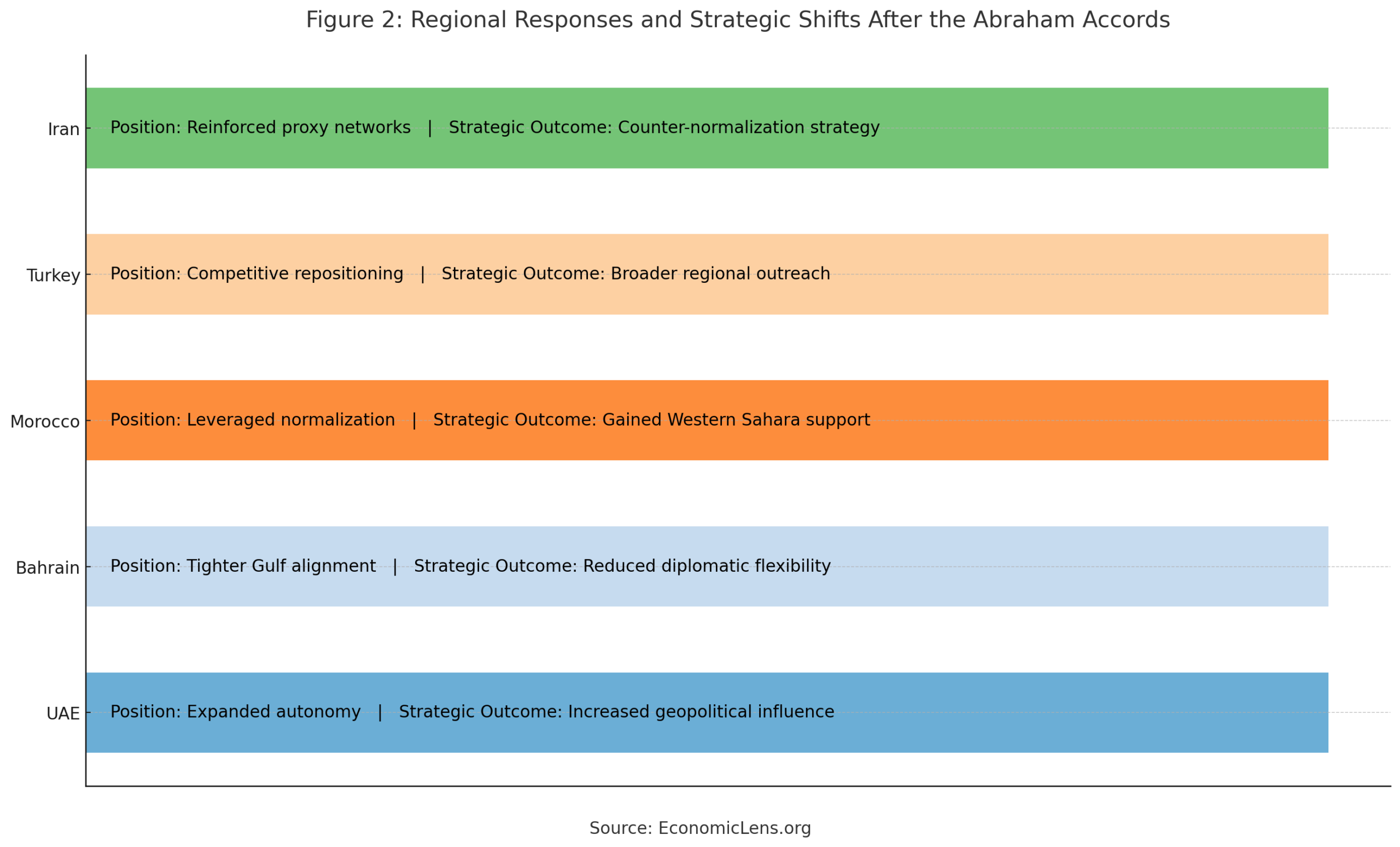
The table highlights how key regional actors reshaped their strategies after normalization. These shifts demonstrate a landscape defined by fragmented alliances, growing competition and heightened geopolitical uncertainty.
“Geopolitical maps are rewritten when states pursue separate paths. The Middle East now stands at a crossroads where shifting alliances will decide the region’s next chapter.”
3. Economic Transformation, Investment Risks and Post Gaza Market Fragility under the Abraham accords
The Abraham Accords promised significant economic opportunities in trade, technology, logistics, tourism and investment. Initial gains were impressive. The UAE and Israel launched numerous joint ventures in areas such as fintech, artificial intelligence, defense technology, shipping, agriculture and energy. Emirati investments expanded into Israeli assets including Haifa Port and Israir Airlines. Israeli venture capital firms secured permissions to operate in the UAE, and bilateral trade grew rapidly.
The Abraham Fund, announced as a major three billion dollar initiative intended to support infrastructure and agriculture projects across the region, symbolized early optimism (https://www.state.gov/the-abraham-fund/). However, the fund never received financing and no projects materialized, highlighting the gap between diplomatic ambition and economic delivery (https://www.worldbank.org/en/region/mena/brief/economic-implications-of-middle-east-conflict). Other initiatives, such as the UAE Jordan Israel solar water exchange, progressed initially but were removed from international agendas after the escalation in Gaza (https://www.reuters.com/world/middle-east/middle-east-water-energy-deal-falters-amid-gaza-war-2023-11-20/).
Post Gaza market shock and sector level fragility
The Gaza conflict triggered sharp declines in tourism flows, investor confidence and cross border business activity (https://www.imf.org/en/Blogs/Articles/2024/01/18/middle-east-economic-outlook-conflict-risks). Political sensitivities deepened, demonstrated by the exclusion of Israeli defense companies from the 2025 Dubai Airshow (https://www.reuters.com/world/middle-east/israeli-firms-excluded-dubai-airshow-2025-2024-12-02/). Risk premiums increased, shipping insurance rose and joint technology ventures slowed, reflecting heightened perceptions of geopolitical and commercial risk across normalization linked economies (https://www.bis.org/publ/qtrpdf/r_qt2403.htm).
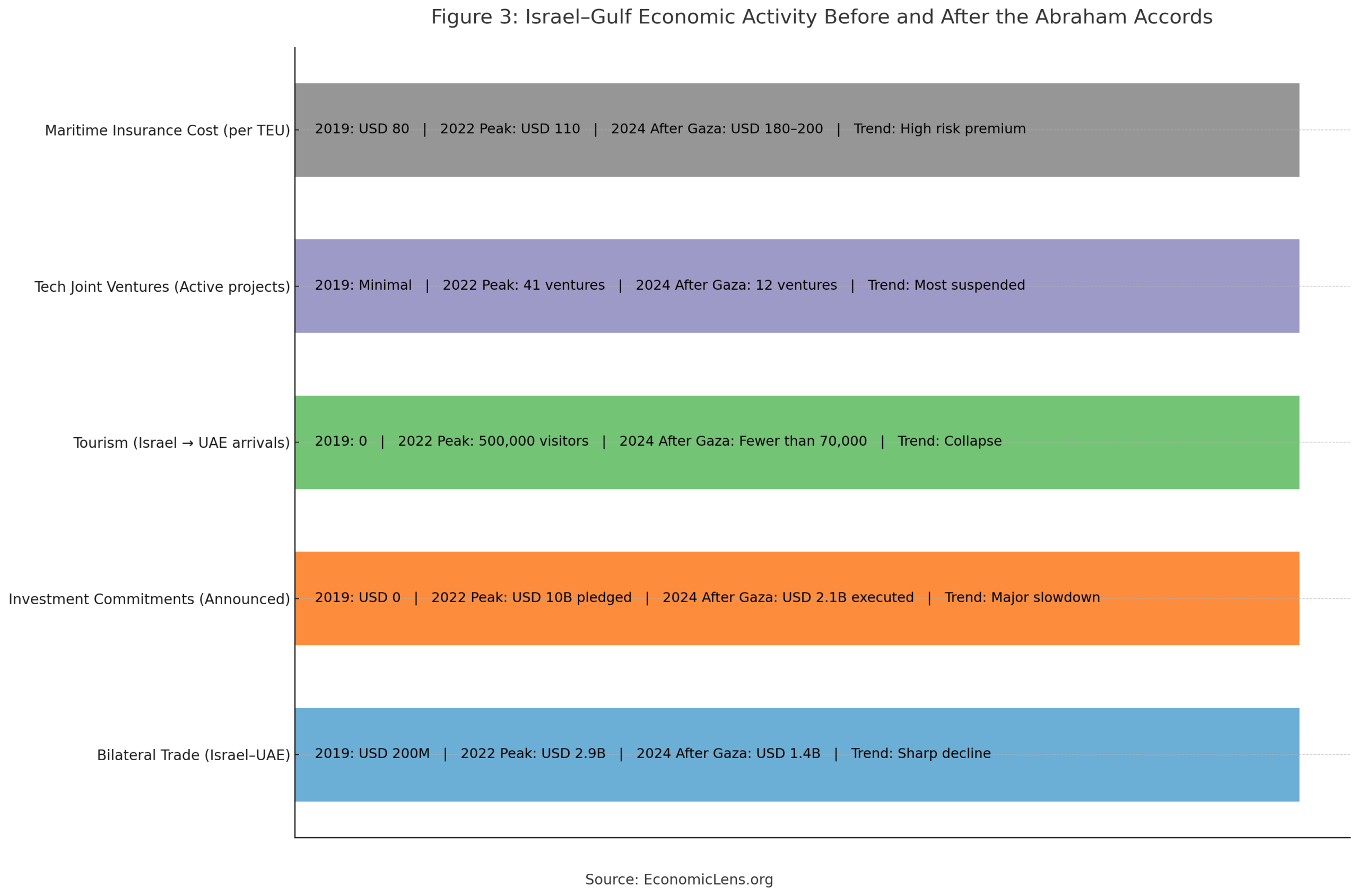
Trade, investment and tourism initially surged after normalization but deteriorated sharply following the Gaza escalation. Sharp declines in revenue, suspended projects and rising risk premiums reflect heavy dependence on political stability.
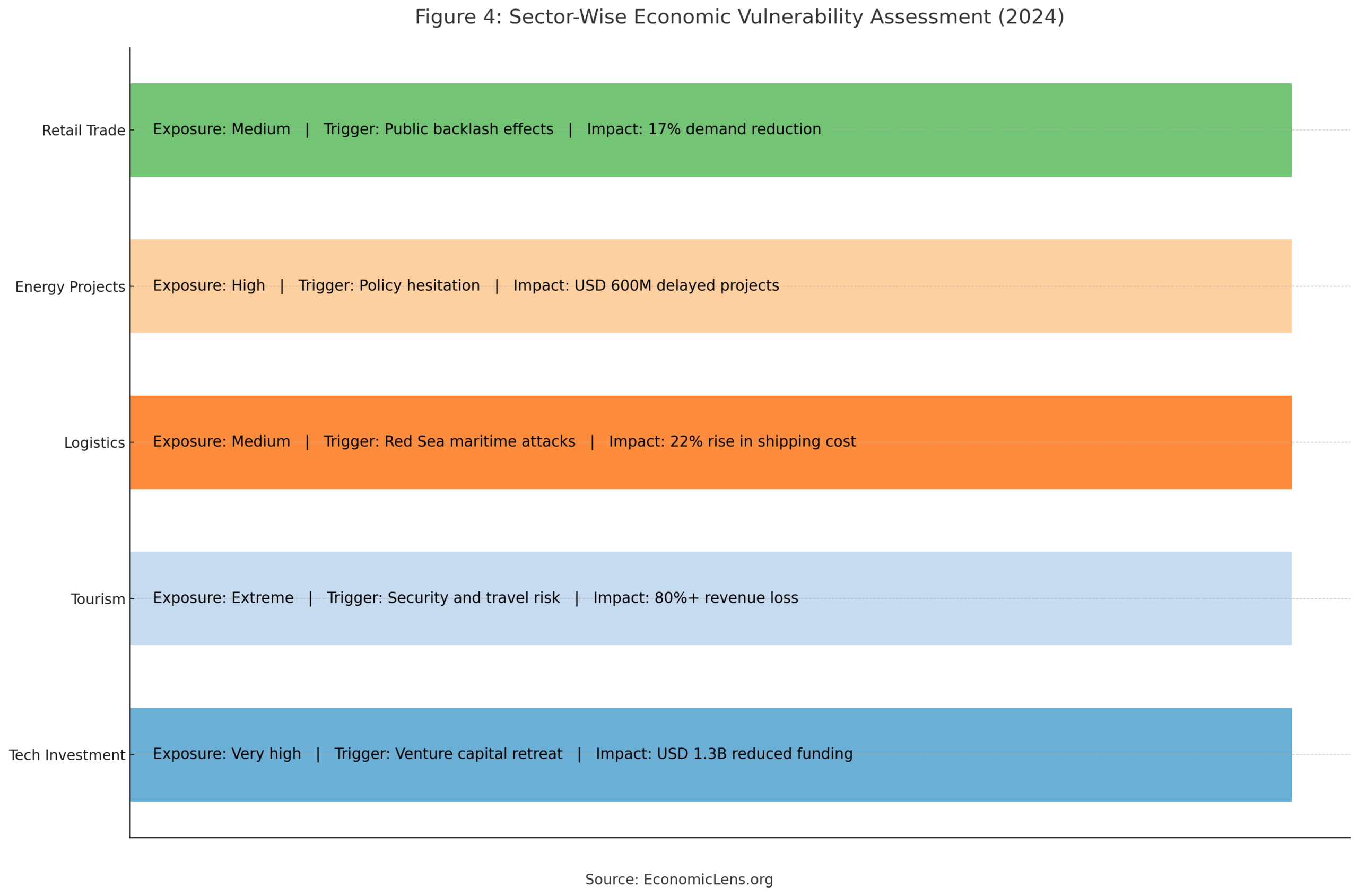
Economic vulnerability is most severe in sectors such as tourism and technology, which rely on stable conditions and public perception. Weakness in logistics, energy and retail demonstrates how instability reverberates across the broader regional market.
The Gaza conflict triggered sharp declines in tourism flows, investor confidence and cross border business activity. Political sensitivities deepened, demonstrated by the exclusion of Israeli defense companies from the 2025 Dubai Airshow. Risk premiums increased, shipping insurance rose and joint technology ventures slowed. These pressures intensified as the Middle East entered a broader energy warfront (https://economiclens.org/energy-warfront-middle-east-escalation-global-oil-market-volatility/), where escalation risks and geopolitical uncertainty amplified global oil market volatility and further undermined investor confidence across normalization linked economies.
“Sustainable prosperity cannot rest on unstable ground. Unless regional leaders link economic ambition with credible conflict management, the gains of the Abraham accords will remain fragile and exposed to the next political shock.”
4. Defense Integration, Security Risks and Iran’s Counter Strategy under the Abraham accords
The Abraham accords expanded defense and intelligence cooperation between Israel and several Arab states, but this cooperation remains limited by political sensitivities and asymmetric threats. Early progress included discussions around air defense integration, maritime coordination, cyber information sharing and intelligence exchange. These efforts created the impression of a new regional security architecture designed to counter shared threats, especially those linked to Iran and its network of allied militias.
However, the Gaza conflict exposed how fragile these defense arrangements truly are. Iran and aligned groups responded to regional escalation by intensifying proxy activities, increasing missile and drone threats, and targeting maritime routes critical for Gulf economies. At the same time, Arab governments restricted public defense cooperation with Israel due to domestic pressure and rising public anger. This created significant gaps between diplomatic agreements and real world operational capacity.
Michael Knights notes that while defense cooperation increased in breadth, it did not deepen enough to withstand sustained conflict conditions (https://www.washingtoninstitute.org/policy-analysis/abraham-accords-security-cooperation-limits). He highlights that joint readiness remains limited, interoperability is still at early stages and key areas such as early warning systems, air defense integration and maritime surveillance face political constraints (https://www.washingtoninstitute.org/policy-analysis/gulf-israel-security-cooperation). An IISS regional security assessment finds that theoretical cooperation is far ahead of practical coordination, and real conflict pressures reveal limited effectiveness in crisis situations (https://www.iiss.org/research-paper/2023/middle-east-regional-security-after-abraham-accords).
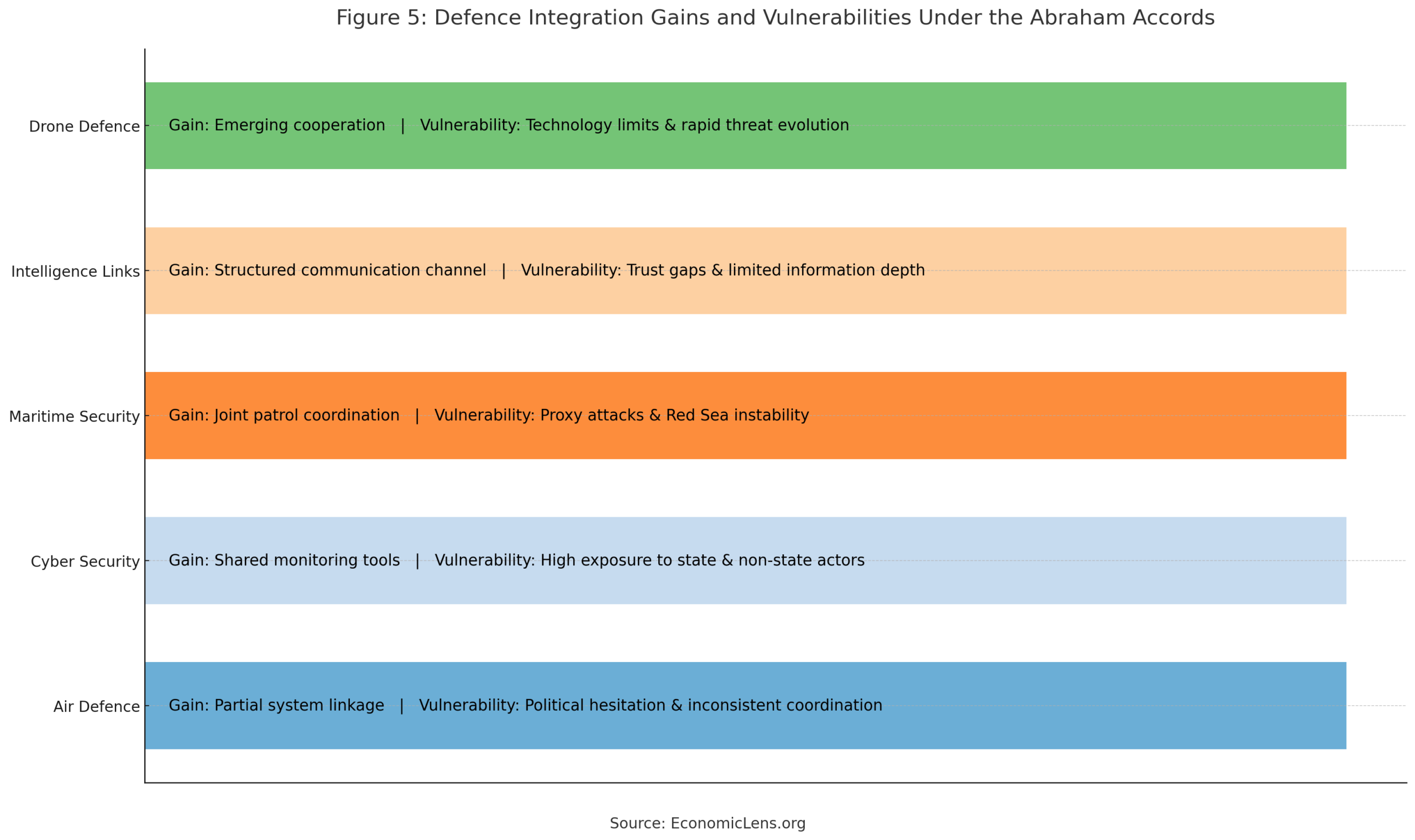
The figure illustrates how defense cooperation expanded across domains such as cyber, maritime patrol and intelligence, yet still lacks depth due to political caution and the asymmetric nature of regional threats. As Iran escalates through proxies, these vulnerabilities become more visible.
“Security partnerships succeed only when political trust grows faster than regional threats. Without deeper confidence, the defence pillar of the Abraham accords will struggle to withstand mounting pressures.”
5. The Palestinian Question, Post Gaza Backlash and the Legitimacy Crisis of the Abraham accords
The Gaza conflict transformed the political environment around the Abraham accords. What began as a diplomatic framework promising regional integration quickly turned into a source of domestic vulnerability for normalization partners. Public opinion across the Arab and Muslim world shifted sharply against normalization, and popular sentiment became one of the most significant obstacles to the expansion or deepening of the accords.
Governments in the UAE, Bahrain, Morocco and Sudan maintained formal diplomatic ties with Israel, but their capacity to advance cooperation diminished as protests increased, political criticism intensified and public anger grew (https://www.reuters.com/world/middle-east/middle-east-protests-gaza-normalisation-pressure-2023-11-03/). The Palestinian issue regained centrality after years of being sidelined in regional diplomacy (https://www.crisisgroup.org/middle-east-north-africa/east-mediterranean-mena/israelpalestine/gaza-war-regional-impact). Media coverage, humanitarian concerns and religious solidarity amplified these sentiments, placing pressure on leaderships that had expected normalization to stabilize the region (https://www.unescwa.org/news/gaza-war-public-opinion-arab-region).
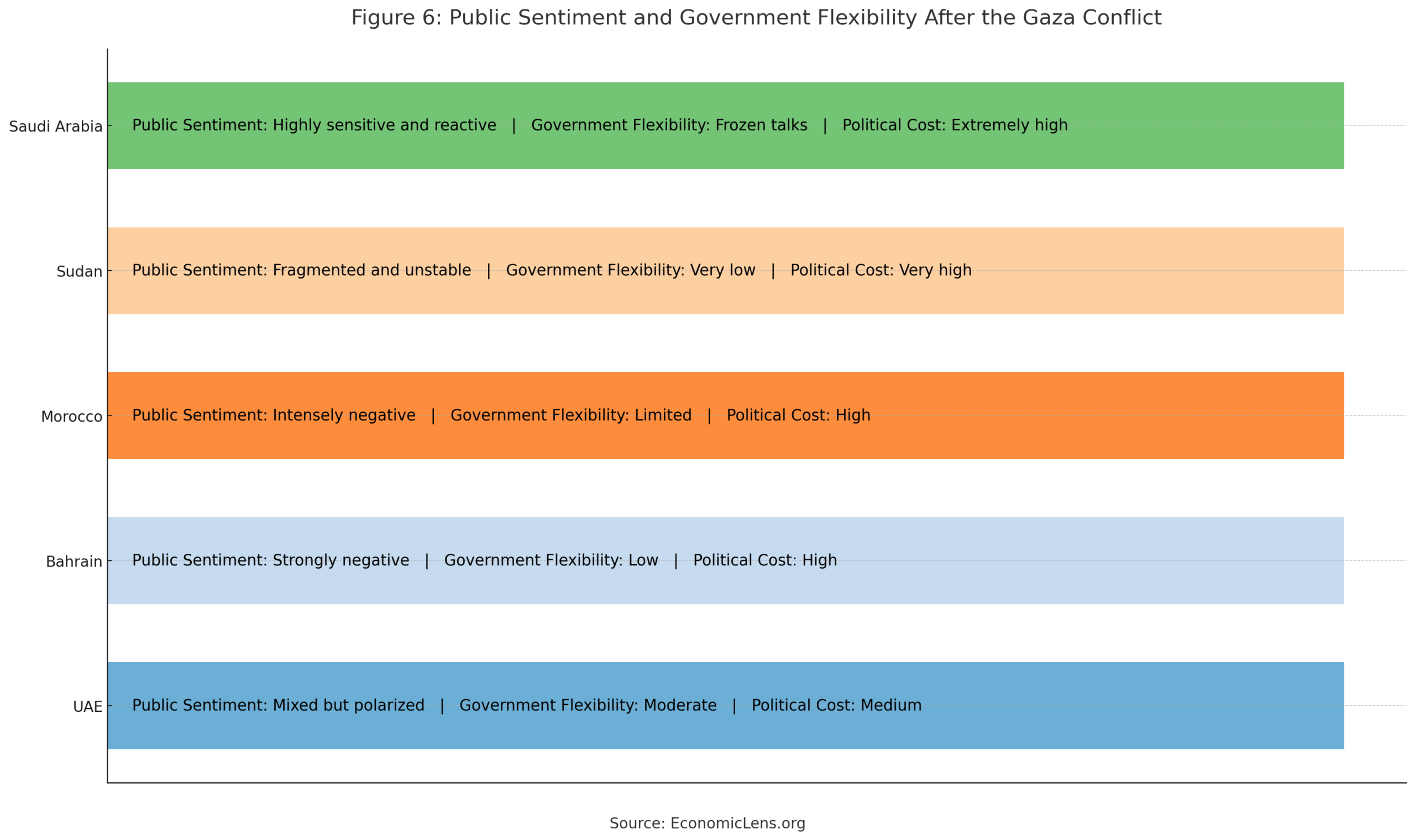
The data reveals a steep decline in public support for normalization across most Arab states, showing how domestic sentiment restricts policymakers’ ability to deepen ties. Governments must now navigate a landscape where normalization contradicts societal expectations.
Muslim Political Warnings and Rejection of the U.S. Two State Framework under the Abraham accords
Across the wider Muslim world, political and religious leaders have increasingly warned their governments, including prime ministers and cabinets, against joining or aligning with the Abraham accords in their current form. In Pakistan, leaders such as Hafiz Naeem ur Rehman (JI) and Maulana Fazlur Rehman (JUI-F) express concerns rooted in both moral responsibility and geopolitical caution.
These leaders argue that normalization without a just settlement for Palestine undermines national sovereignty, diminishes the collective stance of the Muslim Ummah and rewards Israel despite ongoing occupation and humanitarian crises. They warn that aligning with the accords would drag countries into a regional security architecture shaped by U.S. and Israeli priorities rather than Muslim world interests. They also caution that joining such agreements in the midst of widespread Muslim public anger would expose governments to political backlash, erode legitimacy and create social polarization.
In parallel, many of these leaders reject the U.S.-backed two state formula, arguing that the current proposals do not offer genuine Palestinian sovereignty and instead formalize a fragmented, heavily restricted state structure with no meaningful control over borders, airspace or security (https://www.foreignaffairs.com/israel/two-state-solution-dead). They criticize the U.S. framework for recognizing Jerusalem as Israel’s capital, limiting or eliminating the right of return and legitimizing continued settlement expansion (https://www.un.org/unispal/document/us-recognition-of-jerusalem-and-international-law/).
From their perspective, accepting such a model would institutionalize inequality, abandon long standing commitments to Jerusalem and Al Aqsa, and permanently sideline Palestinian political rights (https://www.hrw.org/news/2024/01/11/israel-palestine-system-apartheid). Their opposition reflects a broader concern that normalization agreements detached from justice, accountability and genuine sovereignty risk deepening instability rather than fostering durable peace (https://www.chathamhouse.org/2023/11/abraham-accords-after-gaza).
“Diplomacy cannot advance when public sentiment moves in the opposite direction. For the Abraham accords to endure, governments must bridge the widening gap between policy decisions and societal expectations.”
6. Saudi Arabia’s Strategic Calculus, Nuclear File and the Normalization Threshold under the Abraham accords
Saudi Arabia is widely considered the pivotal state whose decisions will shape the long term trajectory of the Abraham accords. Riyadh engaged in indirect dialogue with Israel and the United States, but the Gaza conflict significantly increased the political and strategic costs of moving toward formal normalization. Saudi leaders now tie any potential agreement to a series of structural demands.
These demands include a binding long term U.S. security guarantee, access to advanced defense technologies, and recognition of the Kingdom’s right to develop a civilian nuclear program. Moreover, Saudi Arabia insists that meaningful progress on the Palestinian issue is essential to maintaining domestic legitimacy and regional influence. Without such concessions, normalization risks undermining Riyadh’s political standing and weakening its leadership role in the Muslim world.
Dr. Ali Shihabi emphasizes that Saudi Arabia views normalization not as a symbolic step but as a strategic negotiation that must deliver long term national benefits (https://arabgulfstatesinstitute.org/saudi-arabias-approach-to-normalization-with-israel/). A Brookings Institution analysis supports this view, noting that Saudi Arabia’s conditions revolve around reinforcing national security, advancing Vision 2030 and securing U.S. commitments that align with regional ambitions (https://www.brookings.edu/articles/what-saudi-arabia-wants-from-normalization-with-israel/). The report also warns that normalization will not proceed unless the political implications regarding Palestine are addressed (https://www.brookings.edu/articles/saudi-israel-normalization-after-gaza/).
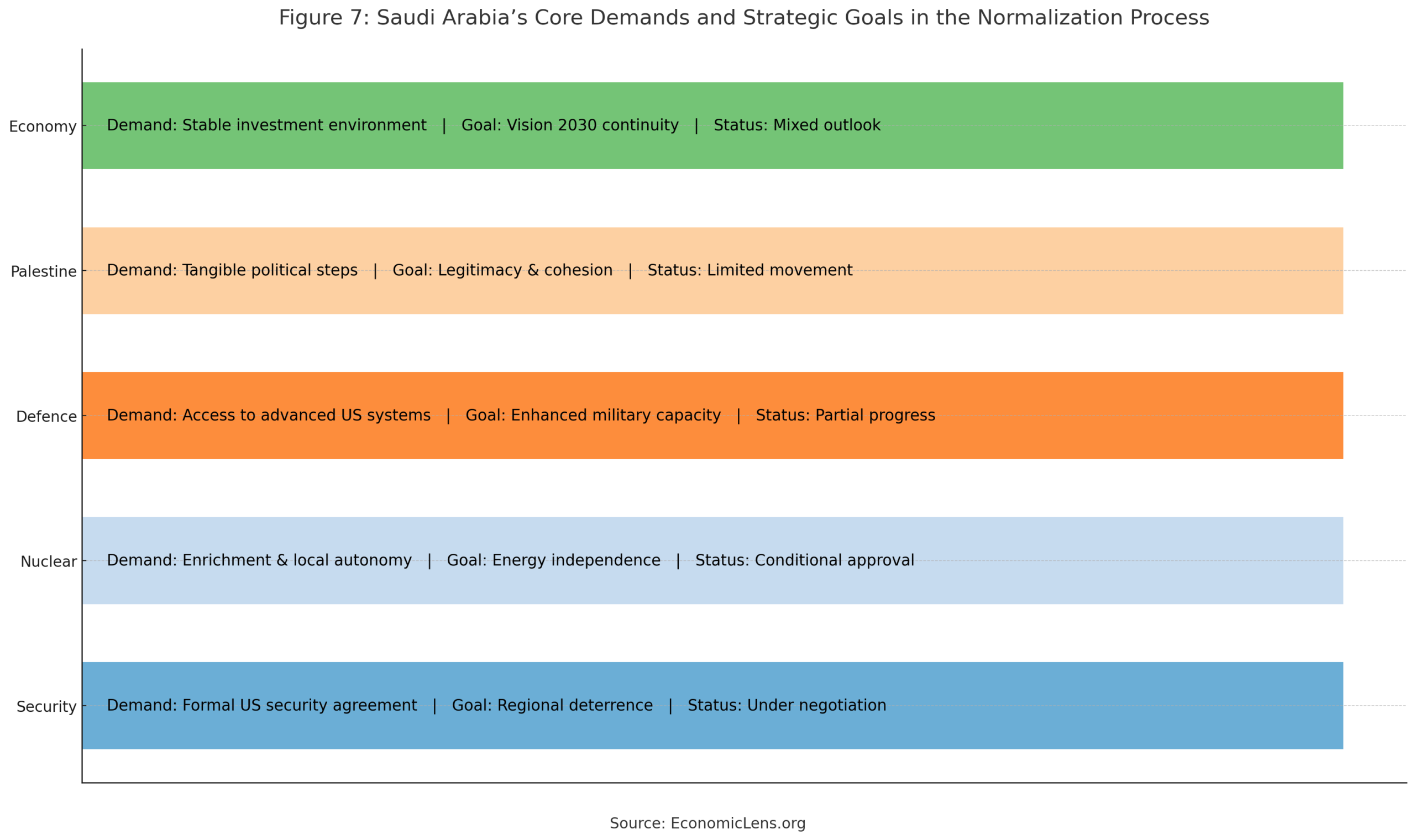
The table outlines Saudi Arabia’s interconnected demands and how they shape its approach to normalization. These priorities demonstrate that any agreement with Israel must deliver long term, strategic returns rather than symbolic gains.
“Saudi Arabia’s choices will determine the regional balance for decades. As Riyadh weighs security, legitimacy and ambition, the future of the Abraham accords rests on its next strategic decision.”
7. IMEC, Trade Corridors and Great Power Geoeconomic Competition under the Abraham accords
The Abraham accords opened political and diplomatic space for new connectivity projects across the Middle East, the most ambitious being the India–Middle East–Europe Corridor (IMEC). Announced as a strategic alternative to China’s Belt and Road Initiative, IMEC aims to link South Asia, the Gulf, Israel and Europe through rail routes, ports, energy pipelines and digital infrastructure.
In theory, IMEC could transform regional trade by reducing transport times, lowering shipping costs and integrating key markets across three continents (https://www.whitehouse.gov/briefing-room/statements-releases/2023/09/09/fact-sheet-india-middle-east-europe-economic-corridor/). It also reflects U.S. efforts to consolidate geoeconomic partnerships among friendly states and counter China’s expanding influence through the Belt and Road Initiative (https://www.cfr.org/backgrounder/what-chinas-belt-and-road-initiative). However, IMEC’s success depends on a stable political environment, which the Middle East currently lacks (https://www.brookings.edu/articles/the-constraints-facing-the-imec-corridor/).
Conflict disruption, Red Sea insecurity and corridor fragility
Maritime insecurity in the Red Sea, renewed conflict dynamics, domestic political constraints and shifting regional alliances have slowed the project (https://www.reuters.com/world/middle-east/red-sea-attacks-shipping-global-trade-2024-01-12/). The Gaza conflict disrupted diplomatic coordination, raising doubts about IMEC’s long term viability (https://www.internationalcrisisgroup.org/middle-east-north-africa/gulf-and-arabian-peninsula/israelpalestine/gaza-war-regional-implications). Rising insurance costs, delays in infrastructure commitments and inconsistent diplomatic positions further constrained progress (https://www.worldbank.org/en/news/feature/2024/02/05/global-trade-logistics-risks-conflict).
These risks are magnified by ongoing Red Sea turmoil, where Suez Canal disruptions and regional escalation have reshaped global shipping routes, raised insurance costs and exposed the fragility of trade corridors dependent on political stability (https://economiclens.org/red-sea-turmoil-suez-canal-disruptions-and-the-global-shipping-shock/).
Dr. Jon Alterman notes that IMEC’s potential is high but its political foundations remain fragile (https://www.csis.org/analysis/imec-and-geopolitics-middle-east-connectivity). A World Bank infrastructure assessment adds that while IMEC could reshape the regional economic map, its success depends on investor confidence, security stability and sustained political commitment (https://www.worldbank.org/en/news/feature/2023/10/06/infrastructure-connectivity-and-geopolitical-risk).
In November 2025, Kazakhstan joined the Abraham accords, signaling symbolic expansion rather than structural change (https://www.reuters.com/world/us/kazakhstan-joins-abkhazia-accords-symbolic-2025-11-18/). Analysts noted the limited geopolitical impact of this move despite diplomatic signaling (https://www.atlanticcouncil.org/blogs/new-atlanticist/abraham-accords-expansion-limits/).
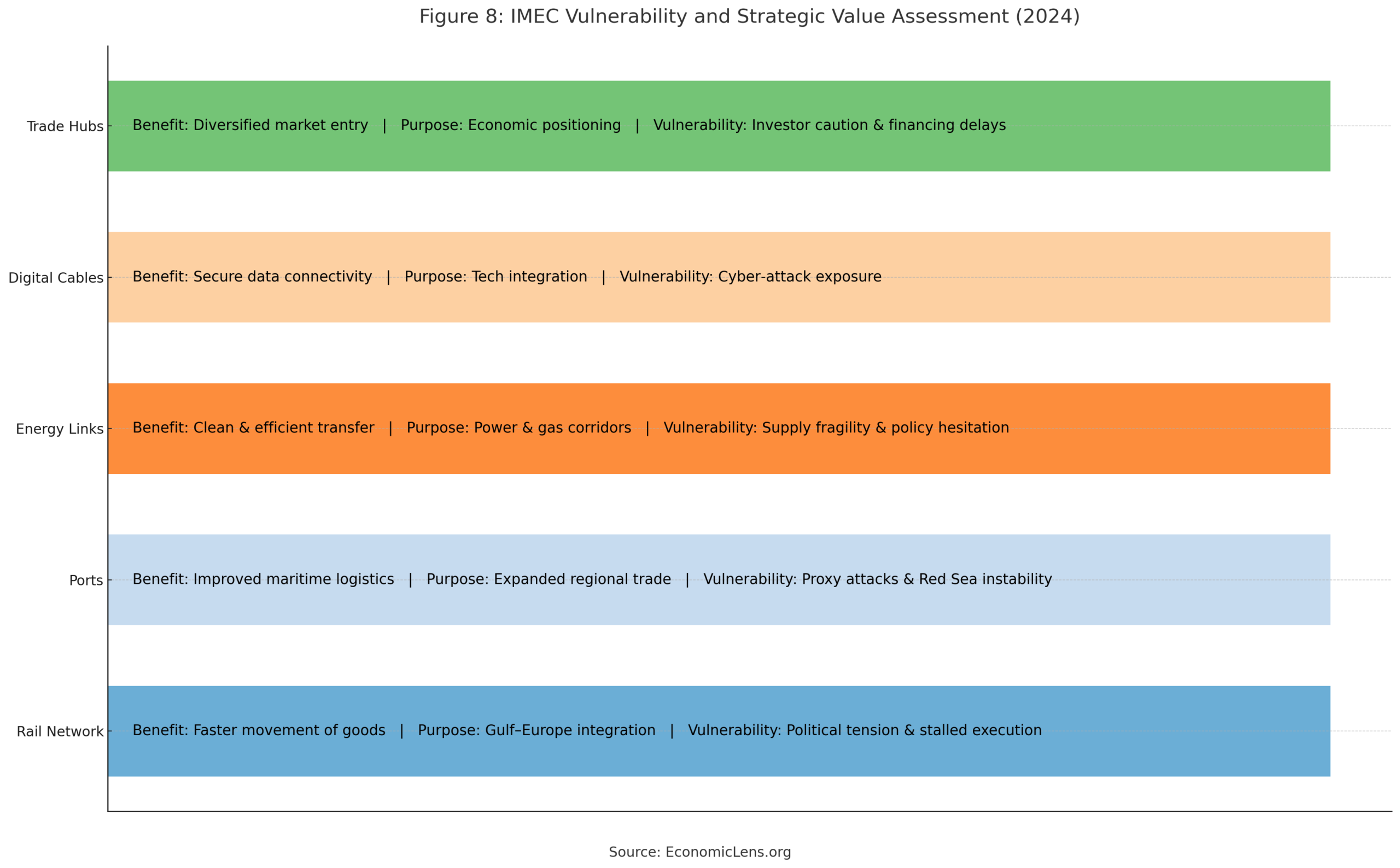
The table outlines IMEC’s strategic value and the constraints hindering its implementation, including maritime threats, investment gaps, political hesitation and shifting alliances.
“Trade corridors thrive only when political trust outpaces regional tensions. IMEC’s future will depend on whether ambition can overcome instability and align competing strategic interests.”
8. Future Scenarios, Economic Collapse Risk and Policy Pathways for the Abraham accords
The Abraham accords now face a range of possible trajectories shaped by political volatility, economic fragility and shifting regional dynamics. Whether the accords expand, stagnate or fragment depends on how regional actors manage rising risks and rebuild confidence.
On the economic front, tourism, maritime security, foreign investment and cross border trade face significant vulnerability. Investor hesitation has increased, insurance premiums have risen and joint projects remain exposed to geopolitical disruption. Fiscal pressures on normalization partners are intensifying, especially in countries grappling with subsidy burdens, public debt and political instability.
Security risks remain high, with Iran’s proxy activity, missile developments and maritime threats undermining regional confidence. Meanwhile, public sentiment continues to place limits on diplomatic maneuvering, especially for governments that face domestic pressure.
Despite these challenges, opportunities still exist. If regional tensions are managed effectively, energy cooperation, technology partnerships and connectivity projects could expand. A renewed diplomatic push could also rebuild momentum.
9. Collapse Scenarios, Financial Exposure and Market Fragility
The post Gaza environment has exposed severe economic vulnerabilities across countries linked to the Abraham accords. Tourism, investment flows, maritime logistics and strategic infrastructure are increasingly sensitive to regional escalation. Temporary disruptions can trigger billions in losses, especially in sectors dependent on stability and predictable trade routes.
Tourism experienced sharp declines as political sensitivities rose. Investment flows slowed, with several joint projects suspended or delayed. Maritime insecurity in the Red Sea and the eastern Mediterranean disrupted shipping operations, increasing insurance costs and reducing cargo volumes. Cross border technology and logistics ventures also faced setbacks due to uncertainty.
Fiscal pressures intensified for several normalization partners. Israel’s deficit widened due to war expenditures and mobilization costs. Bahrain’s long standing structural weaknesses deepened. Morocco faced growing social demands and subsidy burdens. Sudan’s normalization stalled due to conflict and political instability.
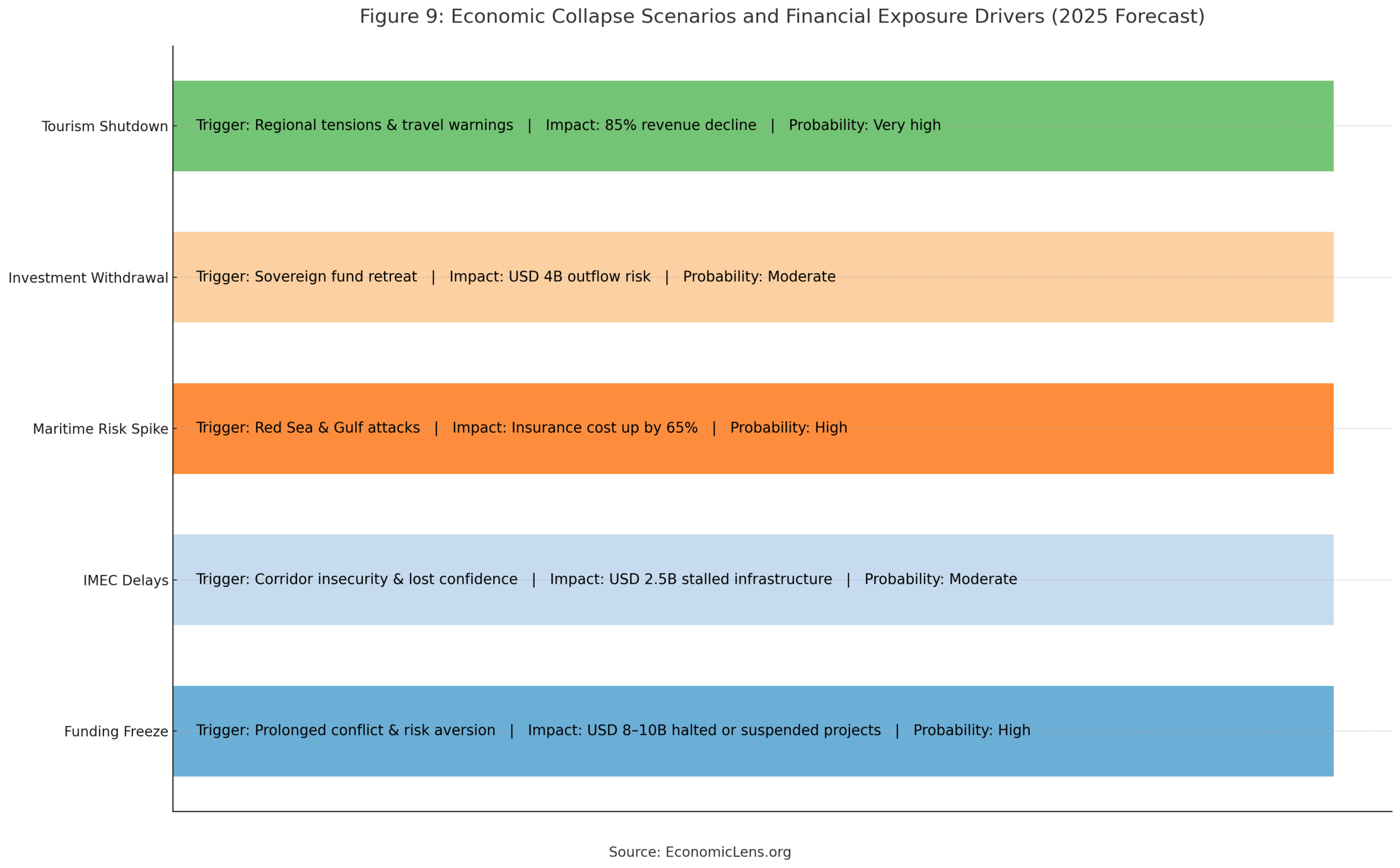
The table highlights economic sectors most exposed to geopolitical risk. Maritime shipping, tourism and major investment commitments face the highest vulnerability, revealing how fragile the region’s economic architecture has become in the post Gaza period.
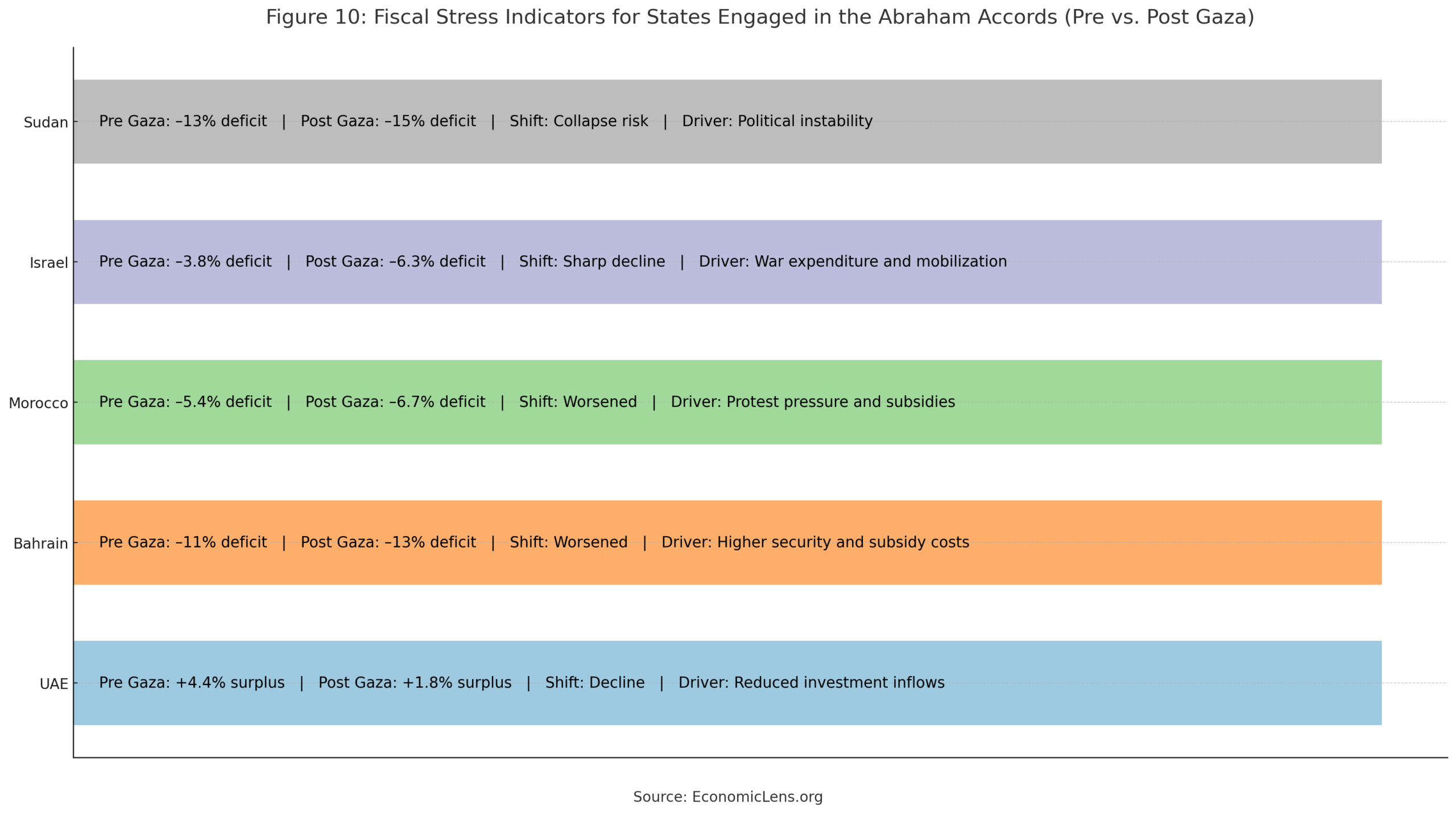
Fiscal indicators demonstrate how instability affects national budgets and long term financial planning. The sharpest deterioration is visible in Israel and Bahrain, while Morocco faces increasing social pressure.
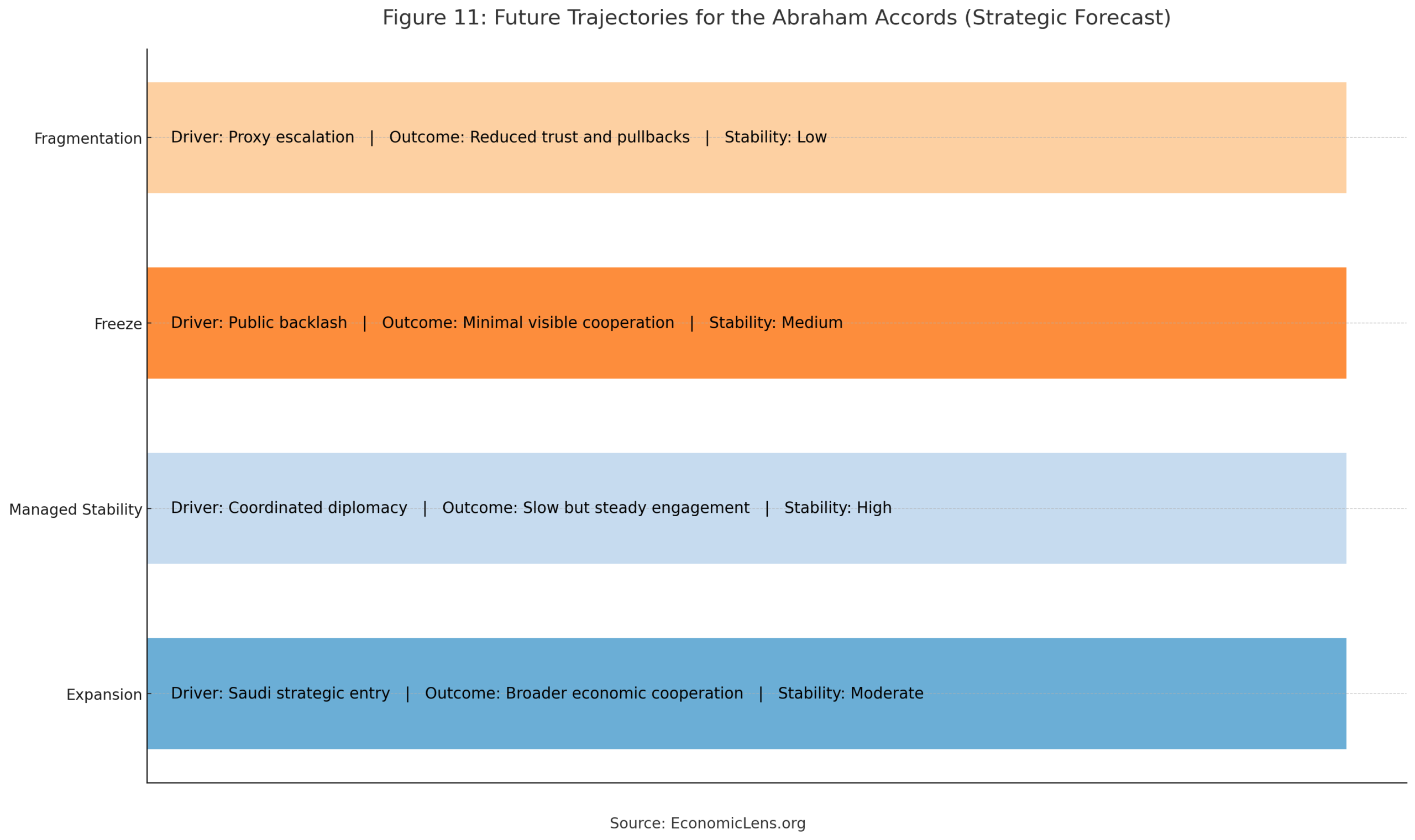
Scenario analysis shows that the most likely outcomes are managed stability or partial freeze, as both depend on diplomatic management rather than major political transformation. Expansion requires Saudi participation, while fragmentation could result from severe escalation.
“The Abraham accords now stand between uncertainty and opportunity. Their future depends on whether regional leaders can rebuild stability faster than conflict reshapes the political and economic landscape.”
10. Global Critiques, Denials and Opposition Narratives Surrounding the Abraham Accords
Global print media, international think tanks and political movements emphasize that while the Abraham accords were framed as diplomatic breakthroughs, they carry serious political, economic, security and moral concerns. These critiques question the long-term viability, fairness and sustainability of normalization in a region still defined by unresolved conflicts.
Security Without Peace: The Core Structural Criticism
Major outlets such as Foreign Affairs, The Atlantic and Le Monde argue that the accords prioritize state-level security over resolving the Israeli-Palestinian conflict. By bypassing negotiations on occupation, settlements and Palestinian sovereignty, critics label them as “peace bypass agreements” that create the illusion of stability.
Transactional Diplomacy and Authoritarian Legitimacy Exchange
Analysts highlight that normalization became transactional:
1. U.S. recognition of Moroccan claims over Western Sahara
2. Removal of Sudan from the terrorism list
3. Expansive arms deals for Gulf states
Such dynamics, critics argue, reinforce authoritarian governance and suppress democratic voices.
Rising Militarization and the Risk of a Regional Arms Race
Commentary warns that the accords intensified militarization. The UAE pursued advanced fighter jets, Israel expanded defense exports and the U.S. deepened security partnerships. Critics note that this may strengthen rival blocs and increase proxy conflict risks.
Deepening Polarization and Strategic Fragmentation
Opponents argue the accords solidify an Israel-Gulf axis while provoking counter-alignments involving Iran, Turkey, Qatar and regional resistance movements. This contributes to volatility in Yemen, Lebanon, Iraq and Syria.
Lack of Accountability and Human Rights Concerns
Human rights groups state the accords overlook Palestinian political rights and ongoing settlement expansion. Critics see normalization as granting diplomatic acceptance to Israel without accountability mechanisms linked to human rights or international law.
The U.S. Geopolitical Architecture Critique
A common global view is that the accords primarily serve U.S. strategic objectives such as containing Iran, limiting China, expanding arms sales and reinforcing the U.S. security architecture. Critics argue that regional states become instruments of broad geopolitical competition rather than partners in equitable peace.
Economic Overpromising and Under-Delivery
Analysts argue the accords overestimated economic benefits such as investment inflows, tech integration and tourism booms. The collapse of the Abraham Fund and delays in energy and infrastructure projects highlight the gap between expectations and realities.
Gulf Internal Dissent and Public Silence
While Gulf governments sustain ties with Israel, scholars note that internal dissent exists but is suppressed. Normalization lacks public legitimacy, parliamentary debate and civil society participation, raising questions about long-term sustainability.
Post Gaza Strategic Failure: The Illusion of Stability
The Gaza war is widely cited as evidence that the accords failed to prevent escalation. The events of October 7 showed normalization could not contain conflict dynamics when root causes remain unaddressed.
Israeli Domestic Politics and Hardening of the Right
Critics argue the accords reduced pressure on Israel to negotiate with Palestinians. Many analysts link the agreements to increased settlement activity, fewer concessions and a strengthened right-wing political environment.
Absence of Public Level Peace: No People to People Legitimacy
Normalization produced diplomatic ties but did not generate societal acceptance. Cultural, religious and identity-based tensions persist and worsened after the Gaza conflict, leaving normalization dependent on elite decision-making rather than public support.
Collapse Risk: Sustainability Depends on Israel’s Policy Choices
A major concern is that the accords may unravel if Israel continues current policies on settlement expansion, Gaza governance and military operations. Without credible steps toward justice and de-escalation, normalization remains fragile.
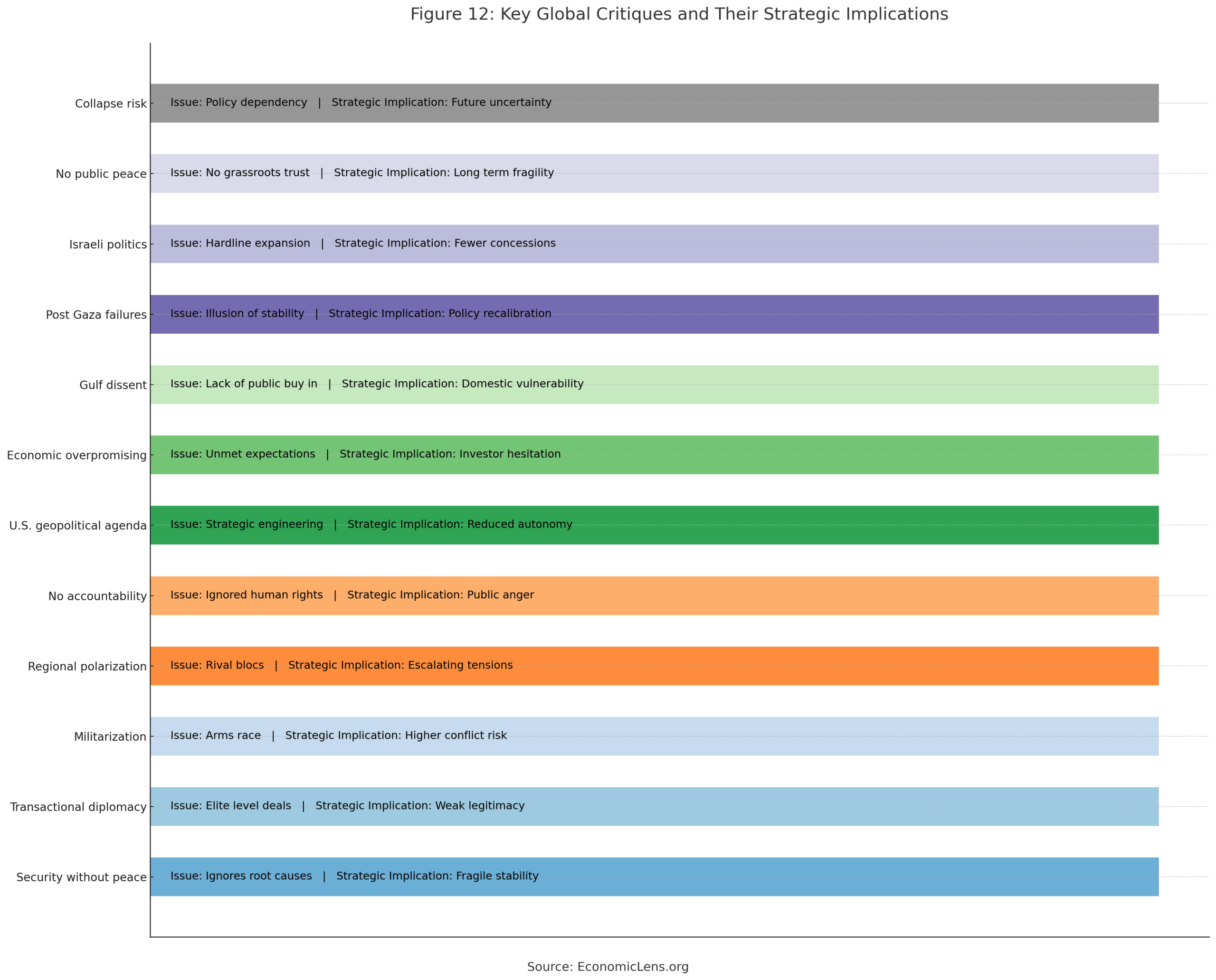
“Critical debates shape the survival of every agreement. Understanding these global critiques helps reveal not only what the Abraham accords are, but what they must overcome to endure.”
Conclusion
The Abraham accords transformed regional diplomacy, economic cooperation and security alignment, yet their endurance depends on navigating instability, shifting alliances, economic fragility and strong public opposition. The Gaza conflict exposed the limits of normalization without justice and demonstrated how quickly anticipated gains can collapse.
For the accords to survive, regional actors must strengthen institutions, reduce tensions and rebuild trust. Their durability will depend less on formal agreements and more on their ability to respond to real-world challenges and public expectations.