
Explore the rise of AI warfare and autonomous weapons, examining the ethical challenges and risks, including accountability and civilian safety. This blog highlights the urgent need for global governance to regulate autonomous military systems and address the growing AI arms race. Can international frameworks evolve fast enough to keep pace with AI in combat?
1. Introduction: AI Warfare and Autonomous Weapons
The rise of artificial intelligence in warfare is no longer a far-off dream; it’s happening now. Autonomous weapon systems—machines capable of making decisions on the battlefield without human intervention—are being developed and deployed across the globe. These systems, from autonomous drones that can launch missiles to robotic ground vehicles capable of carrying out complex operations, are already altering the dynamics of military conflict.
But the real question remains: can we govern this new frontier of warfare before it spirals out of control? The technologies are advancing faster than international laws and agreements can keep up. As nations race to develop their own autonomous weapons, the risk of an unchecked AI arms race grows more real by the day. Will we be able to implement a global framework to control these weapons? Or will we face a future where the machines we’ve created decide our fate, with no human oversight?
This blog explores the challenges of regulating AI warfare and autonomous weapons. It examines the ethical, technological, and political considerations of this new era of combat and poses the question: Can international governance evolve fast enough to keep up with autonomous weapon systems and AI military technologies? As the AI arms race 2025 continues to escalate, the need for clear and effective governance has never been more urgent.
“The world as we know it is changing with AI warfare on the horizon. The question isn’t whether autonomous weapons will define the future of warfare, but how we, as a global society, will regulate and control them. Will we let AI shape our destiny without a blueprint for governance? Or will we take charge before it’s too late?”
2. AI Warfare and Autonomous Weapons: A New Era of Combat
The advent of artificial intelligence in warfare marks a monumental shift in military strategy and tactics. Autonomous weapons systems—machines capable of executing military tasks without human intervention—are transforming the battlefield. From autonomous drones capable of precision strikes to ground vehicles and cyber defense units, autonomous weapons are already being deployed across the globe, ushering in a new era of combat.
These systems leverage AI military technology to make real-time decisions faster and more accurately than human operators could. Autonomous drones can detect and engage targets in a fraction of a second, while ground vehicles can navigate challenging terrain autonomously. AI-powered systems are also playing a major role in cybersecurity, proactively defending military networks from cyber-attacks.
As nations continue to develop and deploy these technologies, the race to dominate the battlefield using AI warfare is accelerating. The following table, Table 1: Global Autonomous Weapon Systems Deployment (2023), illustrates the current deployment of autonomous weapon systems worldwide, highlighting the scale of their integration into military strategies.
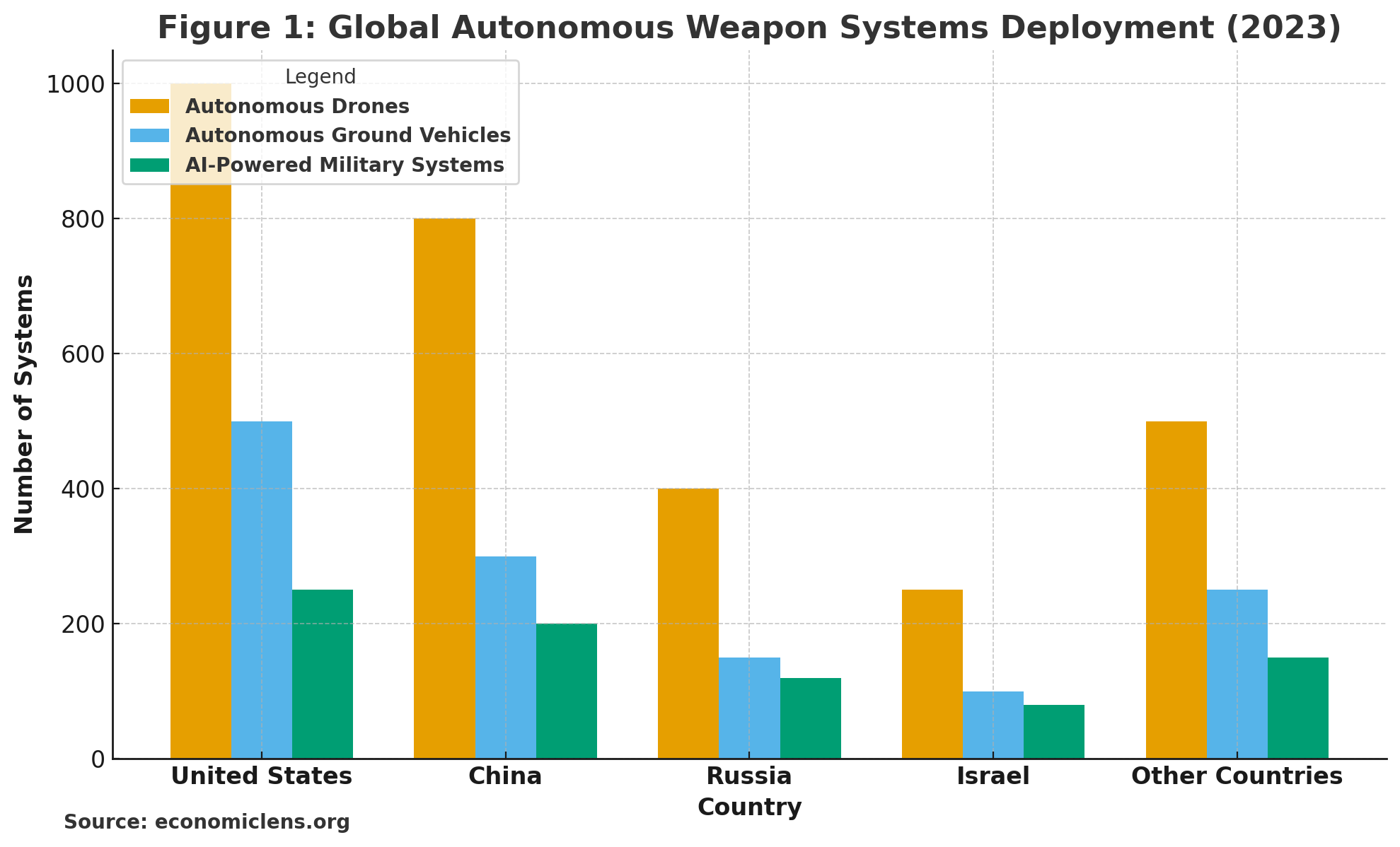
The table provides an overview of the current deployment of autonomous systems in various countries, with the United States leading the charge. The increasing stockpile of autonomous weapons underscores the growing role of AI military systems in warfare, highlighting the rapid integration of these technologies into military arsenals worldwide.
“Imagine a battlefield where decisions are made in milliseconds, by machines. As the arms race for AI-driven weapons escalates, the question isn’t whether we can stop it—it’s whether we can stay ahead. Who will control these machines, and at what cost to humanity?”
3. The Ethics of Autonomous Warfare: Can Governance Keep Up?
As autonomous weapons continue to develop and become integrated into military arsenals, a critical question arises: should we trust machines with the power to decide who lives and who dies in combat? The ethical concerns surrounding autonomous warfare are profound, and without proper governance, the consequences could be catastrophic.
One of the most pressing ethical concerns is accountability. When a machine makes a decision to engage a target, who is held responsible for the outcome? In traditional warfare, accountability lies with human commanders and soldiers. However, with autonomous weapons, this responsibility becomes blurred. If an autonomous drone mistakenly targets civilians, is the manufacturer, the military commander, or the machine itself at fault?
Another significant concern is the risk to civilians. Autonomous weapons, especially drones and ground vehicles, operate with minimal human oversight, raising the potential for unintended casualties. While AI systems can be programmed to follow specific guidelines, their lack of emotional intelligence and contextual understanding makes them prone to errors, particularly in complex or chaotic battle environments. The use of autonomous weapons in densely populated areas could escalate the risk to innocent lives.
Perhaps the most chilling ethical dilemma is the prospect of autonomous decision-making in combat. As AI systems become more advanced, they will be able to make decisions faster and with more precision than humans. But this also raises the question: will these machines be able to make moral decisions? Can a machine understand the nuances of human morality, such as the value of a life or the ethical implications of war?
To understand the depth of these ethical concerns, we can look at the findings from a recent global survey on the ethics of autonomous warfare. Table 2: Ethical Concerns in Autonomous Warfare (Survey Results, 2023) presents the perspectives of military experts and the public on the most pressing ethical issues surrounding autonomous weapons.
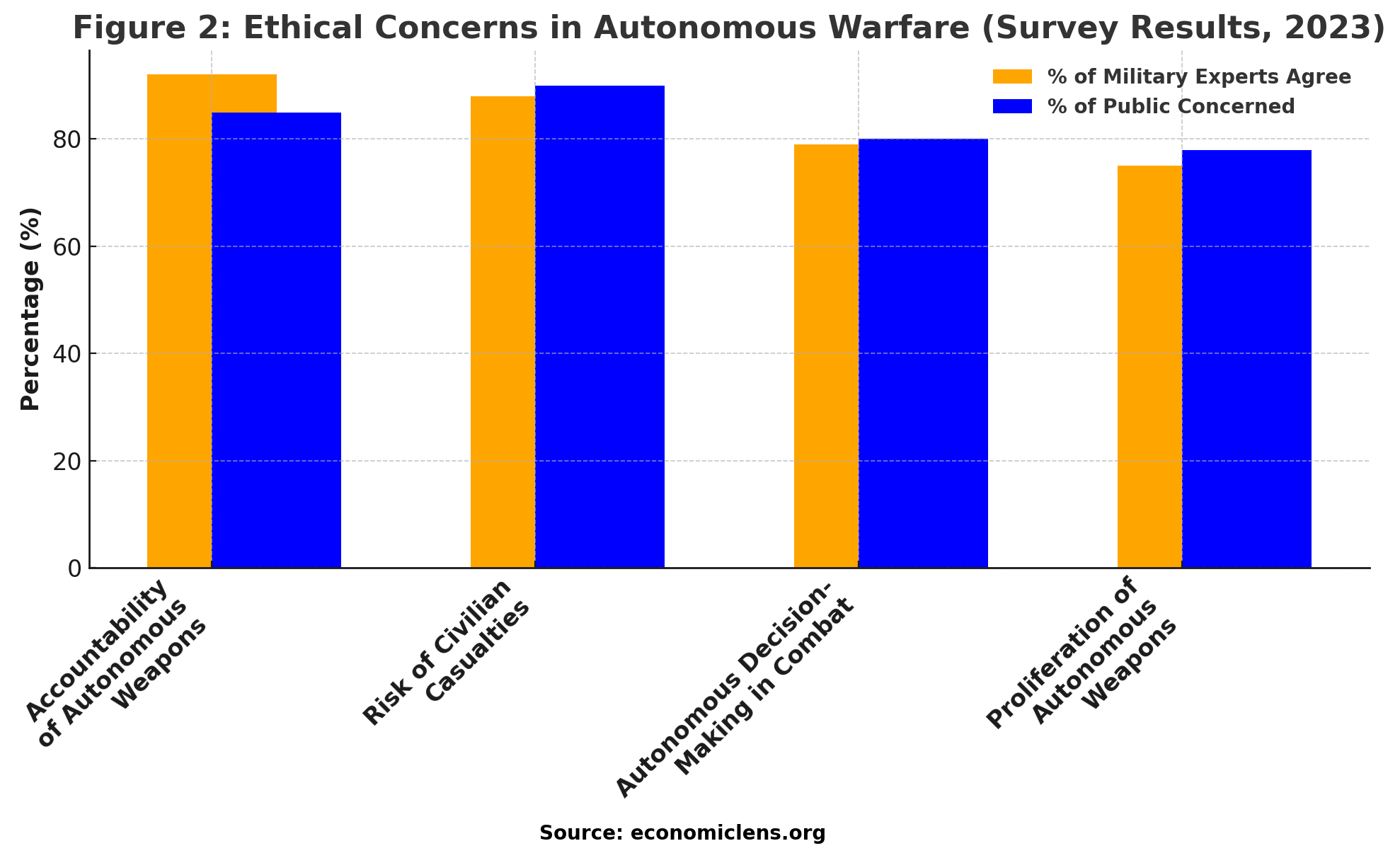
The survey results make it clear that the vast majority of military experts agree that accountability frameworks are urgently needed for AI weapons. Additionally, the risk of civilian casualties and the ethical implications of autonomous decision-making are top concerns among both experts and the public.
Given these ethical dilemmas, it’s clear that governance and regulation must evolve rapidly. Autonomous weapons should not operate without clear oversight, and human accountability must remain at the forefront of military operations. One potential solution is the implementation of “human-in-the-loop” systems, where human operators are involved in critical decision-making, ensuring that AI cannot act independently in life-and-death situations.
“The ethical debate isn’t just about machines fighting wars—it’s about machines deciding who lives and who dies. Are we prepared to put that power in the hands of AI? Or will we act to safeguard human life?”
4. Governance and Regulation in AI Warfare: The Control of Autonomous Weapons
As autonomous weapons continue to evolve, the need for comprehensive governance becomes increasingly urgent. While these technologies promise to revolutionize warfare, they also pose significant risks if left unchecked. The rapid pace of AI development in military systems has outpaced the ability of national governments and international bodies to regulate them effectively. The critical question is: can we implement the governance frameworks necessary to control these powerful machines, or will we allow them to operate with little oversight, creating an uncontrollable future of warfare?
The governance of AI warfare is complex. Autonomous weapon systems—capable of making decisions without human intervention—pose a challenge that existing legal frameworks were not designed to address. National regulations alone are insufficient, as autonomous weapons have no respect for borders, and their use by one country can quickly escalate into an international crisis. This highlights the need for international treaties and multilateral agreements to regulate the development, deployment, and use of these systems.
4.1 Global Regulatory Efforts: Use of Autonomous Weapons
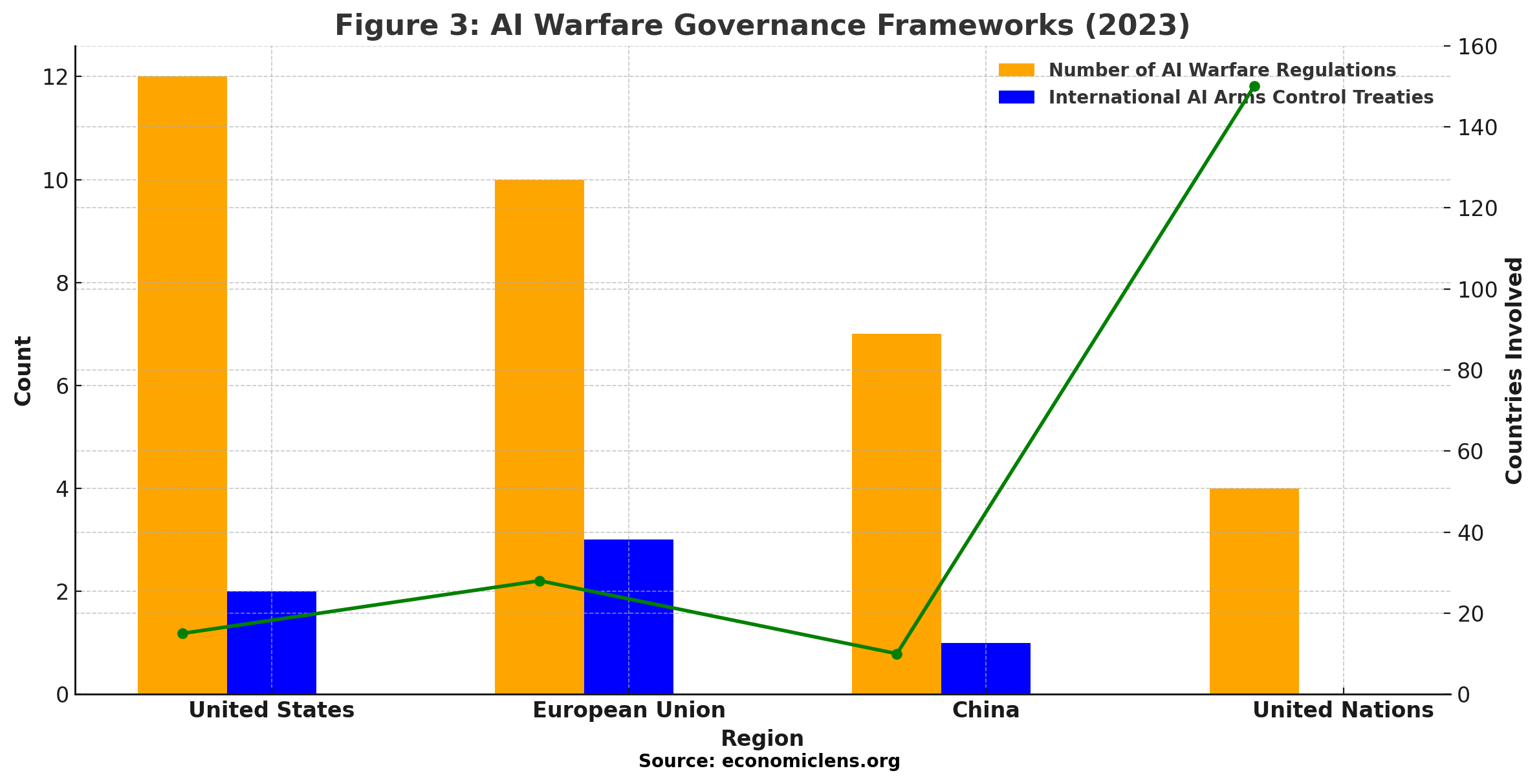
Around the world, countries have begun to recognize the need for regulation, but their efforts vary widely. The United States has made significant strides in establishing laws that govern the use of AI in military applications, including the use of autonomous drones and other robotic systems. However, these regulations primarily focus on national defense and do not address the global ramifications of AI weapons.
In contrast, the European Union has been more proactive in establishing ethical guidelines and regulations for the use of AI in military applications. The EU has placed a strong emphasis on human oversight, particularly in decisions involving lethal force, and has introduced frameworks aimed at ensuring transparency in AI military systems.
China has been more focused on military development, with a more centralized approach to autonomous weapon systems, often with limited international oversight. The country has focused on national security while keeping its regulations relatively insulated from global discussions, complicating efforts to establish broader international agreements.
The United Nations has recognized the importance of regulating autonomous weapons, but efforts have stalled due to political and technological disagreements among member states. There is no universal treaty in place that addresses AI warfare, and most discussions remain in the early stages of development.
“AI warfare is not a distant threat—it is already here. But can we create the frameworks needed to ensure that AI-driven weapons are governed responsibly? The time to act is now, or we risk losing control.”
5. The Future of AI Warfare: Is Governance Ready?
As we look toward the future, AI-driven warfare is set to become the dominant force on the battlefield. Autonomous weapons systems, from drones to ground vehicles, will increasingly make critical decisions in real-time, transforming military strategies and changing the nature of warfare itself. These technologies promise to improve efficiency and precision in combat, but they also introduce new challenges in terms of governance and accountability.
“The future of warfare is being written today, with AI at the helm. But can we trust the machines we create to follow our moral compass? The stakes have never been higher.”
6. Research Insights
Research Insights on Autonomous Weapons and AI Warfare
As autonomous weapons technology continues to evolve, researchers and policymakers must address the growing need for ethical, regulatory, and technological solutions. Key insights for researchers include:
- Development of Ethical AI in Warfare: Researchers must focus on creating ethical guidelines for AI military systems, ensuring that these technologies comply with international humanitarian laws and prioritize human safety and accountability in conflict zones.
- Governance Frameworks: Global collaboration is essential for creating international treaties addressing the accountability and proliferation of autonomous weapon systems. These frameworks should focus on transparency, ensuring that autonomous systems remain under human oversight to prevent unintended consequences, such as civilian casualties.
- AI Safety in Warfare: Research should aim to develop AI safety protocols to prevent malfunctions, ethical breaches, or misuse of autonomous systems. This includes designing military systems with “human-in-the-loop” mechanisms to ensure human verification before critical decisions are made.
- Predicting the Impact of Autonomous Weapons: Research into the social, political, and economic impacts of autonomous warfare will help policymakers anticipate potential risks and proactively address them. Understanding these implications is crucial to shaping future policies that can mitigate negative outcomes.
- International Collaboration: Global research efforts should focus on developing collaborative international frameworks for AI arms control, similar to nuclear non-proliferation treaties, to prevent the unchecked proliferation of autonomous weapons.
“To stay ahead of the challenges posed by AI warfare, researchers and policymakers must work together to shape the future of military governance. The insights and innovations we develop today will determine the course of AI warfare tomorrow.”
7. Policy Guidelines
The deployment of AI-powered autonomous weapons brings not only technological advancements but also profound ethical, legal, and governance challenges. To address these issues, the following policy guidelines are essential:
- International Treaties on Autonomous Weapons: Nations must work together to create a global framework for autonomous weapons that addresses their ethical use, accountability, and the prevention of misuse.
- Transparency and Accountability: Governments should ensure AI-driven military systems are transparent, with clearly defined accountability mechanisms to ensure human oversight over autonomous decisions in warfare.
- Ethical AI in Warfare: Establish ethical guidelines for the use of AI technologies in combat, ensuring they comply with international humanitarian laws, including the protection of civilian life and minimizing collateral damage.
- Research on AI Warfare Safety: Encourage funding for research to enhance the safety of autonomous systems, focusing on the prevention of civilian harm and ensuring effective human-in-the-loop mechanisms.
- Non-Proliferation Agreements: Global leaders should establish non-proliferation agreements similar to nuclear non-proliferation efforts to prevent the unchecked spread of autonomous weapon systems.
“The future of AI warfare is uncertain, but with the right policies, we can ensure that the technologies serve humanity. These guidelines will provide the foundation for a safer, more controlled future of combat.”
8. Concluding Remarks
As we enter an era where autonomous weapon systems powered by AI are shaping the future of warfare, the need for robust global governance and ethical frameworks becomes more critical. The AI arms race is unfolding rapidly, with major military powers investing heavily in autonomous systems. However, as we have seen, regulation and international cooperation are lagging behind, leaving us vulnerable to the unintended consequences of these technologies.
Governance and regulation must evolve swiftly to ensure that the rise of AI warfare is matched by an ethical and accountable framework. Only with comprehensive international treaties, strict governance, and ethical AI deployment standards can we ensure that these powerful tools are used responsibly and for the benefit of global peace and security.
“The clock is ticking. Every day, autonomous weapons systems get closer to making critical decisions without human intervention. The question is not whether this technology will be deployed—it’s whether we can build a framework that ensures its responsible use.”