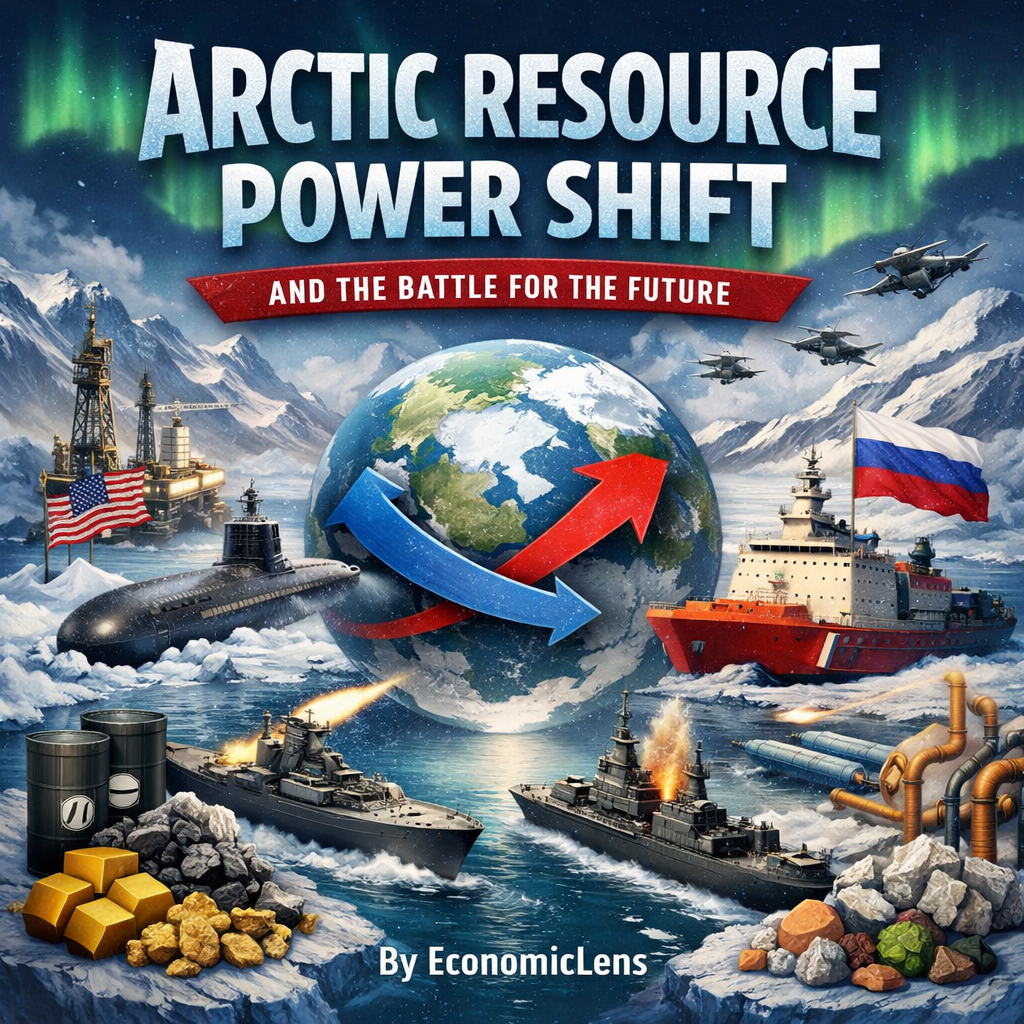
The Arctic resource power shift is reshaping the global geopolitical landscape. What was once a frozen and remote region is now becoming a strategic prize, and this transformation is accelerating. Because climate change is melting polar ice, new resources and sea routes are rapidly emerging. As a result, polar resource competition is no longer theoretical—it is unfolding in real time.
Scientific research confirms that Arctic ice is retreating at a rapid pace, which makes seasonal navigation increasingly viable. Consequently, routes such as the Northern Sea Route and the Northwest Passage are opening more often and for longer periods (https://arxiv.org/abs/2403.01856; https://www.planete-energies.com). These changes are not only environmental. Instead, they are also economic and strategic, which means the Arctic power struggle is intensifying.
Beneath the ice lie vast reserves of hydrocarbons and critical minerals. These materials are vital for advanced technology, clean energy systems, and modern defense industries. In particular, rare earth elements are essential for semiconductors, wind turbines, and military electronics. Therefore, the United States Geological Survey closely tracks these global supply chains (https://www.usgs.gov/centers/national-minerals-information-center/rare-earths-statistics-and-information).
As Arctic conditions become more accessible, these resources become commercially and geopolitically valuable. Consequently, states and corporations are moving early to secure positions. Some analysts already see this as a new phase of Arctic economic domination, where early movers lock in future control. Moreover, this pattern resembles historic resource races but with far higher technological and military stakes, as examined in The Trump Doctrine: Resource Nationalism and the Road to World War III (https://economiclens.org/the-trump-doctrine-resource-nationalism-and-the-road-to-world-war-iii/).
Therefore, the Arctic resource power shift is no longer a distant forecast. Instead, it is becoming a central force that will shape global trade, security, and energy markets for decades.
Strategic Stakes in the Arctic Resource Power Shift
Climate Change as a Geopolitical Trigger in Ice Age Geopolitics
The Arctic is warming more than twice as fast as the global average. Because of this, the region is being transformed from a frozen barrier into an accessible frontier (https://trendsresearch.org/insight/navigating-the-melting-north-climate-change-and-the-arctics-role-in-21st-century-geopolitics/). As ice disappears, areas once blocked to ships and drilling rigs are now opening.
This creates two major strategic shifts. First, vast resource zones become reachable, which intensifies the polar mineral race. Second, new shipping routes emerge between Asia, Europe, and North America, which changes global trade patterns. Therefore, these shifts are not temporary—they are structural features of modern ice age geopolitics.
The Hidden Wealth Beneath the Ice in the Arctic Power Struggle
The Arctic holds enormous quantities of oil, natural gas, and critical minerals. Previously, these resources were too expensive or dangerous to extract. However, technological advances and climate change have now made them commercially viable.
Rare earth elements and strategic metals are particularly important because they power electric vehicles, renewable energy grids, and military hardware. As a result, access to these minerals gives states major industrial and security advantages. Therefore, the Arctic power struggle is also a battle for technological supremacy.
Moreover, these mineral rivalries are not unique to the Arctic. They mirror global resource tensions, such as those seen in Venezuela, where energy and minerals drive geopolitical competition (https://economiclens.org/venezuela-and-u-s-regime-change-defending-dollar-supremacy/).
New Arctic Shipping Lanes in Polar Resource Competition
As ice retreats, Arctic shipping routes are becoming viable. The Northern Sea Route and the Northwest Passage can reduce travel between Asia and Europe by up to 40 percent compared to traditional routes like Suez or Panama (https://www.planete-energies.com/en/media/article/potential-arctic-routes). Therefore, these lanes dramatically lower transport costs and delivery times.
Shorter routes also create new logistics hubs while reshaping naval strategy and maritime security. However, ice conditions remain unpredictable, and political tensions still create risk. Even so, the strategic value of Arctic shipping continues to grow, which further intensifies polar resource competition.
Great Power Rivalry in the Arctic Resource Power Shift
Russia’s Role in Arctic Economic Domination
Russia has the longest Arctic coastline and the most developed polar infrastructure. Therefore, it has invested heavily in icebreakers, ports, and northern rail corridors. These assets support the Northern Sea Route, which Moscow wants to transform into a global trade artery (https://www.reuters.com/world/europe/putin-says-geopolitical-rivalries-are-rising-arctic-cooperation-is-possible-2025-03-27).
At the same time, Russia sees Arctic resources as essential to its long-term energy and security strategy. Consequently, Arctic control strengthens its broader geopolitical position within the Arctic economic domination framework.
China and the Polar Mineral Race
Although China is not an Arctic state, it has become a major Arctic actor. Beijing calls itself a “near-Arctic state” and promotes a Polar Silk Road (https://en.wikipedia.org/wiki/Ilulissat_Declaration). Through this strategy, China invests in Arctic research, ports, and energy projects.
Because China lacks territory, it builds influence through finance and trade. Nevertheless, its growing presence makes it a central player in the polar mineral race.
The United States and Allied Arctic Power Struggle
The United States has also expanded its Arctic engagement. It is strengthening military presence, scientific research, and infrastructure. For example, the ICE Pact with Canada and Finland aims to expand icebreaker fleets (https://en.wikipedia.org/wiki/ICE_Pact).
Greenland adds another strategic layer because its location links North America and Europe while also holding valuable mineral deposits (https://apnews.com/article/6066195d0c6b9e1bbe6da27d55b26ece). Therefore, the Arctic power struggle now sits firmly inside wider global rivalry.
Law, Governance, and the Arctic Resource Power Shift
Existing Legal Frameworks in Ice Age Geopolitics
Arctic governance depends on treaties built for a colder, less accessible region. The Arctic Council promotes cooperation, while the Svalbard Treaty grants Norway sovereignty but allows economic access to others (https://www.wikipedia.org/wiki/Svalbard_Treaty; https://arcticportal.org/arctic-governance/international-agreements).
However, these frameworks were designed before large-scale mining and shipping were possible. Therefore, they struggle to manage today’s ice age geopolitics.
Legal Gaps in the Arctic Power Struggle
Many legal issues remain unresolved. For example, the Svalbard Treaty does not clearly define rights over offshore continental shelves. As a result, companies and states face uncertainty when trying to extract resources (https://www.highnorthnews.com/en/svalbard-treaty-100-years-journey-terra-nullius-all-mans-land). Consequently, legal ambiguity increases the risk of conflict in the Arctic power struggle.
Environmental Limits in Polar Resource Competition
The Arctic ecosystem is extremely fragile. Increased drilling and shipping threaten wildlife and indigenous communities. Yet enforcement powers remain weak, which makes reckless exploitation more likely. Therefore, environmental protection is becoming another front in polar resource competition.
Conclusion
The Arctic resource power shift is already transforming global politics. As ice melts, access to minerals, energy, and shipping routes is reshaping economic and security systems.
Russia, China, and the United States are not merely competing for land. Instead, they are competing for future technological and industrial dominance. Consequently, the polar mineral race will influence supply chains, defense planning, and clean-energy transitions worldwide.
The real question is not whether the Arctic will be exploited. Rather, it is whether that exploitation will be governed through cooperation or driven by rivalry. In a world defined by climate change and strategic competition, the Arctic resource power shift is now one of the most decisive forces of the twenty-first century.