China’s growth strategy 2026 is taking shape through expanded public investment and strategic infrastructure. As Beijing prepares for the 15th Five-Year Plan, nearly 295 billion yuan has been approved for national, security-related, and green projects. Consequently, policymakers aim to stabilize growth and strengthen resilience amid weak private demand and external uncertainty. Overall, this analysis explains the policy signals, investment priorities, and risks shaping China’s economic transition.
Introduction
China’s growth strategy 2026 reflects a renewed emphasis on state-led investment. In recent years, policymakers have sought ways to stabilize economic momentum. However, weak private demand, property-sector stress, and external uncertainty continue to weigh on activity. As a result, Beijing is relying more heavily on public capital expenditure. In the short term, this approach is intended to anchor growth.
Meanwhile, the latest approvals from the National Development and Reform Commission highlight a broader shift. Specifically, China is recalibrating its development model. At the same time, emerging economies are contributing a larger share of global growth. This wider context is examined in EconomicLens analysis on global growth dynamics (https://economiclens.org/global-economic-growth-can-emerging-economies-challenge-chinas-economic-dominance/).
China’s growth strategy 2026 and investment approvals
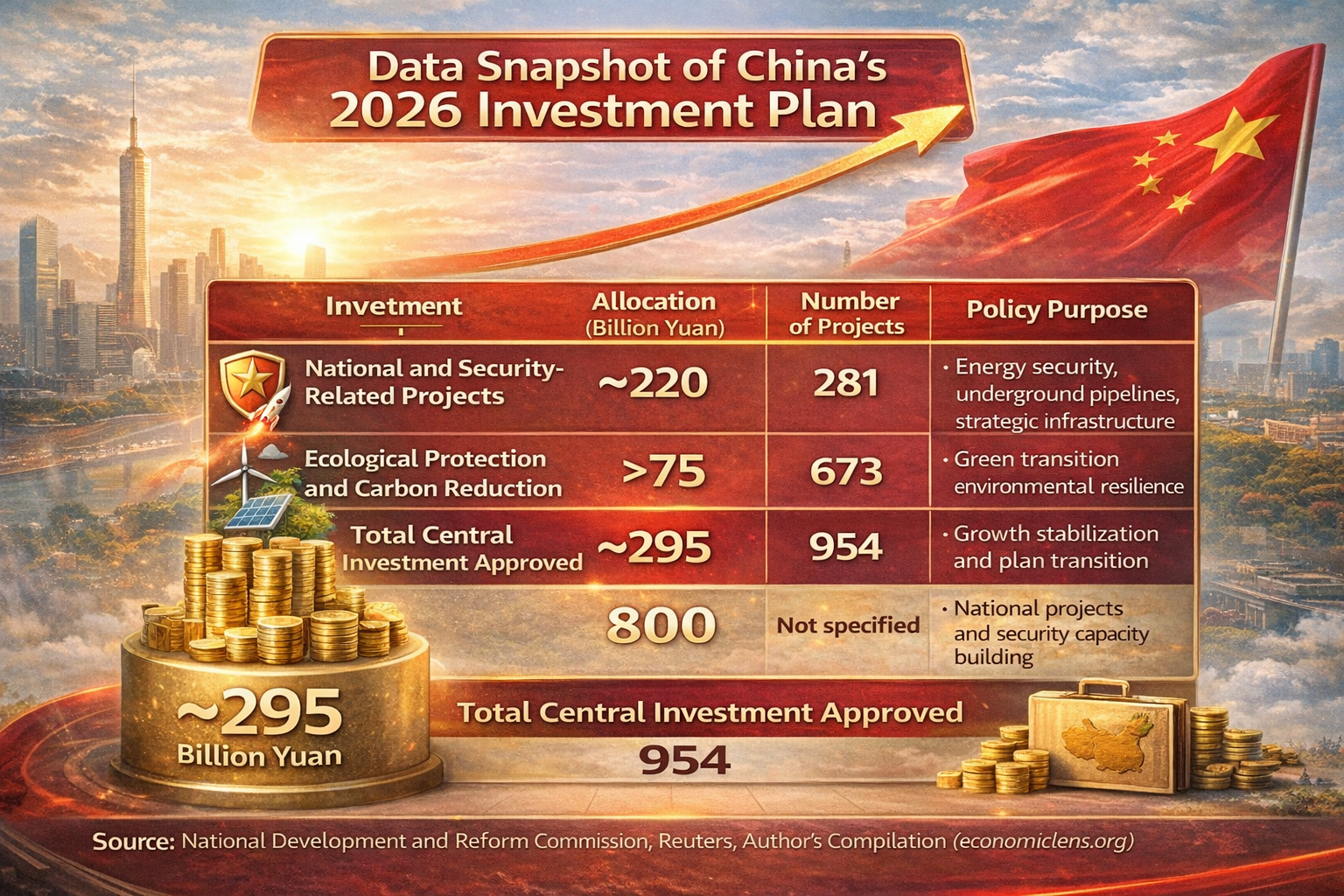
In practice, China’s state planner has approved a central government investment plan for 2026. The total allocation stands at about 295 billion yuan, or roughly $42.2 billion. Notably, the announcement was made by Li Chao. He serves as a spokesperson for the National Development and Reform Commission. In turn, the commission oversees national development and investment coordination (https://www.ndrc.gov.cn).
More importantly, the approved pipeline focuses on national priorities and infrastructure resilience. In addition, it targets long-term strategic capacity. Although the headline figure is modest relative to total fixed-asset investment, the project mix carries strong policy signals. Therefore, the composition matters more than the size alone.
Why China’s growth strategy 2026 relies on infrastructure
Public investment remains one of Beijing’s most reliable macroeconomic tools. International Monetary Fund assessments show that infrastructure spending has historically played a counter-cyclical role in China during periods of private-sector weakness (https://www.imf.org).
China growth strategy 2026 places particular emphasis on infrastructure that enhances security and efficiency. Projects such as underground pipeline systems improve energy reliability, reduce urban risk, and support long-term productivity. This reflects a continued move away from property-centered stimulus toward more targeted capital formation.
Green investment within China growth strategy 2026
More than 75 billion yuan has been allocated to ecological protection and carbon reduction projects. This allocation signals that climate and environmental objectives remain embedded within China growth strategy 2026 rather than treated as secondary goals.
The integration of green investment aligns with broader evidence from the World Bank on the economic costs of delayed climate action and the growth benefits of early transition investment (https://www.worldbank.org).
Transition to the 15th Five-Year Plan
Officials have stated that the approved projects will support a smooth start to the 15th Five-Year Plan covering 2026 to 2030. Early project approval reduces execution delays and helps anchor expectations at the beginning of the new planning cycle.
China growth strategy 2026 therefore serves as a bridge between short-term stabilization and medium-term structural planning. Execution quality will be decisive.
Risks and constraints to watch
Despite its stabilizing role, state-led investment faces constraints. Local government debt remains elevated, and the marginal returns on infrastructure spending have declined in some regions.
Research by the Bank for International Settlements has warned that prolonged reliance on credit-driven investment can raise financial vulnerabilities if productivity gains do not materialize (https://www.bis.org).
Another key uncertainty is whether public investment can crowd in private capital. If confidence remains weak, infrastructure spending may only offset private-sector retrenchment rather than generate durable growth.
Conclusion
China growth strategy 2026 underscores Beijing’s continued reliance on public investment as a stabilizing force during economic adjustment. The emphasis on strategic infrastructure and green projects reflects an effort to adapt the growth model rather than revive past stimulus cycles.
However, the effectiveness of this strategy will depend on fiscal discipline, project efficiency, and the restoration of private-sector confidence as China enters its next development phase.