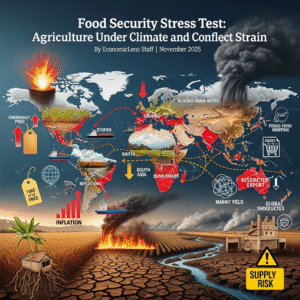
In this blog, we explore the critical role of climate finance and green investment in combating the growing issue of global food insecurity. As climate change disrupts agricultural systems worldwide, innovative financial support is urgently needed to strengthen resilience. Sustainable finance can drive the adoption of climate-smart agriculture, helping farmers adapt to extreme weather and ensure food security. By shifting financial resources towards agriculture, we can prevent an impending agricultural crisis and build a more sustainable future for food production. Discover how targeted investments and eco-friendly financial resources can turn the tide against the food crisis, ensuring stability for vulnerable populations.
Feeding a Hotter World
In the 21st century, a paradox is unfolding on our plates: despite the Earth producing vast quantities of food, millions still face famine. Rising temperatures, droughts, and erratic rainfall are transforming once-fertile lands into arid zones, pushing agricultural regions toward dependence on imports. This environmental trend has spiraled into a global economic crisis, with more than 600 million people experiencing severe food insecurity in 2024—an increase of 20% in just five years.
As agricultural production rapidly declines in regions with growing populations, the economic toll becomes evident—reduced yields, higher input costs, and shrinking rural incomes. This crisis is not merely climatic; it’s an issue of inequality. Despite evidence that adaptation could yield substantial economic benefits, agriculture continues to receive less than five percent of global climate funding (IMF, 2025). This funding gap threatens to worsen, with projections showing a potential 20% loss in global crop production by 2050, not due to a lack of knowledge, but due to insufficient investment.
The pressing question is no longer if climate change will impact agriculture, but whether climate finance and green investment can adapt quickly enough to enable the necessary transformations. The next major food crisis will stem not only from failing harvests but also from the lack of financial resources needed to bolster agricultural resilience. The future of food security will rely as much on capital investment as it will on rainfall, underscoring the urgent need for increased sustainable finance to protect vulnerable agricultural systems.
The Economic Toll of Climate Change
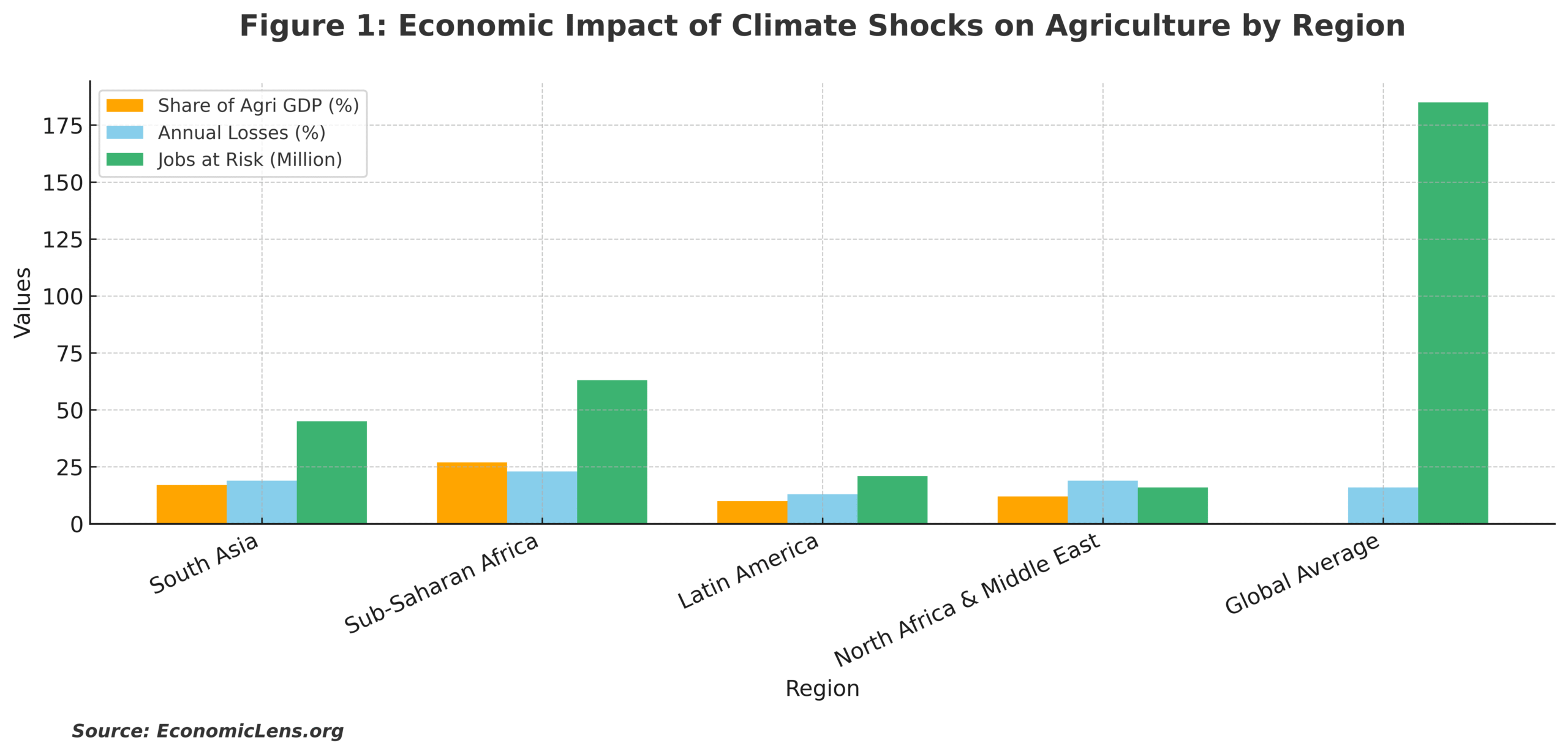
Climate shock losses have transcended environmental concerns and have become a global balance-sheet issue. As per Figure 1, the tendency is consistent across regions: nations with the highest dependence on agriculture have the most significant economic shocks. Sub-Saharan Africa loses around 25% of its agricultural GDP each year due to drought and heat stress. Each lost percentage point leads to the elimination of millions of jobs and a reduction in household incomes. A climate disaster triggers an economic downturn—a prolonged crisis that merges environmental instability with financial strain.
The Missing Finance Link
Despite its significance to livelihoods, agriculture remains the most underfunded sector in global climate financing. Financial resources mostly target renewable energy and infrastructure; nevertheless, agricultural systems, the sector most susceptible to climate change, get just a minimal share of support (IMF, 2025).
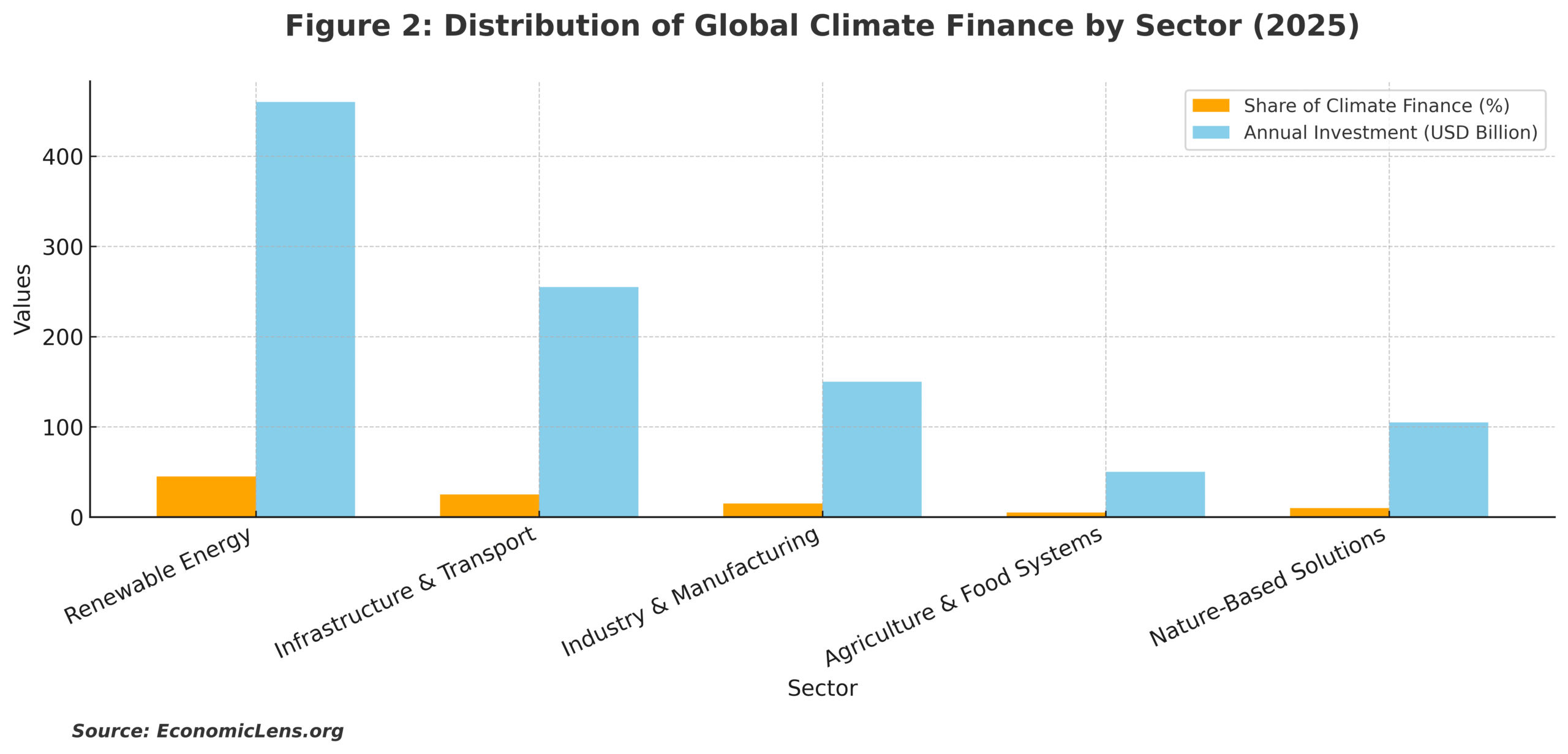
This inequality is not only quantitative; it is also systemic. Agriculture sustains 2.5 billion people worldwide; however, it receives less financial assistance than other urban sectors. Diverting even 10 percent of global climate funding towards agriculture might substantially improve adaptation capacities in developing countries. Research demonstrates that each dollar invested in drought-resilient agriculture yields four dollars in averted losses and productivity improvements (World Bank, 2025). The imbalance between financial resources and climate urgency defines the vulnerability of modern food systems.
The Power of Climate-Smart Farming
Climate-Smart Agriculture (CSA) offers an integrated approach that unifies productivity, resilience, and mitigation. By combining agronomic research with financial innovation, CSA aims to sustain a growing population while restoring environmental balance (FAO, 2025).
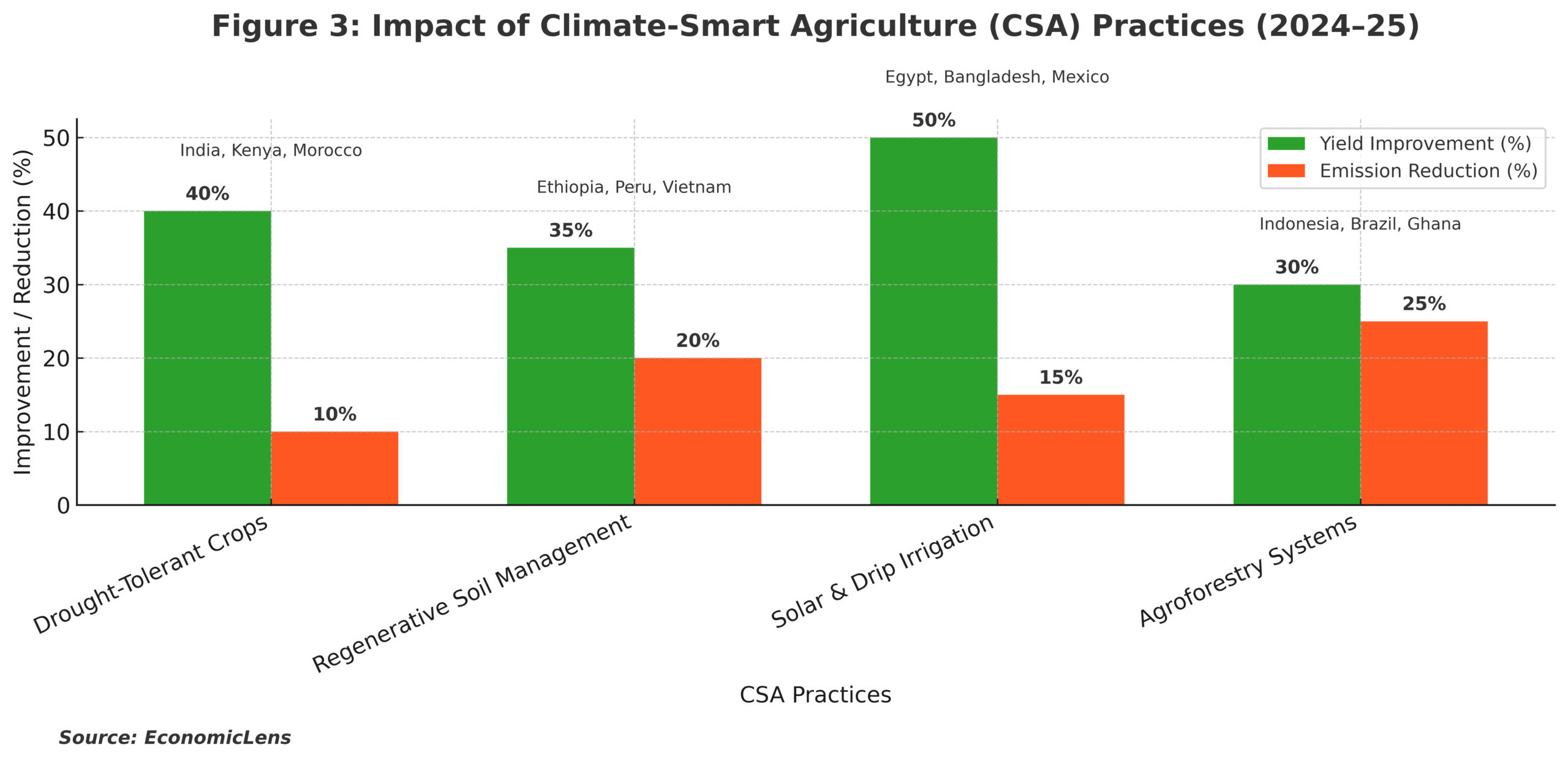
CSA demonstrates that climate adaptation and economic growth are not mutually exclusive. Drought-resistant crops and solar irrigation systems consistently enhance yields in dry years, while soil restoration approaches boost long-term productivity. Agro-forestry and regenerative agriculture provide carbon sequestration benefits, converting agricultural regions into useful tools for mitigation. These strategies convert susceptibility into resilience and redefine agriculture as a climate solution instead of a victim of change.
Agriculture That Pays Back
Economically, CSA transforms adaptation into an investment opportunity. The Asian Development Bank (ADB, 2025) forecasts that the proliferation of Climate-Smart Agriculture (CSA) methodologies might provide an extra 230 billion USD to global agricultural GDP by 2035. Countries adopting Climate-Smart Agriculture, like Vietnam, India, and Kenya, demonstrate yield stability during El Niño occurrences.
The difference is measurable. Nations that invest in adaptation maintain stable food prices and employment rates, but those reliant on reactive measures face persistent crises. The financial justification for adaptation is as clear as its ethical basis: every dollar allocated to resilience produces several advantages in growth, food security, and fiscal sustainability (World Bank, 2025).
Innovation on the Farm
Technological innovation and carbon funding are revolutionizing the future of agriculture. Modern farms have progressed from simple production sites to hubs for data, carbon sequestration, and renewable energy (UN-SPIDER, 2025).
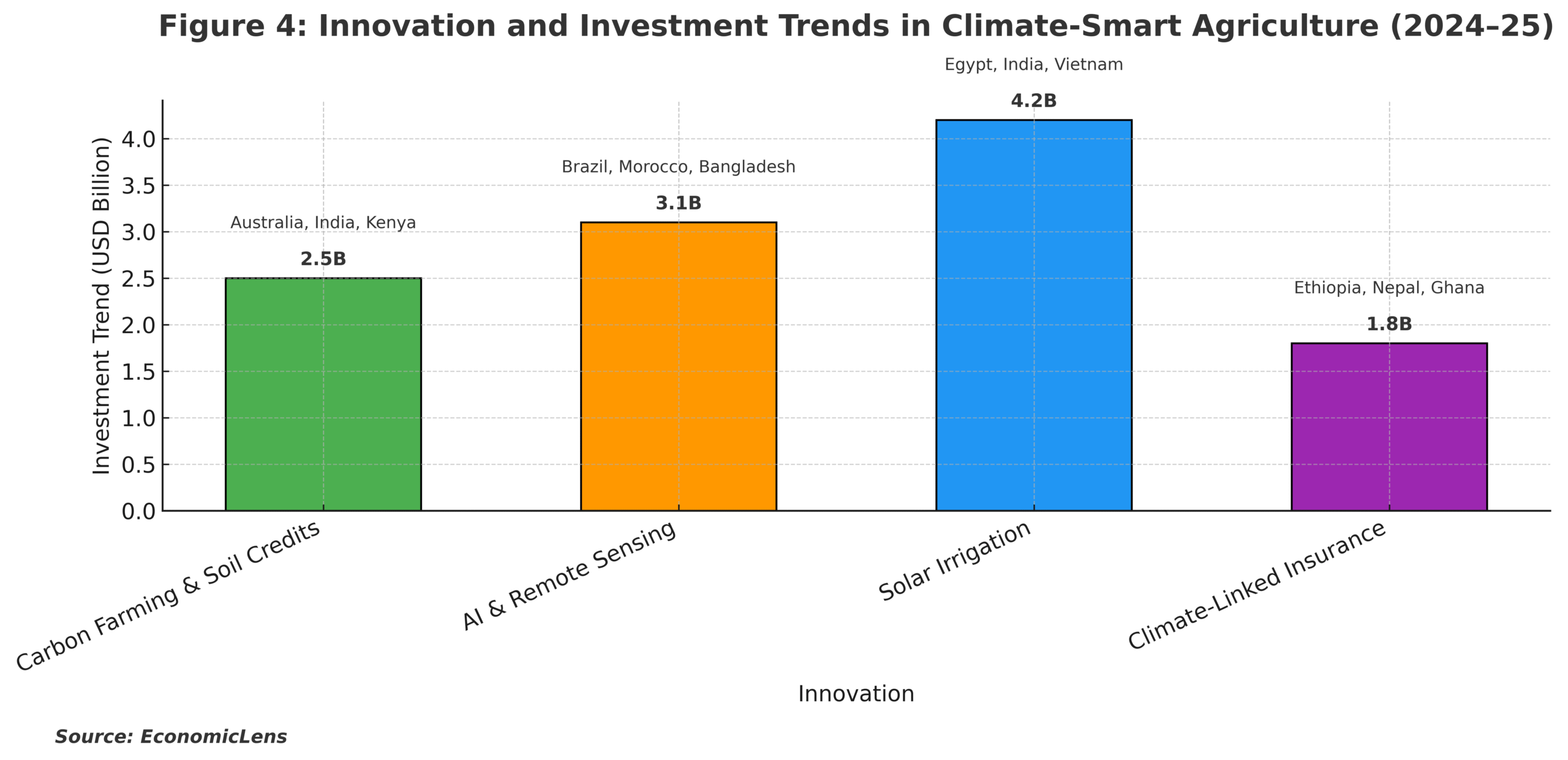
These technologies are converting resilience into a measurable, marketable, and financeable asset. Carbon farming allows smallholders to benefit from soil restoration, while AI technologies provide predictive insights that reduce crop risk. The amalgamation of technology and economics is converting adaptation into a legitimate asset class, in which environmental sustainability and profitability mutually reinforce each other.
When Food Meets Migration
The consequences of insufficient support for adaptation are seen in the simultaneous rise of food prices and displacement.
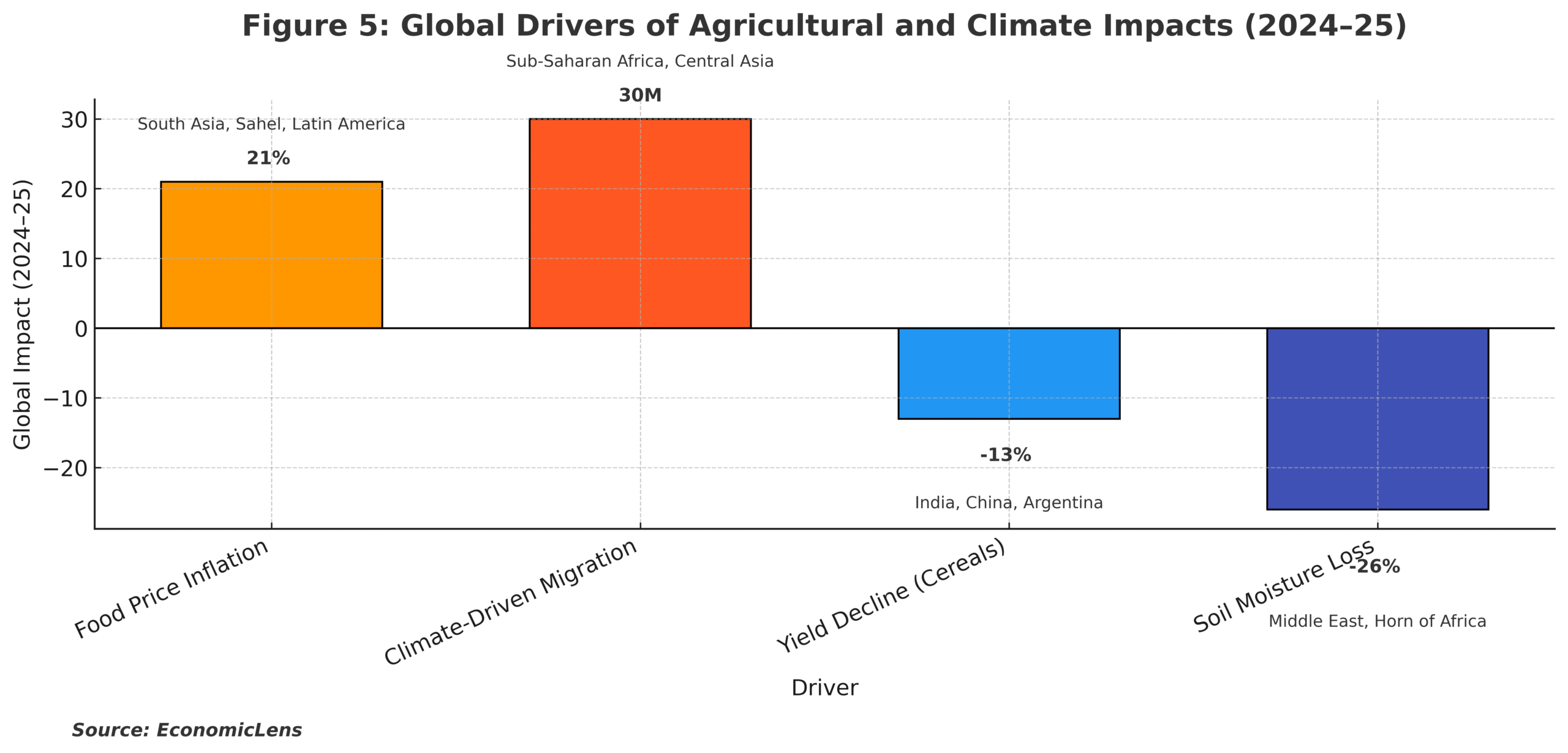
Data Sources: UNDP (2025); FAO (2025); IMF (2025)
Regions experiencing the most significant yield declines simultaneously exhibit the most accelerated migratory patterns. Food insecurity drives families to relocate from rural regions to urban areas, creating new social and political problems. Without accessible funding for resilience, climate change becomes a human mobility challenge rather than only an environmental one (UNDP, 2025).
Winners and Losers of Green Finance
A new global dichotomy is emerging. Kenya, India, and Vietnam are using sovereign green bonds and Climate Smart Agriculture frameworks to transform risk into opportunity, whilst nations like Yemen and Haiti remain trapped in cycles of dependency on aid.
Access to affordable green capital increasingly determines whether economies achieve food sovereignty and which become dependent on imports. In the next decade, agricultural resilience may influence global power as much as energy has previously.
The Road to Resilient Agriculture
Meeting the demands of a warming planet requires the alignment of fiscal policy, private investment, and local innovation. The following policy instructions may bridge the current gap between financial potential and actual impact.
- Integrate adaptation criteria, such as soil-carbon sequestration and irrigation efficacy, into national budgets (World Bank, 2025).
- Augment Climate-Smart Agriculture (CSA) by modifications in subsidies and research incentives (FAO, 2025).
- Encourage private investment via green bonds and blended financing (IMF, 2025).
- Expand digital microfinance to assist smallholder and female farmers (UNDP, 2025).
- Promote regional standards via frameworks like ASEAN’s CSA Roadmap and the African Development Bank’s Feed Africa Initiative (ADB, 2025).
When governance, finance, and technology converge, agriculture evolves from a casualty of climate change into a principal collaborator in combating it.
Research Insights
Recent studies from development institutes emphasize five crucial frontiers:
- Assessing resilience results from adaptation investments (World Bank, 2025).
- Modeling climate-related debt exchanges for fiscal stability (IMF, 2025).
- Utilizing artificial intelligence to enhance soil and water management (UN-SPIDER, 2025).
- Evaluating inclusive financial options for smallholder farmers and women (FAO, 2025).
- Improving regional adaptation funding using ADB and OECD frameworks (OECD, 2025).
These observations confirm that the convergence of finance, innovation, and inclusion will dictate the efficacy of global food production in a changing environment.
Final Word
Feeding the future is both an economic and moral obligation. Climate finance supplies the funds; climate-smart agriculture offers the strategy. Together, they can convert scarcity into stability and fragility into resilience.
The choice before humanity is urgent yet simple:
“invest in adaptation today or inherit a century defined by hunger, migration, and lost opportunity”