
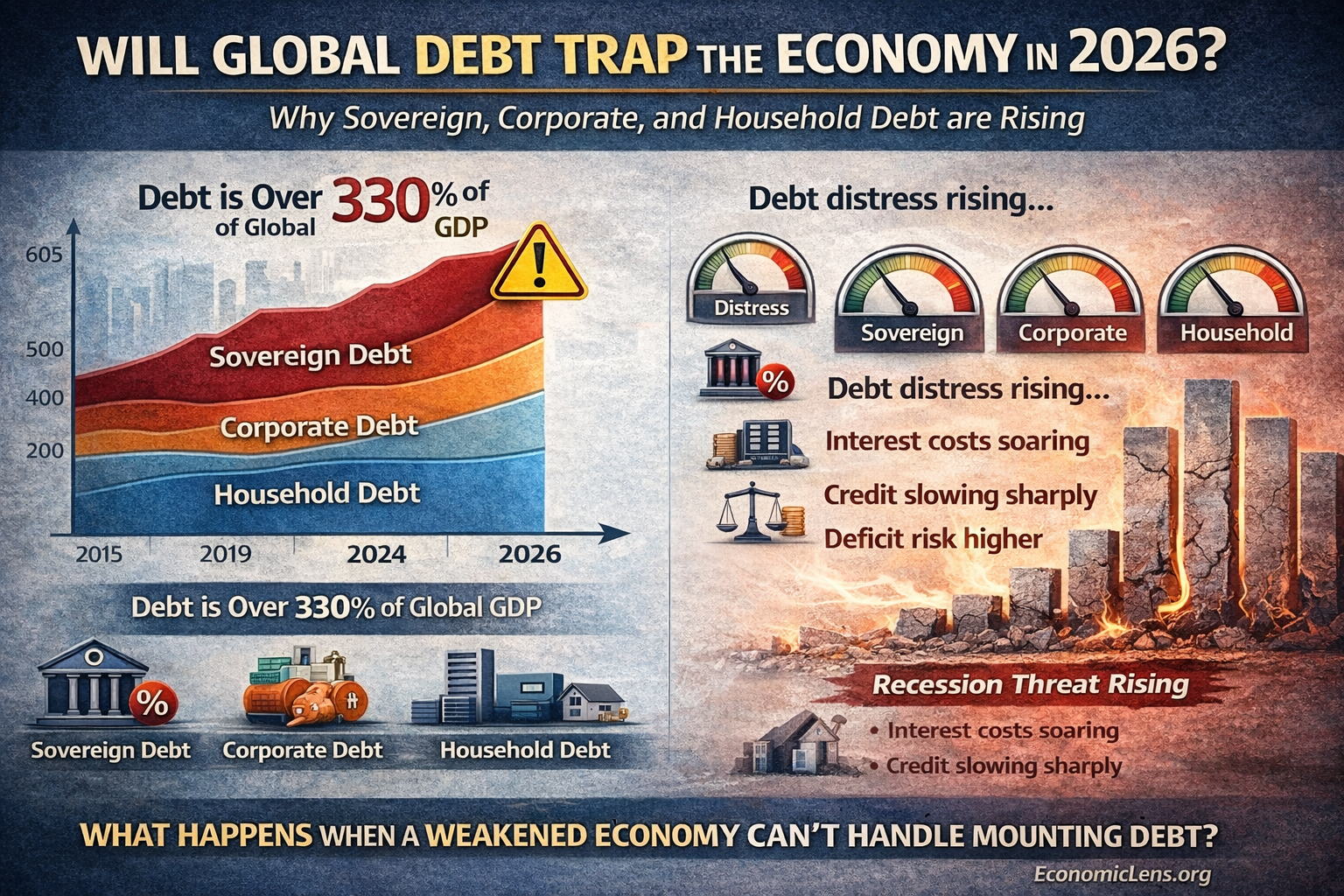
Global debt risks 2026 explain why total debt above 330 percent of global GDP is elevating financial stress across sovereign, corporate, and household sectors. Rising interest costs, slowing credit, and debt servicing pressures are increasing recession risk and limiting policy flexibility worldwide.
Introduction
Global debt risks 2026 has become a major macroeconomic concern as total debt levels exceed 330 percent of world GDP. Sovereign, corporate, and household sectors are increasingly vulnerable to rising financing costs, credit tightening, and slower growth. Rising debt burden 2026 explains why debt has shifted from a supportive role to a potential constraint on growth.
Global debt risks 2026 and the scale of debt accumulation
Debt has risen sharply across economies over the past decade. Governments expanded fiscal support during crises, firms increased leverage during extended low rate periods, and households took on more credit.
This expansion in debt relative to economic output is the central theme of EconomicLens coverage on global debt crisis risks and the need for fiscal trust and reform (https://economiclens.org/global-debt-crisis-risks-trust-and-fiscal-reform/). Total global debt now exceeds 330 percent of global GDP, highlighting the expansive nature of the challenge.
How higher interest rates amplify global debt risks 2026
The challenge is not just the level of debt but also the cost of servicing it. Interest rates have moved significantly higher, and elevated costs are pressuring borrowers across sectors.
This phenomenon is well documented in EconomicLens analysis on higher for longer interest rates and sovereign debt stress (https://economiclens.org/higher-for-longer-interest-rates-sovereign-debt-stress-fiscal-fragility/). According to the International Monetary Fund, higher interest costs are crowding out productive spending and fiscal buffers (https://www.imf.org).
Sovereign debt stress and crisis vulnerabilities
Sovereign debt stress is a key dimension of rising debt burden 2026. Many emerging and developing economies face tight financing conditions and limited fiscal space.
EconomicLens coverage on debt defaults and IMF rescue programs highlights how debt distress is emerging as a policy challenge in developing economies (https://economiclens.org/debt-defaults-imf-rescue-programs-a-new-crisis-for-developing-economies/). The World Bank also notes elevated debt distress risks for low and middle income countries (https://www.worldbank.org).
Corporate and household debt stress in the debt driven slowdown
Corporate and household sectors are also under pressure. High leverage among firms increases default risk as financing costs rise. Household debt repayments absorb more income, reducing consumption and weakening demand.
This feedback loop is connected to the broader weak growth environment described by EconomicLens in its global economic slowdown 2026 analysis (https://economiclens.org/global-economic-slowdown-2026-why-growth-feels-slower/). Tighter credit conditions, noted by the Bank for International Settlements, further slow borrowing and activity (https://www.bis.org).
Why global debt risks 2026 raise recession and stability concerns
Importantly, high leverage amplifies vulnerabilities when growth slows. Rising interest costs reduce fiscal and private sector flexibility. In such conditions, adverse shocks can trigger deeper downturns.
The Organization for Economic Cooperation and Development highlights that high debt levels can deepen slowdowns when credit conditions tighten (https://www.oecd.org). Therefore, rising debt burden 2026 elevate both recession probabilities and financial stability pressures.
Policy implication of global debt risks 2026
Looking ahead, mitigating rising debt burden 2026 requires coordinated policy action. Strengthening fiscal frameworks, enhancing debt transparency, and developing effective restructuring mechanisms are essential. At the same time, encouraging sustainable private sector leverage and resilient household balance sheets will support medium term stability.
Without such strategies, high debt burdens may continue to constrain growth and increase volatility in global financial markets.
Key takeaway
Global debt risks 2026 represents a structural interplay between high leverage, high financing costs, and slowing growth. Addressing these risks requires thoughtful policy design and international cooperation to avoid recurring stress events.




1 thought on “Global Debt Risks 2026: Will Debt Trap Growth?”
You have remarked very interesting details ! ps decent internet site.