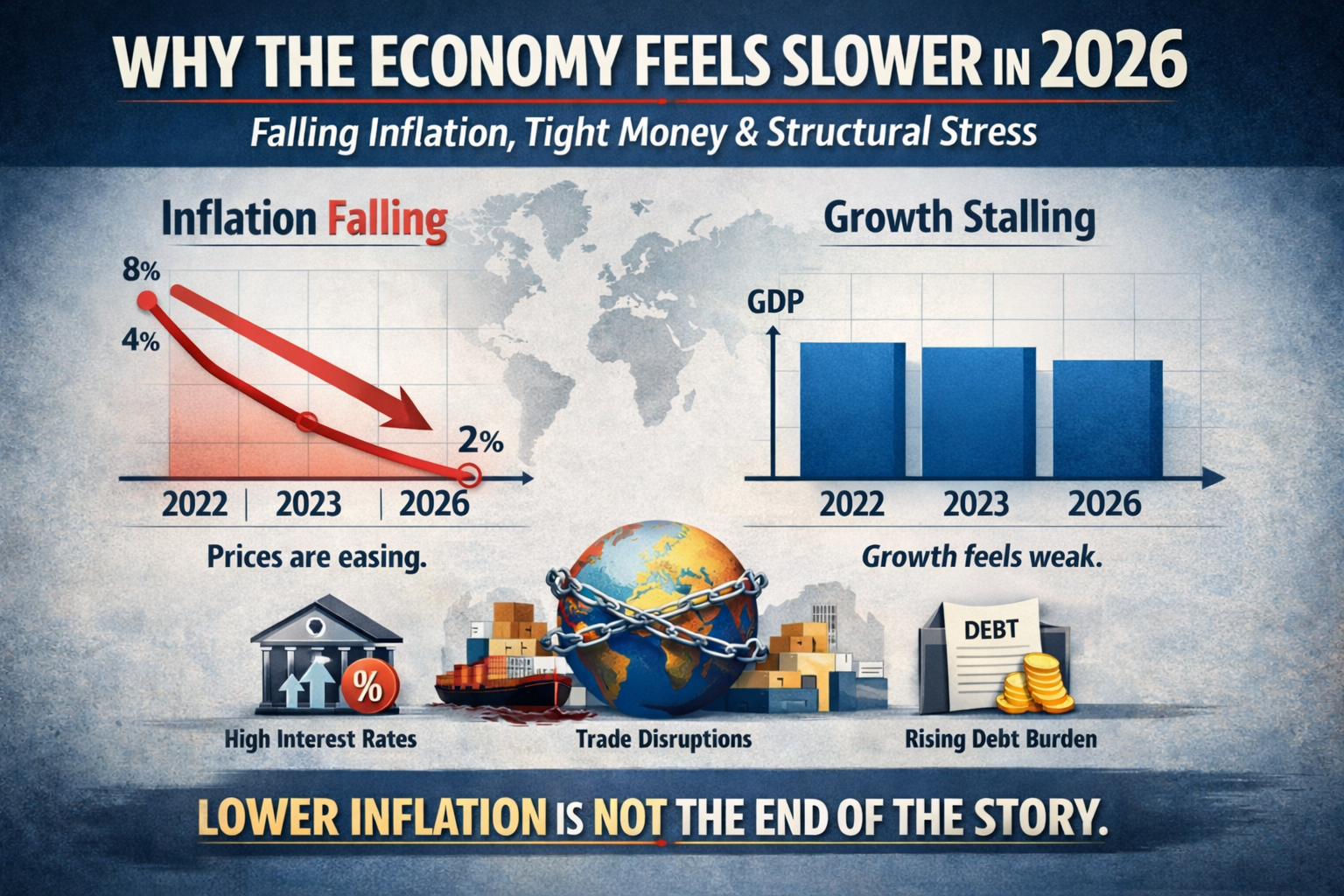
Global economic slowdown 2026 explains why economic conditions feel constrained even as inflation falls. Tight monetary policy, weak investment, trade disruptions, and rising debt burdens are slowing global growth momentum. The analysis shows why lower inflation alone is not restoring economic confidence.
Introduction
Economic slowdown in 2026 defines the current economic mood more accurately than crisis narratives. Inflation is falling, yet growth feels weak. As a result, households and firms experience persistent strain despite improving headline indicators. This pattern aligns with broader concerns already discussed in EconomicLens analysis on synchronized global stagnation risks (https://economiclens.org/global-growth-slowdown-2025-2026-are-major-economies-sliding-into-a-synchronized-stagnation/).
Weak global growth outlook and falling inflation
Inflation has eased across advanced and emerging economies. Energy prices have stabilized, and goods inflation has softened. However, weak global growth outlook shows that disinflation does not restore lost purchasing power immediately.
Prices remain higher than before recent shocks. Consequently, real income recovery is slow. According to the International Monetary Fund, disinflation reduces pressure but does not guarantee stronger demand (https://www.imf.org).
Tight money driving the weak global growth outlook
At the same time, monetary policy remains restrictive. Central banks prioritize credibility after prolonged inflation episodes. Therefore, interest rates stay elevated even as inflation falls.
In the context of weak global growth outlook, tight money suppresses borrowing and investment. This dynamic mirrors EconomicLens analysis of tight monetary conditions and global financial stress (https://economiclens.org/global-economic-outlook-2025-2026-slow-growth-sticky-inflation-rising-debt/). The Bank for International Settlements also notes that prolonged high rates weigh heavily on credit cycles (https://www.bis.org).
Weak investment under the economic slowdown in 2026
Economic slowdown in 2026 is closely linked to subdued investment. Capital spending remains weak due to uncertainty, financing costs, and fragile demand expectations. As a result, productivity growth stays muted.
World Bank analysis shows that weak private investment is a central constraint on medium term growth (https://www.worldbank.org). This investment drag reinforces the global economic slowdown 2026 through slower capital deepening.
Structural stress behind the weak global growth outlook
Beyond cyclical forces, structural pressures intensify the slowdown. Trade disruptions, supply chain fragmentation, and geopolitical risks reduce efficiency. In addition, rising public debt constrains fiscal space.
These themes are consistent with EconomicLens research on trade fragmentation becoming a default global condition (https://economiclens.org/fragmentation-is-now-the-default-setting-of-the-global-economy/). OECD assessments further note that high debt burdens limit countercyclical policy options (https://www.oecd.org).
Why weak global growth outlook feels persistent
Importantly, weak global growth outlook feels persistent because multiple forces interact. Inflation falls, but monetary policy remains tight. Growth continues, but momentum is weak. Structural constraints prevent rapid acceleration.
As a result, economic stability without expansion feels like stagnation for many households and firms.
Policy implication of the weak global growth outlook
Looking ahead, addressing weak global growth outlook requires more than inflation control. Structural reforms, productivity investment, and credible fiscal frameworks are essential. Without these measures, low growth risks becoming entrenched.
Therefore, policy must shift from crisis management toward long term growth restoration.