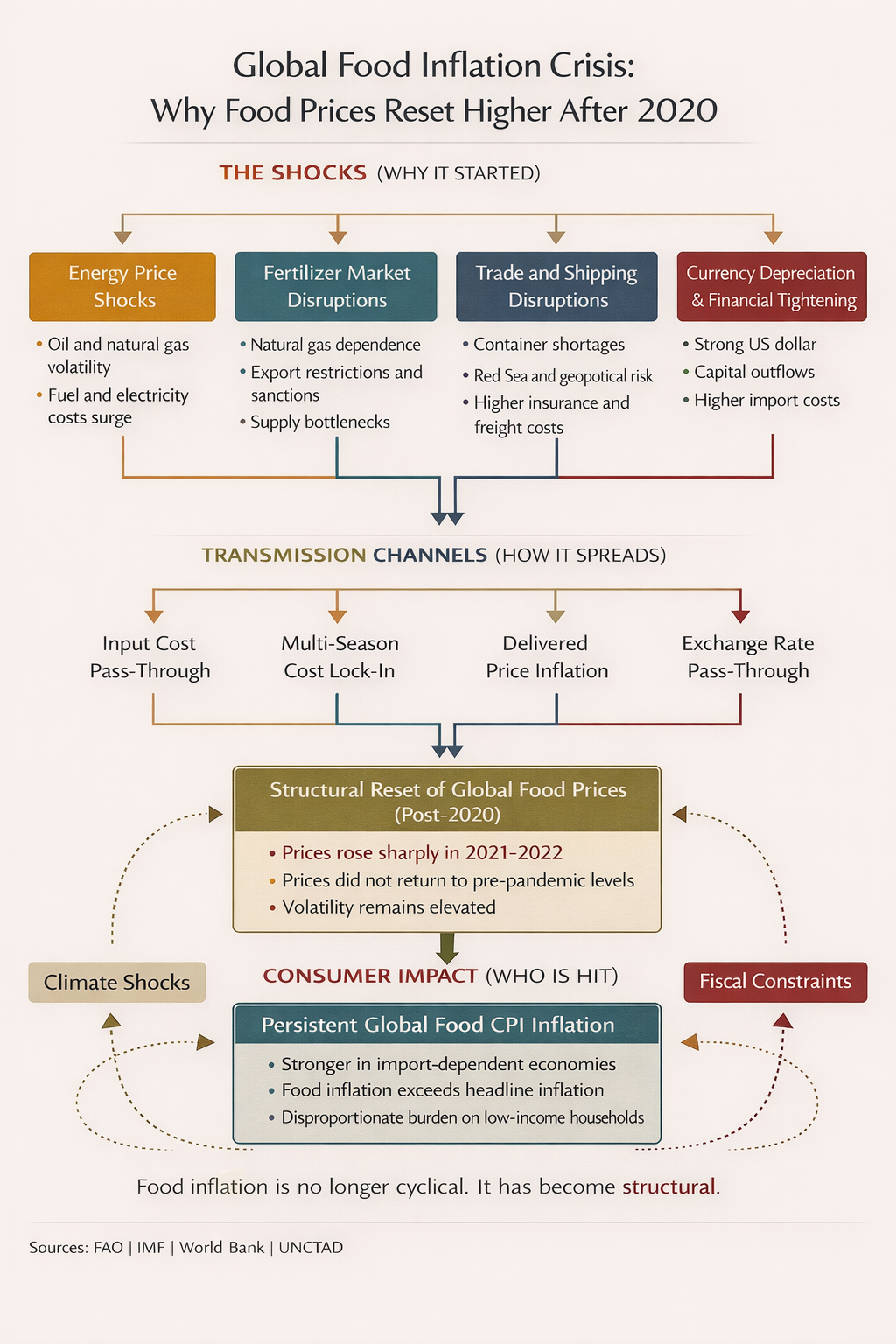
The global food inflation crisis reflects a structural reset in food prices after 2020. Energy shocks, fertilizer disruptions, trade costs, currency depreciation, and climate stress pushed prices sharply higher in 2021–2022. This visual story explains why food prices did not return to pre-pandemic levels and why food inflation remains persistent, especially in import-dependent economies.
Introduction
Global food inflation crisis marks a structural shift in how food prices behave after 2020. Food prices surged sharply in 2021 and 2022 and did not return to pre-pandemic levels. Unlike earlier cycles, inflation remained elevated even after supply conditions improved. This global food inflation crisis has reshaped macroeconomic stability, fiscal policy, and political pressure worldwide.
The broader economic and political consequences of rising food prices are examined in detail in this EconomicLens analysis on how food inflation is reshaping economies and politics in 2025:
https://economiclens.org/global-food-crisis-how-food-inflation-is-reshaping-economies-and-politics-in-2025/
Why the Global Food Inflation Crisis Started
The global food inflation crisis began with overlapping shocks across energy, agriculture, trade, and finance.
Energy prices became highly volatile after 2020. Oil, natural gas, and electricity costs increased sharply. Farming, food processing, and transport depend heavily on energy inputs. As a result, higher energy prices fed directly into food production and retail costs, a pattern highlighted in IMF assessments of post-pandemic inflation dynamics:
https://www.imf.org/en/Topics/inflation
Fertilizer markets faced severe disruptions at the same time. Fertilizer production relies on natural gas. When gas prices rose, fertilizer prices surged. Export restrictions and supply bottlenecks reduced availability. For further analysis on global food insecurity and persistent food price pressures, see Global Food Insecurity 2025: Hunger Trends, Costly Diets, The Fertilizer Shock (https://economiclens.org/global-food-insecurity-2025-hunger-trends-costly-diets-the-fertilizer-shock/), and Food Inflation in Emerging Economies 2026: Why Prices Stay High (https://economiclens.org/food-inflation-in-emerging-economies-2026-why-prices-stay-high/).
According to the Food and Agriculture Organization, fertilizer shortages played a central role in sustaining higher global food prices even after harvest conditions improved: https://www.fao.org/worldfoodsituation/foodpricesindex
Trade, Shipping, and Supply Chain Disruptions
Trade and shipping disruptions added another layer of pressure. Container shortages increased freight rates. Insurance and logistics costs rose sharply. These factors raised delivered food prices, particularly for import-dependent economies.
UNCTAD notes that elevated transport and trade costs continue to weigh on global food markets and cross-border food availability: https://unctad.org/topic/transport-and-trade-logistics
Export bans and trade restrictions further tightened supply. These dynamics are analyzed in this EconomicLens assessment of the global food supply crunch driven by climate shocks and policy barriers:
https://economiclens.org/global-food-supply-crunch-climate-shocks-export-bans-and-inflation-risk/
How the Global Food Inflation Crisis Spread
Higher input costs passed rapidly through food supply chains. Farmers faced rising energy and fertilizer expenses. These costs moved to processors and retailers. Consumer food prices increased across regions.
Food production cycles locked in higher costs. Planting decisions and contracts reflected earlier price spikes. This multi-season cost lock-in prevented food prices from falling back quickly.
Delivered price inflation reinforced the trend. Transport, storage, and insurance costs remained elevated. Retail food prices continued to reflect earlier disruptions. The World Bank highlights how these logistics constraints continue to affect food affordability, especially in low-income economies:
https://www.worldbank.org/en/topic/food-security
Exchange rate movements further amplified inflation. Currency depreciation raised food import bills faster than other consumer prices. This explains why food inflation exceeded headline inflation in many economies.
Structural Reset of Global Food Prices After 2020
Food prices rose sharply during 2021 and 2022. However, prices did not return to pre-pandemic levels. Volatility remains elevated across global markets.
This pattern signals a structural reset. The global food inflation crisis is no longer cyclical. Higher baseline prices now define the global food system.
Climate shocks reinforce this reset by repeatedly disrupting agricultural supply and yields. These dynamics are examined in this EconomicLens deep dive on climate-induced food inflation and global risk exposure:
https://economiclens.org/climate-induced-food-inflation-climate-shocks-food-price-surge-global-risk/
Consumer Impact of the Global Food Inflation Crisis
Persistent food CPI inflation affects households unevenly. Import-dependent economies face stronger pressure. Food inflation often exceeds overall inflation.
Low-income households bear the greatest burden. Food absorbs a larger share of income. Fiscal constraints limit government support. Food security risks intensify under these conditions.
These combined pressures are assessed further in this EconomicLens food security stress test examining agriculture under climate and conflict strain:
https://economiclens.org/food-security-stress-test-agriculture-under-climate-and-conflict-strain/
Conclusion
Food inflation is no longer temporary. The global food inflation crisis reflects a structural transformation driven by energy costs, fertilizer disruptions, trade frictions, currency pressures, and climate shocks. Prices reset higher after 2020 and remain volatile. Food inflation has become structural rather than cyclical.