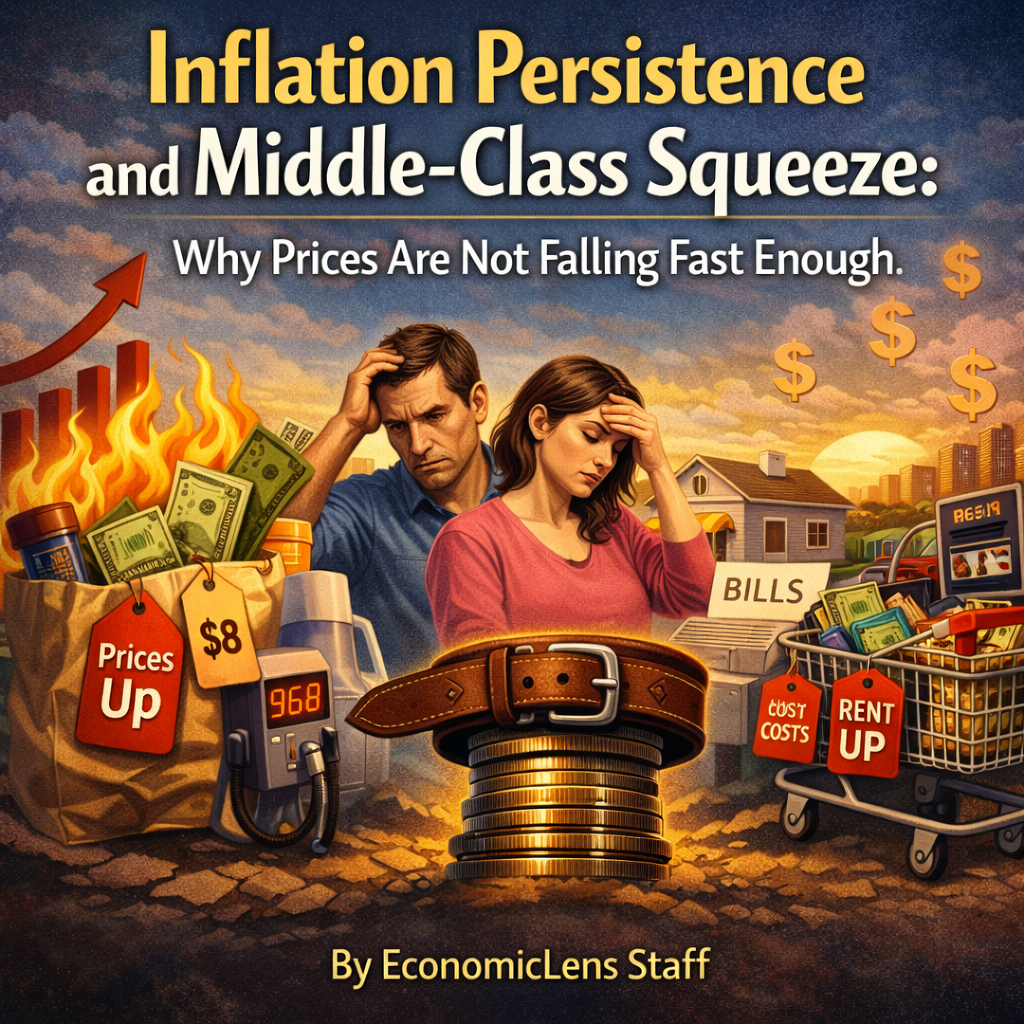
Middle class inflation pressure explains why prices are not falling fast enough. Sticky services inflation, rising housing costs, and wage-price mismatches continue to erode real incomes across advanced and emerging economies, limiting relief even as headline inflation declines.
Inflation pressure on middle incomes in the post-shock economy
Middle class inflation pressure has emerged as one of the most persistent challenges in the post-shock global economy. Although headline inflation has eased across many countries, households continue to face elevated everyday prices. Consequently, official inflation indicators often fail to reflect lived experience. This divergence shapes consumption patterns, savings behavior, and confidence among middle-income households.
Initially, falling energy prices and easing supply chain disruptions created expectations of rapid normalization. However, inflation did not disappear. Instead, price pressures migrated toward sectors with strong downward rigidity. In particular, services and housing adjusted slowly while goods inflation moderated. This pattern closely mirrors the dynamics discussed in the analysis of slow growth and sticky inflation (https://economiclens.org/slow-growth-and-sticky-inflation/).
The International Monetary Fund highlights that services inflation now dominates core inflation dynamics across many economies (https://www.imf.org). Therefore, persistent inflation household pressure reflects structural conditions rather than temporary shocks.
Sticky inflation cost pressure from the services sector
Sticky inflation cost pressure plays a central role in sustaining middle class inflation pressure. Services dominate modern consumption baskets and rely heavily on labor, regulation, and localized demand. For this reason, service prices rarely fall outright once they increase.
Healthcare, education, transport, and personal services respond weakly to easing commodity prices or softer global demand. Moreover, labor shortages and rising wage costs in service industries keep operating expenses elevated. Firms therefore protect margins by holding prices steady rather than reducing them.
Evidence from the Organisation for Economic Co-operation and Development shows that services inflation has declined far more slowly than goods inflation since 2022 (https://www.oecd.org). As a result, inflation driven affordability pressure remains embedded in everyday expenses. Without productivity improvements or regulatory reform, services inflation continues to constrain real income recovery for middle-income households.
Affordability pressure through housing costs
Housing costs remain the most persistent driver of middle class inflation pressure. Rent, mortgage payments, maintenance, and utilities absorb a growing share of household income. Even modest increases therefore generate sustained financial strain.
Housing supply has lagged behind demand due to zoning restrictions, construction bottlenecks, and higher financing costs. At the same time, urbanization and demographic shifts keep demand strong. Monetary tightening, while effective in slowing aggregate inflation, often raises borrowing costs and worsens short-term housing affordability.
Global housing indicators confirm that shelter inflation remains one of the slowest components of consumer prices to cool (https://www.worldbank.org). As a result, housing acts as an anchor delaying broader disinflation. In some economies, energy and currency shocks also feed indirectly into housing costs, similar to dynamics outlined in the Pakistan energy–currency–inflation loop analysis (https://economiclens.org/pakistan-energy-crisis-oil-currency-and-inflation-loop/).
Persistent Inflation Household Pressure by Component
Comparing inflation components rather than headline figures clarifies why middle class inflation pressure persists.
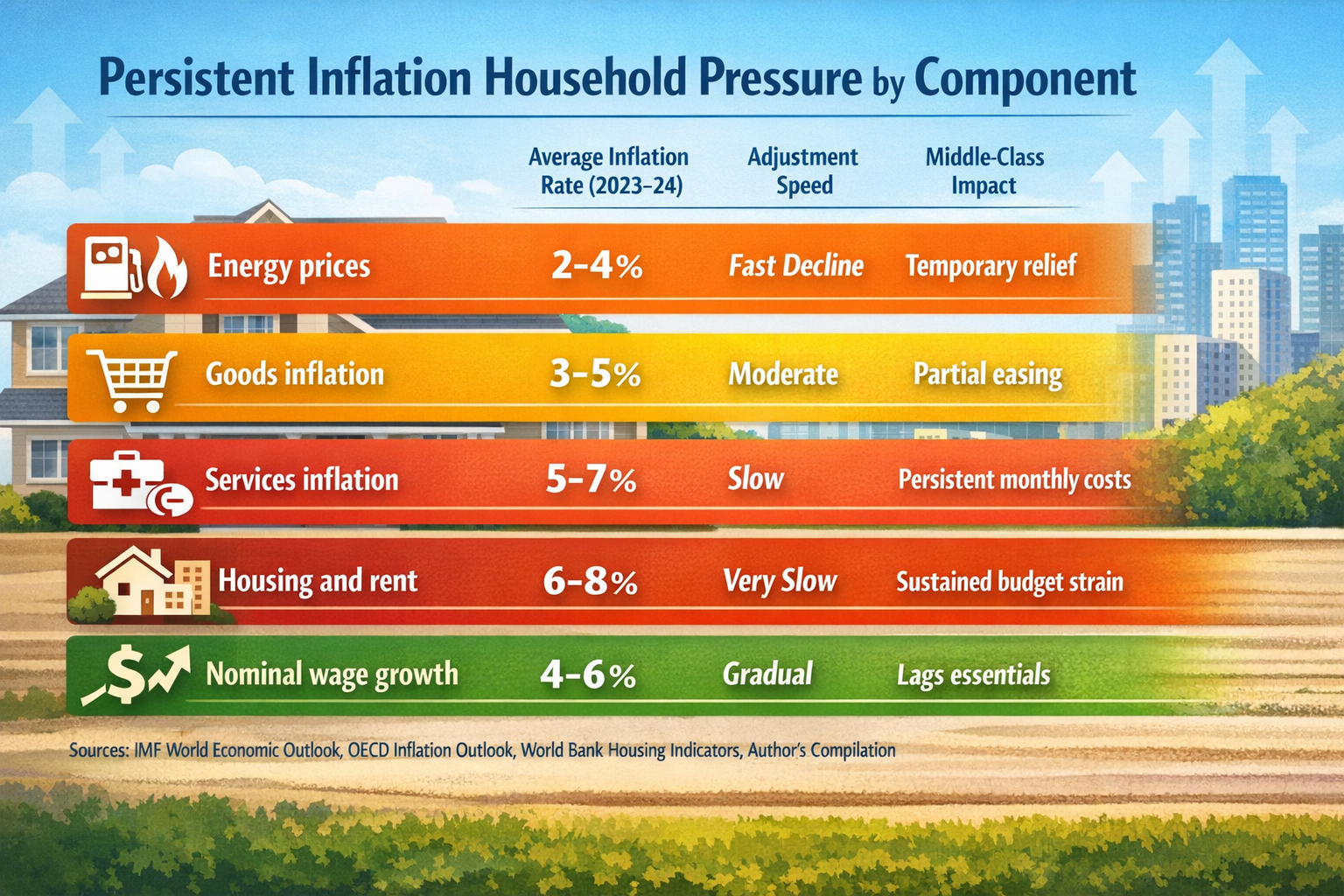
The table shows that essential costs rise faster and adjust more slowly than wages. Consequently, middle-income inflation stress remains even when headline inflation improves.
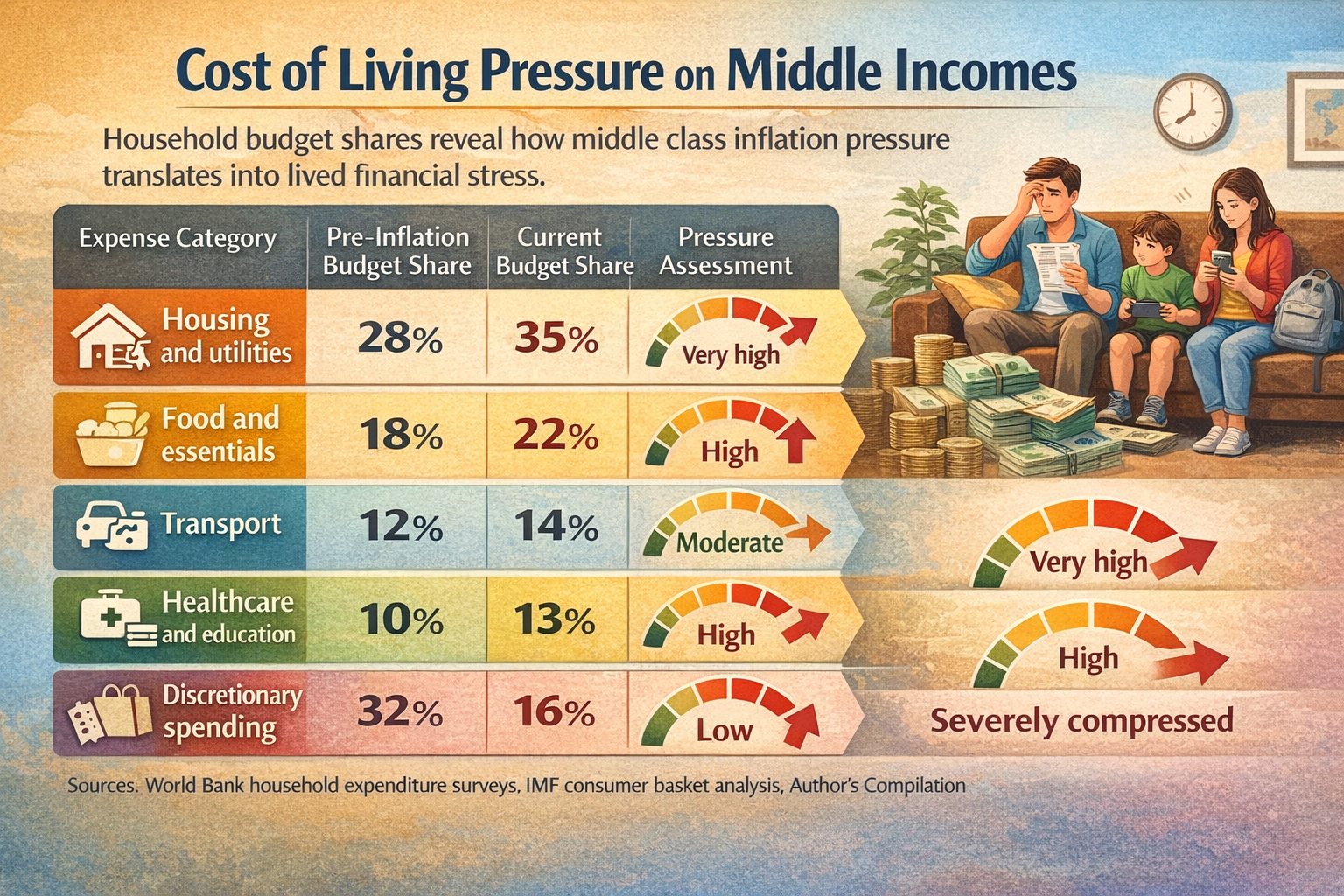
This distribution highlights the core mechanism of inflation driven affordability pressure. Essential expenses crowd out discretionary spending, reducing financial resilience even when employment remains stable.
Middle-income inflation stress from wage–price mismatches
Middle-income inflation stress deepens when wage growth fails to keep pace with essential expenses. Although nominal wages have risen in many sectors, they often lag behind housing, healthcare, and education inflation. This mismatch gradually erodes purchasing power.
Middle-income households rarely qualify for targeted subsidies. At the same time, they lack the asset buffers available to higher-income groups. As a result, middle class inflation pressure appears through declining savings and reduced discretionary spending rather than immediate job losses.
The Bank for International Settlements shows that uneven wage growth amplifies inflation burdens across income groups (https://www.bis.org). Consequently, employment alone no longer guarantees financial stability for middle-income households.
Why monetary tightening fails to ease affordability pressure
Middle class inflation pressure also reveals the limits of monetary policy. Interest rate hikes are effective against demand-driven inflation. However, current pressures largely stem from supply constraints and structural rigidities.
Higher interest rates cool credit growth and consumption. Yet they do not quickly expand housing supply or reduce regulated service costs. In some cases, tighter policy increases household expenses through higher debt servicing.
Energy market normalization has helped reduce headline inflation. However, it cannot offset services and housing inflation on its own (https://www.iea.org). Therefore, reliance on monetary tightening alone delays meaningful relief from cost of living pressure.
Persistent inflation household pressure in emerging economies
In emerging economies, middle class inflation pressure often appears more severe and persistent. Currency depreciation raises import prices, while food and energy costs remain volatile. Fiscal space for targeted relief also remains limited.
Middle-income households face rising prices without strong social safety nets. Moreover, informal employment weakens wage adjustment mechanisms. As a result, inflation translates directly into lower living standards.
The dynamics seen in Egypt’s currency devaluation and inflation spiral illustrate how exchange rate pressures amplify inflation persistence (https://economiclens.org/egypt-currency-devaluation-and-inflation-spiral-explained/). In such contexts, persistent inflation household pressure carries long-term implications for growth and stability.
Policy responses to ease middle class inflation pressure
Reducing middle class inflation pressure requires coordinated policy action beyond headline inflation control. Housing supply must expand through zoning reform, infrastructure investment, and affordable financing. Service-sector productivity should improve through digitalization and skills development.
Targeted fiscal measures also matter. Temporary tax relief and housing support can ease pressure without reigniting broad inflation. Policymakers should therefore prioritize affordability outcomes rather than headline inflation alone.
The International Monetary Fund emphasizes that structural reforms are essential for addressing persistent inflation pressures (https://www.imf.org). Therefore, comprehensive strategies matter more than patience or monetary tightening in isolation.
Conclusion: affordability erosion despite falling inflation
Middle class inflation pressure explains why prices are not falling fast enough. Sticky services inflation, housing costs, and wage–price mismatches slow the disinflation process. Consequently, middle-income households absorb adjustment through eroded savings, reduced discretionary spending, and rising insecurity.
Unless policymakers confront these structural drivers directly, inflation may fall statistically while affordability remains strained. In that case, economic frustration will persist despite apparent macroeconomic progress.