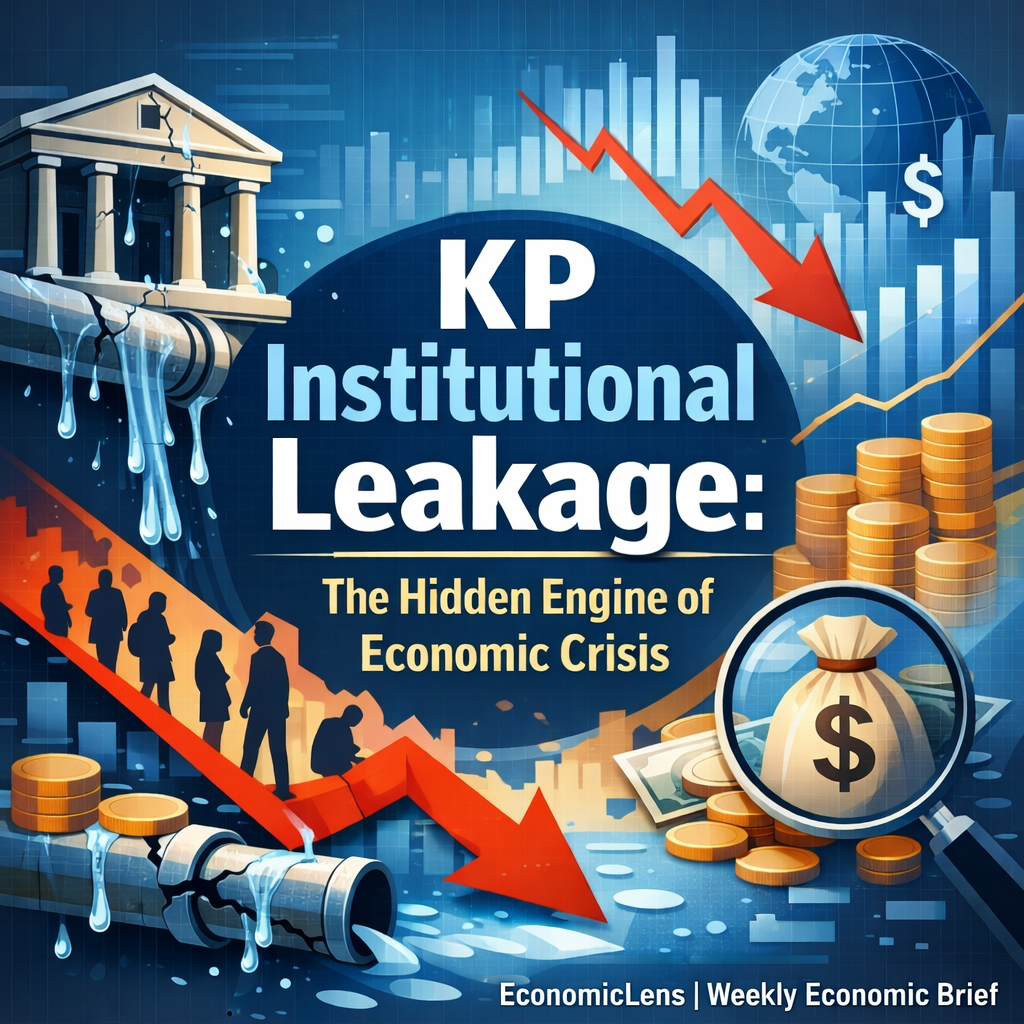
The KP Institutional Leakage framework explains why the KP Economic Crisis persists despite repeated policy announcements and budget allocations. Economic stress in Khyber Pakhtunkhwa no longer stems only from inflation or low growth. Instead, it flows through institutional channels where public resources leak before reaching households, markets and services, a dynamic examined in detail in the EconomicLens analysis on KP’s economic stress and fiscal strain (https://economiclens.org/kp-economic-crisis-poverty-corruption-pressures-and-financial-strain/).
Moreover, electronic media coverage increasingly highlights governance failures that reflect systemic patterns rather than isolated events. Therefore, this weekly brief places KP fiscal leakage at the center of analysis to explain how corruption pressure converts fiscal resources into economic fragility and social stress in Khyber Pakhtunkhwa.
The Core Driver of the Economic Crisis
KP Institutional Leakage manifests when development funds fail to translate into functioning schools, hospitals, roads and utilities. As a result, public spending loses economic impact even when allocations increase. Consequently, the KP Economic Crisis deepens through wasted fiscal capacity, reinforcing the broader governance breakdown documented in the EconomicLens governance crisis assessment (https://economiclens.org/kp-governance-crisis-security-turmoil-border-disruptions-and-institutional-decay/).
Electronic media reporting has repeatedly illustrated this pattern. Coverage on Geo News and ARY News has focused on cost overruns, audit objections and delayed completion of large infrastructure projects. These stories emphasize procurement weaknesses and accountability gaps rather than legal verdicts.
According to World Bank governance analysis (https://www.worldbank.org/governance), institutional leakages can reduce development effectiveness by up to one-third in fragile regions. KP increasingly fits this profile, confirming KP Institutional Leakage as a structural economic constraint.
How KP Fiscal Leakage Amplifies Economic Stress
Economic hardship intensifies when KP Institutional Leakage drains fiscal response capacity. Poverty continues to rise, while household borrowing for food reflects declining resilience. Inflation pressure on essentials compounds this stress. However, institutional leakage magnifies these effects by limiting effective policy delivery.
Moreover, electronic media discussions often link incomplete local development schemes to leakage concerns. Coverage on Samaa TV has highlighted district-level projects that remain unfinished despite full fund releases. Consequently, local markets weaken and employment generation stalls.
According to IMF fiscal transparency research (https://www.imf.org/en/Publications), weak fiscal governance significantly slows recovery from inflation shocks. Therefore, KP Institutional Leakage operates as an economic multiplier that deepens the KP Economic Crisis.
Governance Failure and the Institutional Leakage Channel
Governance fragility strengthens KP Institutional Leakage through weak oversight and fragmented administration. Enforcement inconsistency enables rent-seeking behavior, while accountability mechanisms remain ineffective. As a result, public trust erodes and compliance declines, a pattern central to KP’s governance deterioration (https://economiclens.org/kp-governance-crisis-security-turmoil-border-disruptions-and-institutional-decay/).
Electronic media reporting on health and education procurement illustrates this channel clearly. Reports aired on Express News have focused on alleged overpricing, emergency procurement without competitive bidding, and audit flags in public facilities. These reports signal economic risk rather than isolated misconduct.
According to UNODC governance and crime analysis (https://www.unodc.org), corruption in fragile governance environments directly undermines institutional legitimacy and security. This interaction reinforces KP Institutional Leakage and accelerates the KP Economic Crisis.
Border Trade, Smuggling and Institutional Leakage
Border regions represent a critical transmission point for KP Institutional Leakage. Enforcement inconsistency enables informal payments and smuggling networks. Consequently, formal trade contracts while prices rise in local markets.
Electronic media reporting on border disruptions has frequently highlighted alleged collusion between enforcement personnel and smugglers. Coverage on Dunya News often frames these stories around revenue losses, selective enforcement and market volatility.
According to UNCTAD border governance research (https://unctad.org), prolonged border corruption shifts economic activity into informal channels. This shift weakens revenue collection, increases inflation pressure and deepens the KP Economic Crisis.
Social and Human Costs of KP Fiscal Leakage
The social impact of KP Institutional Leakage reflects its human cost. When funds fail to reach clinics and schools, households absorb the loss through malnutrition, school dropouts and delayed healthcare. Youth unemployment remains elevated, while skills programs underperform due to misallocation. These dynamics align closely with the wider social breakdown analyzed in the EconomicLens social crisis study (https://economiclens.org/kp-social-crisis-demographic-stress-youth-vulnerability-and-human-collapse/).
Electronic media investigations into ghost teachers and non-functional schools consistently highlight salary payments without service delivery. These stories shape public perception of economic mismanagement and institutional decay.
According to UNDP human development research (https://hdr.undp.org), corruption-driven service exclusion accelerates long-term human capital erosion. Therefore, KP Institutional Leakage transforms the KP Economic Crisis into a future productivity crisis.
Why KP Institutional Leakage Connects Economy, Governance and Society
The defining feature of the current crisis is reinforcement. Economic stress increases rent-seeking incentives. Rent-seeking weakens institutions. Institutional decay worsens social outcomes. Consequently, trust collapses and informal systems expand.
Inflation-driven poverty pushes households toward informal dispute resolution. Service delivery failure deepens social fragmentation. Thus, KP Institutional Leakage functions as the central connector across economic, governance and social dimensions.
Conclusion
The KP Economic Crisis increasingly revolves around KP fiscal leakage. Economic hardship, governance failure and social stress reinforce each other through persistent fiscal leakages and weak accountability. Without confronting this channel directly, recovery efforts will remain ineffective.
Therefore, stabilization requires transparency, enforcement and institutional discipline. If KP Institutional Leakage persists, poverty will deepen, trust will erode and human development losses will harden across Khyber Pakhtunkhwa.