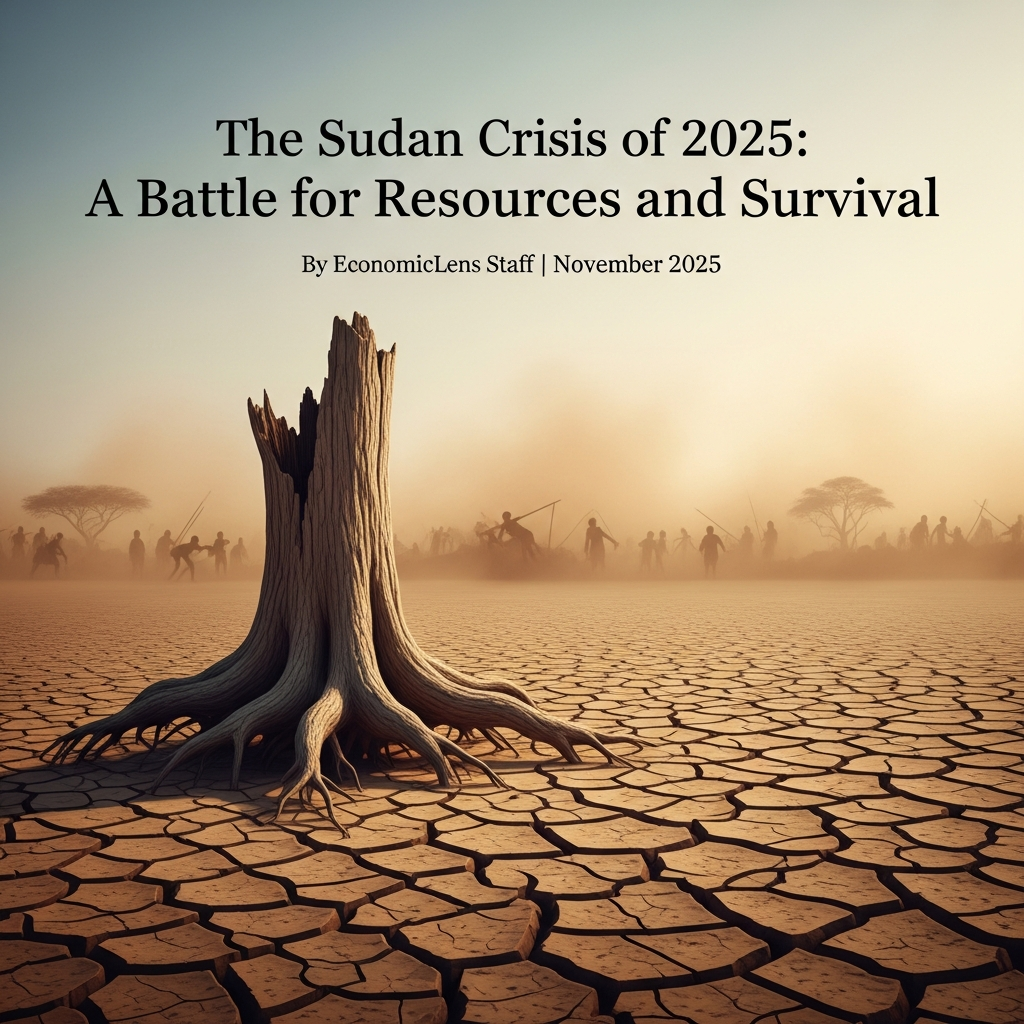
Explore how the 2025 Sudan Crisis, driven by conflicts over oil, gold, and fertile land, is disrupting global trade, energy markets, and supply chains. This blog highlights the humanitarian impact, mass displacement, and the need for sustainable development, while examining the role of foreign intervention and international cooperation in Sudan’s recovery.
Executive Summary
The Sudan Crisis of 2025, fueled by conflicts over oil, gold, and fertile land, is causing a humanitarian disaster with mass displacement and severe global impacts. Disrupting global energy markets, international trade, and supply chains, this crisis highlights the urgent need for sustainable development, renewable energy, and international cooperation. This blog explores Sudan’s resource-driven conflict, foreign intervention, and the path to recovery, focusing on Sudan’s oil and gold resources, refugee crisis, food insecurity, and global supply chain disruptions. It emphasizes the role of global efforts, governance reform, and sustainable solutions in mitigating the crisis
1. Introduction: Sudan Crises 2025
“The battle for Sudan’s resources is not merely a struggle for control over land—it’s a fight for the future of millions of lives. As the conflict intensifies, the global community must take immediate action to prevent further devastation.”
The Sudan Crisis of 2025 is more than a national struggle—it’s a global contest for vital resources. Rich in oil, gold, and fertile land, Sudan has become a battleground for regional power struggles and international competition. For decades, internal conflicts and the scramble for control of its wealth have torn the country apart. As global powers and militias vie for resources, it is the people of Sudan who bear the heaviest cost.
Central to the conflict are Sudan’s oil reserves, essential to many nations’ energy needs, alongside its gold, minerals, and fertile agricultural land, particularly along the Nile River. These resources are vital for both regional food security and global markets, driving local violence and displacement while attracting foreign governments and corporations seeking profit.
As Sudan’s internal strife intensifies, the effects ripple worldwide, impacting oil prices, gold markets, and regional food security. This is not just a regional crisis—it’s a global one that demands urgent attention. The key question remains: How can the world support Sudan’s recovery, and what role does the international community play in either perpetuating or resolving this conflict?
“While global powers fight over Sudan’s resources, it’s the people of Sudan who bear the real cost. The world must decide whether it will stand by or intervene in this moment of crisis.”
2. Overview of the Sudan Crisis 2025
“The crisis in Sudan is a warning sign of what can happen when the world’s great powers compete over a country’s wealth without regard for its people’s future. If the global community does not act, Sudan’s crisis will only escalate.”
Sudan’s crisis is driven by its valuable resources—oil, gold, and fertile land—that attract both local and foreign powers. While these resources hold potential for prosperity, they have sparked geopolitical competition, drawing global and regional actors vying for control.
The struggle over Sudan’s wealth is not just a national issue; it involves major powers like China, Russia, and the West, each seeking access to oil for energy security. Gold has attracted both legitimate investors and illegal miners, further complicating peace efforts.
The human toll is severe, with millions displaced and Sudan’s agriculture, crucial for both the country and its neighbors, crippled. The crisis has far-reaching implications for regional stability, global supply chains, and international relations.

Sudan’s resources, especially oil, fuel geopolitical struggles, with China’s involvement complicating peace. Unregulated gold mining, controlled by militias, funds violence and damages the environment. Control over Nile water also creates tensions with neighboring countries like Egypt and Ethiopia. These resources contribute to instability, highlighting the need for responsible management and international cooperation
“As Sudan’s wealth fuels global conflicts, it is the Sudanese people who bear the burden. The question is no longer just about Sudan’s future—it’s about the world’s responsibility in shaping it.”
3. Setting the Scene: Why Sudan?
“Sudan’s wealth and location have made it a flashpoint for global powers. If the world doesn’t recognize the geopolitical and economic stakes of this crisis, Sudan’s problems will become a global crisis.
Sudan’s wealth and location have made it a flashpoint for global powers. If the world doesn’t recognize the geopolitical and economic stakes of this crisis, Sudan’s problems will become a global crisis.
3.1 Sudan’s Strategic Importance in Africa and Beyond
Sudan’s strategic location at the crossroads of North Africa and the Horn of Africa makes it vital for trade, energy, and geopolitical influence. Its position has sparked power struggles over resources, land, and water rights. With borders shared by seven countries, Sudan faces complex internal and external challenges. Its role in the Nile Basin is crucial for Egypt’s food security, while competition over oil with South Sudan remains a significant issue. Sudan’s oil, gold, and fertile land attract global powers like China, Russia, and Western nations, all vying for economic and strategic advantage.
3.2 Sudan’s Role in the Global Energy Market
As Africa’s third-largest oil producer, Sudan’s oil reserves are critical to both African and global energy markets. Despite losing significant production after South Sudan’s independence in 2011, Sudan controls essential refining and pipeline infrastructure crucial for regional oil transport. China and Russia are major investors, with China’s involvement deepening Sudan’s dependence on foreign powers. The ongoing oil conflict with South Sudan over revenue-sharing and infrastructure use fuels instability and tensions.

Sudan’s oil sector is central to its economy and conflict, and the ongoing oil market disruption caused by internal strife has created uncertainties in global energy markets, leading to fluctuations in oil prices. The ongoing dispute with South Sudan over oil resources and infrastructure continues to fuel violence and corruption. Ethical management and international cooperation in Sudan’s oil industry are essential for peace and development.
“Sudan’s strategic position and wealth are not just local concerns—they’re global issues. The world must pay attention, or it will face the consequences.”
4. Economic Resources at the Heart of the Conflict
“The economic resources of Sudan are both its greatest strength and its most dangerous weakness. Until these resources are used for the good of its people, rather than the benefit of foreign powers and armed factions, Sudan will remain in a state of perpetual conflict.”
Sudan’s abundant natural resources—oil, gold, and fertile land—make it strategically important but also a source of internal conflict. While these resources offer economic potential, they are often exploited by militias, foreign governments, and multinational corporations. The competition for control has led to economic instability, social fragmentation, and humanitarian suffering, perpetuating violence, displacement, and a cycle of exploitation.
4.1 Oil: The Engine of Conflict and the Key to Sudan’s Future
Sudan’s oil reserves are a major revenue source and a key driver of conflict, particularly with South Sudan. Since 2011, disputes over oil wealth and infrastructure, with most reserves in South Sudan and key pipelines in Sudan, have fueled tensions. Militias fight for control to fund operations, while global powers, including China, Russia, and Western nations, view Sudan’s oil as vital for energy security and geopolitical influence. However, a lack of regulation, militia involvement, and illegal extraction has led to corruption, smuggling, and further destabilization.

4.2 Gold: The New Frontier of Resource Conflict
With oil wealth diminishing, Sudan’s gold sector has become its economic lifeline. As one of Africa’s top gold producers, the gold rush has fueled new conflicts, including illegal mining and unregulated exploitation. Both foreign investors and militias benefit, with armed groups controlling gold mines and using profits to fund operations, escalating violence and humanitarian crises.

Sudan’s gold industry, like its oil sector, has become a dual source of economic opportunity and conflict. Unregulated and illegal mining fuels paramilitary groups, exacerbating instability. While international investors see gold as valuable, militia control and the lack of regulation threaten the sector’s long-term sustainability, worsening inequality and violence.
4.3 Agricultural Land: The Key to Regional Stability
Sudan’s agricultural land, especially in the fertile Nile Basin, is crucial for both Sudan and its neighbors. Disputes over water access have heightened tensions with Egypt and Ethiopia, both reliant on the Nile for irrigation and drinking water. Egypt fears Sudan’s increasing control over water could jeopardize its agricultural security, while Sudan views its land as essential for national security and food production. Rather than fostering peace, these resources have fueled division and conflict, highlighting the urgent need for change.
“While Sudan’s resources could provide the foundation for peace and prosperity, they have instead become a curse, driving further division and conflict. The time for change is now.”
5. Facilitators of the Crisis
“The role of foreign actors and militias in Sudan’s conflict cannot be ignored, with ethnic violence being a significant factor in the ongoing conflict, especially in regions like Darfur, where local militias often exploit ethnic divisions to fuel violence. If the global community continues to fuel the crisis by supporting their interests, Sudan’s suffering will never end.”
The crisis in Sudan is fueled by both internal mismanagement and external interventions. The control of Sudan’s valuable resources—oil, gold, and agricultural land—has attracted foreign governments, multinational corporations, and regional militias, all of which have exacerbated violence, human rights abuses, and instability. While Sudan’s government contributes to the conflict, global powers like China, Russia, and Western nations, along with multinational corporations, complicate peace efforts. These external actors have pursued Sudan’s resources and provided military support, intensifying violence and undermining the country’s long-term stability.
5.1 Foreign Governments and Military Support
The foreign intervention in Sudan’s conflict, particularly from China and Russia, has exacerbated the situation, with both nations supporting the Sudanese government in exchange for access to Sudan’s resources. This intervention has complicated peace efforts and prolonged the crisis. Both nations have invested heavily in Sudan’s oil industry and provided military aid to the Sudanese government to safeguard their geopolitical interests. China, Sudan’s largest trading partner, has supplied weapons and military equipment to help maintain government control and suppress opposition. Russia has also expanded its influence, providing arms, training, and military support to secure access to Sudan’s resources and strengthen the government’s ability to quell dissent.

China’s economic partnership has entrenched authoritarian rule in exchange for access to oil, while Russia seeks to expand its influence in Africa. In contrast, the U.S. and U.K. focus more on human rights and peacekeeping but struggle with balancing their interests as China and Russia deepen their involvement.
5.2 Regional Militias and Armed Groups
Local militias and armed groups play a central role in sustaining the Sudan crisis. These groups control key resources, such as gold mines, oil fields, and agricultural land, using the profits to fund military operations. The lack of regulation in Sudan’s resource industries has allowed these militias to thrive, escalating violence and human rights abuses. For example, the Janjaweed militias in Darfur have been involved in ethnic violence, forced displacement, and mass murder while exploiting land and water resources. These militias often finance their activities through illegal mining and smuggling.
The Sudanese government is accused of collaborating with these militias, providing them with arms and financial support in exchange for loyalty. This alliance has allowed militias and paramilitary forces to operate with impunity, backed by both foreign and domestic actors vying for control of Sudan’s resources.
“The facilitators of Sudan’s crisis are not just external actors—they are complicit in the violence. To stop the conflict, the world must hold these facilitators accountable.”
6. Socioeconomic Impact of the Crisis
“The economic collapse in Sudan has created a humanitarian catastrophe that goes beyond borders. The world cannot ignore the suffering of millions—Sudan’s crisis demands an urgent and coordinated global response.”
While the political and military aspects of Sudan’s crisis dominate global attention, the human cost is equally devastating. The conflict has shattered Sudan’s economy, social fabric, and livelihoods, displacing millions of civilians and leaving entire regions in ruin. The economic impact extends beyond Sudan, affecting neighboring countries through spillover effects. Once reliant on oil and agriculture, Sudan’s economy now faces hyperinflation, a collapsed currency, and widespread food insecurity. Disrupted trade routes, especially in oil and agriculture, have stalled growth, leading to business closures, deteriorating public services, and the destruction of critical infrastructure.
6.1 Displacement and Refugee Crisis
The ongoing conflict has caused massive displacement, with millions fleeing their homes, resulting in a refugee crisis that has placed immense strain on neighboring countries. Refugee aid efforts have been critical but remain insufficient in the face of growing humanitarian needs. Many live in temporary camps in neighboring countries like Chad, Ethiopia, and Egypt, facing dire conditions such as inadequate shelter, food scarcity, and limited healthcare. Sudan’s refugee crisis is among the largest in the world, placing immense pressure on host countries. Despite international aid, the funding gap remains significant, and long-term solutions to displacement are unclear.

6.2 Food Insecurity and Economic Collapse
The conflict has devastated Sudan’s agricultural sector, destroying crops, causing livestock loss, and driving up food prices, leaving many unable to afford basic necessities. The disruption of trade routes and hyperinflation has worsened food insecurity, with over 13 million people facing hunger. Sudan’s economy has collapsed, marked by soaring unemployment and a worthless currency, crippling public services and deepening the humanitarian crisis. International sanctions have further compounded these challenges, blocking access to essential resources like food and medicine. Economic recovery remains distant, and Sudan’s population remains trapped in a cycle of poverty and violence.

The ongoing economic collapse and sanctions have deepened Sudan’s crisis, with no immediate solutions in sight. Without urgent international intervention, Sudan’s people will continue to face severe hardship.
“The true cost of Sudan’s crisis is not measured by the value of oil or gold, but by the lives of millions of innocent civilians who have lost everything.”
7. Impact on Global Supply Chains
“As the crisis in Sudan disrupts global supply chains, the world must recognize that Sudan’s collapse is not just a regional issue—it is a global problem that affects everyone.”
In addition to its role in global supply chains, Sudan’s oil reserves and pipeline infrastructure link it to international energy markets, making it a key player in both regional and global trade despite the ongoing conflict. However, ongoing conflict has severely disrupted oil production, leading to a decline in output and exports, affecting global energy prices. Disputes over oil revenues between Sudan and South Sudan, along with militant attacks on oil infrastructure, have created uncertainty and instability in the international oil market. Countries like China, India, and those in Europe, which depend on Sudanese oil, have experienced higher prices and energy uncertainty as a result.

The ongoing energy crisis in Sudan, caused by the collapse of oil production and transportation, has contributed to energy shortages across the region, further destabilizing both Sudan and neighboring countries’ energy security.
7.2 Gold and Mining Sector Disruptions
Sudan’s gold industry, a key global producer, has been heavily disrupted by the ongoing conflict. Militias control much of the gold mining, resulting in inefficiencies, illegal mining, and unpredictable supply. These disruptions have not only fueled the conflict but also reduced Sudan’s potential economic revenue, as gold exports are often diverted to black markets, contributing to corruption and economic instability. Multinational corporations have struggled to operate due to the lack of regulation, while armed groups profit from the illegal gold trade, perpetuating violence.

Sudan’s gold sector, once a major economic asset, has become a source of instability. Illegal mining, militia control, and environmental damage have severely impacted both Sudan’s economy and global gold markets, while perpetuating violence and corruption in the region.
“The world cannot afford to ignore Sudan’s impact on global supply chains. As Sudan falters, we all face the consequences.”
8. Path to Sustainable Recovery
“The window for a peaceful solution is closing fast—without immediate intervention, the damage will be irreversible.”
Sudan’s crisis stems from internal conflict, resource competition, and external geopolitical interests. To resolve this, a multi-stakeholder approach involving multinational corporations (MNCs), international organizations, regional cooperation, and youth empowerment is crucial. While MNCs in sectors like oil and gold have contributed investments, they’ve also fueled resource exploitation, human rights abuses, and environmental damage. Companies such as CNPC and AngloGold Ashanti have helped the Sudanese government suppress opposition, exacerbating the crisis. Meanwhile, international organizations like the UN, AU, and World Bank have provided humanitarian aid and peacekeeping support, but their efforts are often limited by geopolitical interests and fragmented engagement.
8.1 Inclusive Peace Talks and Diplomacy
Sustainable peace requires inclusive negotiations involving the Sudanese government, rebel groups, militias, and civil society. Past peace agreements failed due to exclusion, particularly on issues of resource control and political representation. The involvement of regional powers like Ethiopia and Egypt, alongside global players like China and Russia, highlights the necessity for multilateral diplomacy to address Sudan’s internal divisions and bring lasting peace.
8.2 Sustainable Energy and Agricultural Practices
For lasting peace and development, sustainable investment in Sudan’s infrastructure, energy sector, and agriculture is essential. By encouraging ethical investment practices, Sudan can rebuild its economy and foster long-term growth. With abundant solar and wind resources, Sudan can reduce reliance on fossil fuels, lower energy costs, and create jobs. Similarly, reviving the agricultural sector through sustainable farming practices, such as agroforestry and modern irrigation, will combat food insecurity, reduce rural poverty, and restore environmental balance, providing long-term economic growth.
8.3 Youth Empowerment: Sudan’s Future Leaders
Sudan’s youth, a vital portion of the population, are key to its recovery but are marginalized by limited access to education and employment. Investment in education, particularly technical and vocational training, and empowering youth through leadership programs, entrepreneurship, and peacebuilding roles will drive Sudan’s transformation.
8.4 Regional Cooperation and Global Support
Sudan’s crisis affects neighboring countries like Ethiopia, Egypt, and Chad through refugees, trade disruptions, and security issues. Regional cooperation is critical to managing shared resources such as the Nile River and providing humanitarian aid. Global actors, including the UN, World Bank, EU, and the US, must offer financial support, technical aid, and diplomatic engagement to help Sudan stabilize.
8.5 Governance Reform and Economic Diversification
Sudan’s recovery hinges on governance reform and economic diversification. Transparent and accountable institutions are needed to reduce corruption, promote democracy, and ensure equitable resource distribution. Additionally, Sudan must diversify its economy beyond oil and gold, investing in agriculture, renewable energy, technology, and manufacturing to build resilience against global price fluctuations.
8.6 Technology and Innovation as Drivers of Change
Technological innovation is essential for Sudan’s reconstruction. Expanding digital infrastructure, improving connectivity, and investing in mobile tech can foster financial inclusion, e-commerce, and entrepreneurship. AgTech solutions, like precision farming and smart irrigation, can modernize agriculture, boost yields, and mitigate climate change, positioning Sudan as a regional leader in clean energy and technology.
8.7 Corporate Responsibility and Ethical Practices
MNCs must take responsibility for their impact in Sudan by aligning operations with ethical standards. They should contribute to peacebuilding, sustainable development, and respect for human rights. International accountability mechanisms, such as regulatory frameworks and corporate codes of conduct, can ensure responsible corporate behavior that supports Sudan’s recovery.
9 Final Word: Call to Action
Sudan’s future depends on a coordinated effort from regional and global actors. A unified approach to peacebuilding, economic recovery, and sustainable development is necessary for long-term stability. The international community must intensify its engagement, ensuring resources are used responsibly, human rights are respected, and Sudan is on a path to peace and prosperity.
Sudan’s recovery is possible but requires a comprehensive, multi-faceted approach. The involvement of MNCs, international organizations, regional cooperation, sustainable development, and youth empowerment is essential. The global community must unite to support Sudan, addressing the root causes of conflict and fostering long-term solutions that empower the Sudanese people
“The time for Sudan’s recovery is now. We must prioritize the people of Sudan, ensuring that its resources are used for peaceful development, not conflict.“