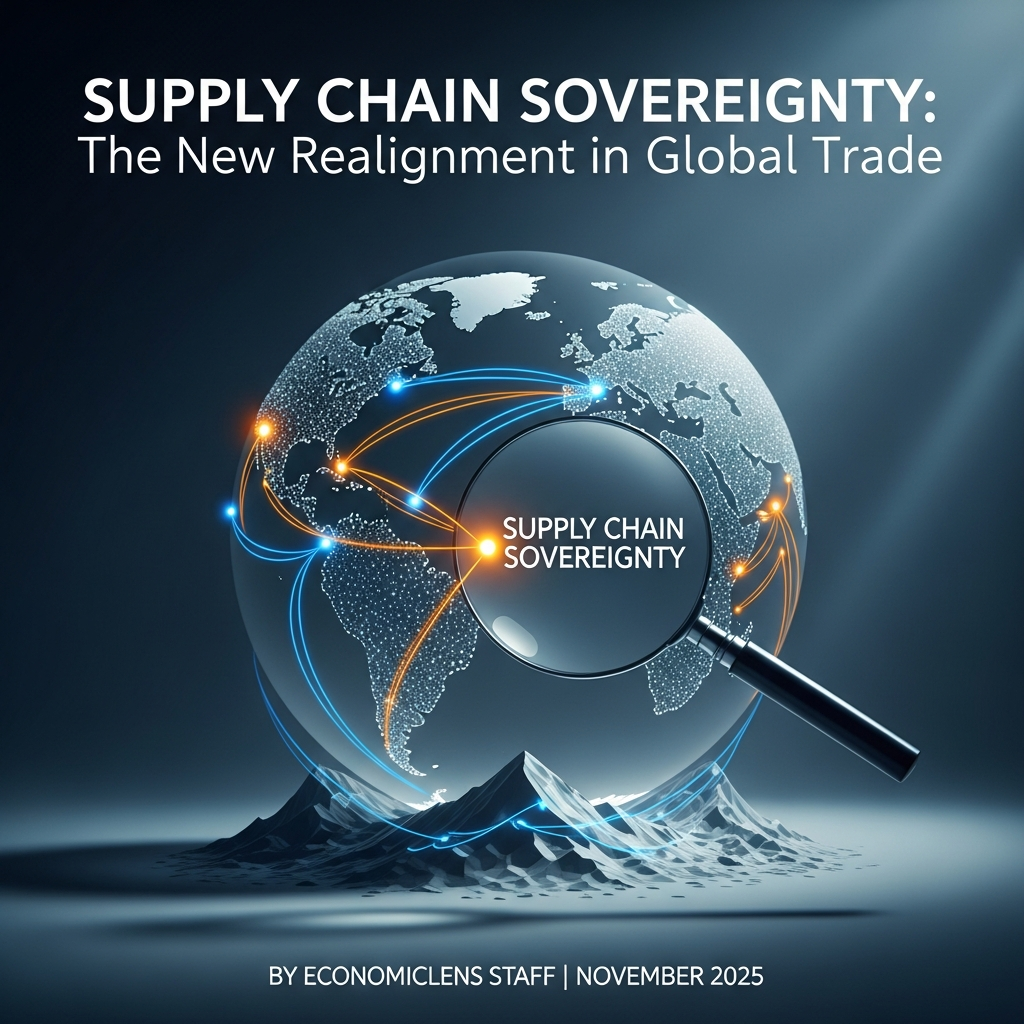
Supply chain sovereignty is transforming global commerce as nations reshape trade routes, rebuild industrial capacity, and reduce strategic dependencies. From emerging trade blocs to advanced manufacturing and policy shifts, this analysis explores how resilience and realignment are redefining the future of global trade.
Introduction
The world economy is undergoing a profound transformation driven by the rise of supply chain sovereignty, a strategic movement aimed at reducing dependency, strengthening industrial capacity, and reshaping global commerce. After years of disruptions—from pandemics to geopolitical tensions—nations are redesigning the flow of goods, technology, and resources. This shift challenges decades of globalization, replacing efficiency-driven supply networks with resilience-driven systems. As supply chain sovereignty becomes central to economic strategy, governments and industries are realigning trade relationships and rethinking industrial policy. Understanding this transition is essential for predicting the future architecture of global trade.
1. Why Supply Chain Sovereignty Has Become a Global Priority
Nations are embracing supply chain sovereignty to protect critical industries and reduce exposure to external shocks. Recent crises revealed weaknesses in overextended supply networks, prompting countries to strengthen domestic production, diversify suppliers, and secure essential resources. Moreover, economic nationalism and geopolitical rivalry have intensified the demand for supply chain control, making sovereignty a strategic necessity rather than an optional policy.
The OECD’s 2024 Resilience Report states, “Countries pursuing supply chain sovereignty will achieve higher economic stability and reduced geopolitical exposure.” McKinsey adds that 75% of global supply chains experienced disruptions severe enough to trigger structural realignment.

The table shows that security and geopolitical tensions are now the strongest forces shaping global supply chains. Nations are compelled to reconfigure production networks to reduce vulnerability.
“Sovereignty is becoming the currency of global resilience. Nations securing their supply chains today are building the economic foundations of tomorrow.”
2. Trade Realignments Reshaping Global Commerce
Global trade is undergoing a strategic realignment as countries pivot toward trusted partners. The era of hyper-globalization is giving way to regional blocs, friend-shoring networks, and resource-focused alliances. Consequently, supply routes are shifting from cost-based to trust-based models.
The World Trade Organization notes that regional trade corridors grew 28% faster than global trade in 2024. Economist Laura Henning writes, “Supply chain sovereignty is driving the most significant trade realignment since the post–Cold War era.”

These blocs illustrate how nations are designing specialized ecosystems to secure critical industries—from semiconductors to energy.
“The rules of global commerce are being rewritten. Strategy, not geography, now determines who trades with whom.”
3. Industrial Strategies Transforming Global Manufacturing
Countries are deploying aggressive industrial policies to achieve supply chain sovereignty. The U.S. is reshoring semiconductor production; the EU is stockpiling essential materials; Japan is friend-shoring critical technologies; India and Vietnam are attracting multi-shoring projects at record pace. These industrial strategies are reshaping global manufacturing footprints.
The McKinsey Industrial Competitiveness Index shows a 43% rise in industrial policy spending between 2023 and 2025. Analyst Dev Patel states, “Industrial strategy is now the frontline of global economic competition.”

The table highlights massive incentive programs targeting high-value industries essential to sovereignty and technological leadership.
“Nations are no longer just manufacturing goods—they are manufacturing independence.”
4. Technology and Automation Reinventing Supply Networks
Technology is redefining how global production lines operate. AI-driven forecasting, industrial robotics, 3D printing, and digital twins are enabling nations to modernize operations and reduce dependence on foreign suppliers. As a result, production is becoming smarter, more localized, and less risk-prone.
Accenture’s 2025 Manufacturing Futures Report notes that companies adopting automation frameworks achieved 40% greater operational resilience. Robotics economist Dr. Hana Lee states, “Technology is the backbone of supply chain sovereignty.”

These rising adoption rates demonstrate the industry-wide shift toward intelligent, adaptive manufacturing ecosystems.
“The factories of tomorrow won’t just produce—they will anticipate, respond, and evolve.”
5. Winners and Losers in the New Supply Chain Order
The move toward supply chain sovereignty is creating clear geopolitical and economic winners. Nations offering political stability, advanced infrastructure, and skilled labor are becoming manufacturing magnets, while others risk being sidelined.
The Economist Intelligence Unit reports that Mexico, India, and Vietnam saw double-digit FDI growth due to nearshoring and multi-shoring trends. Analyst Renee Kim states, “The redistribution of supply chains is creating new economic champions.”

These nations are benefiting from strategic positioning and readiness to absorb global manufacturing flows.
“In the new era of supply chains, competitive advantage isn’t given—it’s built.”
6. Policy Implications: How Governments Will Govern the New Trade Order
As supply chain sovereignty reshapes economic priorities, governments must implement new frameworks for resilience, competitiveness, and national security. These include stricter audits, tighter export controls, digital trade systems, and large-scale investment incentives.
The Brookings Trade Policy Review warns that “supply chain sovereignty demands coordinated industrial and trade governance to avoid fragmentation.” Policy strategist Dr. Omar Rafiq adds, “Sovereignty must be balanced with openness to avoid global inefficiency.”

This policy shift demonstrates how deeply supply chain strategy is embedded in national security and economic planning.
“The nations writing tomorrow’s policies will define tomorrow’s markets. Governance is becoming the new competitive advantage.”
Future Outlook
Over the next decade, supply chain sovereignty will become the backbone of global economic strategy. Trade networks will be more regional, manufacturing more automated, and industrial policy more central to national planning. Nations that prepare now will shape the future of global commerce.
Conclusion
Supply chain sovereignty is more than a trend—it is the blueprint of a new global economic order. As nations, companies, and industries restructure their networks, the balance of global commerce will continue shifting.
“The supply chains of today are the power structures of tomorrow. Those who reshape them now will lead the world ahead.”
Call to Action
Stay informed about trade realignments, industrial strategies, and technology-driven disruptions. The future of commerce will belong to those who understand how the world is being rebuilt.