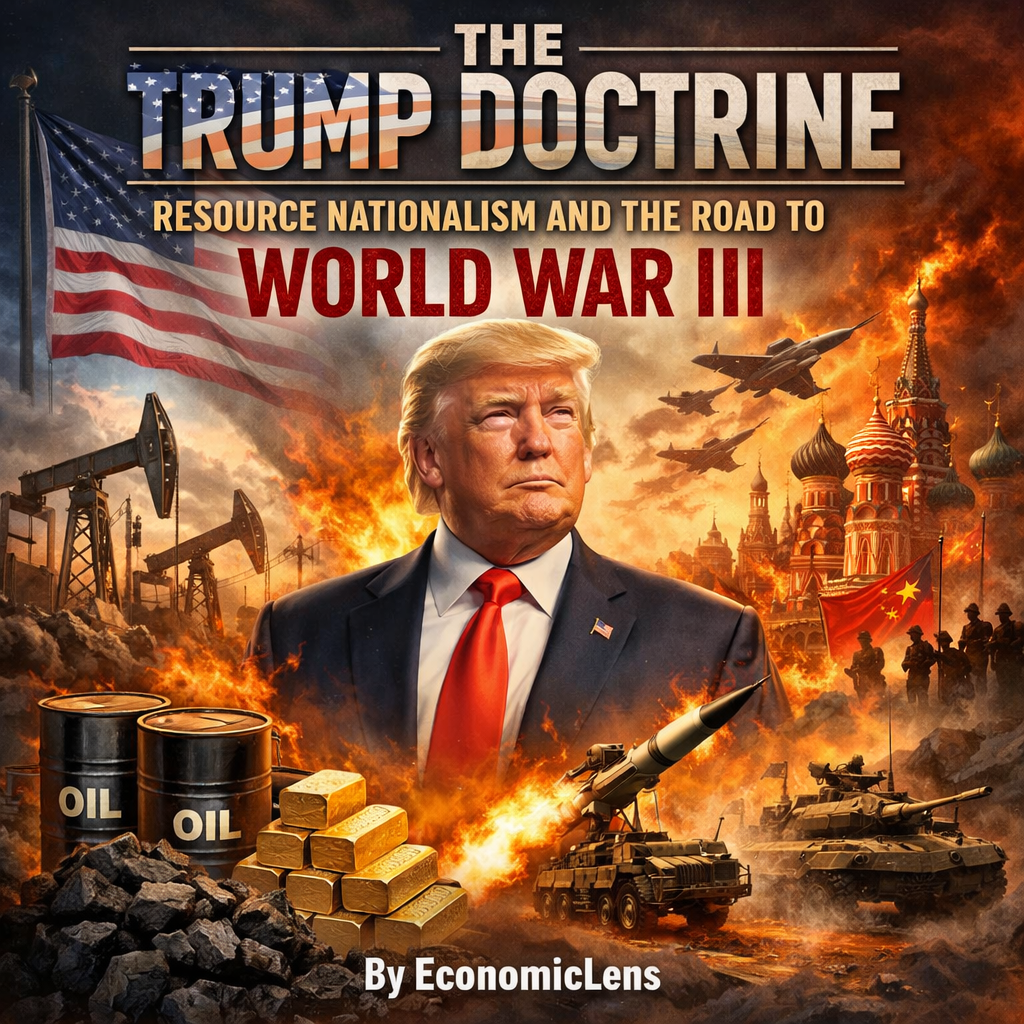
Trump Doctrine and World War III are increasingly connected as U.S. foreign policy shifts toward resource nationalism, regime pressure, and rejection of international legal constraints. From Venezuela and Iran to Greenland and Taiwan, strategic resource control and escalation dynamics are reshaping global stability and increasing the risk of systemic war.
The Trump Doctrine: Resource Nationalism and the Road to World War III
Global politics is no longer shaped by isolated crises. Instead, multiple regions are under pressure at the same time. Energy markets, supply chains, and strategic territories have become central to power competition. Within this environment, Trump Doctrine and World War III are increasingly discussed together, not as speculation, but as a structural risk emerging from policy choices. The Trump Doctrine prioritizes resource nationalism, unilateral leverage, and exclusion of rivals over multilateral stability. As these principles are applied across regions, systemic tension grows. Large-scale war does not require a single trigger. Rather, it emerges from accumulated pressure across multiple theaters. Understanding the connection between Trump Doctrine and World War III is therefore essential for assessing the current global trajectory.
Trump Doctrine Global War Strategy and Venezuela’s Energy Resources
Venezuela represents one of the clearest examples of how Trump Doctrine global war strategy operates through resource nationalism. The country holds the world’s largest proven oil reserves according to international energy assessments (https://www.iea.org). For years, Venezuela’s energy sector attracted competing interests from major powers. Under the Trump Doctrine, however, competition shifted toward exclusion and dominance.
Economic sanctions were expanded to restrict oil exports and access to international finance. IMF reporting shows that these measures sharply reduced government revenue and production capacity (https://www.imf.org). As fiscal pressure increased, political instability followed. While public justification focused on governance issues, the strategic outcome centered on control over energy flows.
At the same time, U.S. policy increasingly framed Venezuelan oil as a hemispheric security concern. Reuters analysis highlighted fears of Chinese and Russian influence in Venezuelan energy infrastructure (https://www.reuters.com). Consequently, the objective extended beyond regime pressure. It aimed to reshape regional energy dominance.
This approach reflects a core logic linking Trump Doctrine and World War III. When energy-rich states are treated as strategic assets rather than sovereign economies, escalation risks rise. Venezuela demonstrates how economic coercion can substitute for military occupation while still reshaping sovereignty. Over time, this method deepens rivalry and contributes to global instability.
Trump Doctrine Escalation Framework and Iran’s Regime Pressure
Iran sits at the center of the Trump Doctrine escalation framework due to its energy wealth and strategic geography. The country holds major oil and gas reserves and lies near critical maritime chokepoints (https://www.worldbank.org). As a result, Iran’s sovereignty directly affects global energy security.
Sanctions served as the primary mechanism of pressure. These measures restricted exports, banking access, and shipping insurance. OECD analysis shows that prolonged sanctions reduce long-term investment and growth capacity (https://www.oecd.org). Economic stress narrowed policy options and intensified domestic unrest.
At the same time, indirect military pressure increased through regional escalation. Israeli strikes on Iranian-linked targets are documented as part of a broader containment strategy (https://www.sipri.org). Within this framework, proxy conflict degrades influence without direct U.S. military engagement.
Public rhetoric also signaled declining respect for legal constraints. This reduced barriers to unilateral action. When combined with sanctions and proxy conflict, regime pressure becomes structural. Iran illustrates how Trump Doctrine and World War III intersect through sustained coercion rather than open war. As similar strategies are applied elsewhere, systemic escalation risks grow.
Strategic Resource Control Doctrine and Greenland’s Mineral Wealth
Greenland shows how the strategic resource control doctrine expands beyond traditional conflict zones. The territory contains significant reserves of rare earth elements and critical minerals essential for modern energy systems and defense technologies (https://www.iea.org). It also occupies a vital position in Arctic security architecture.
Under the Trump Doctrine, Greenland is framed as a strategic asset rather than a political entity. Public discussions about acquiring or controlling Greenland reflected a shift from alliance-based governance to resource-centric calculation. Climate research confirms that melting ice is increasing access to minerals and shipping routes (https://www.ipcc.ch).
Greenland’s location intersects with missile defense, undersea infrastructure, and Arctic transit lanes. This multiplies its strategic value. Consequently, assertions of exclusive influence risk provoking responses from other Arctic stakeholders, including Russia and China.
This case reinforces the structural link between Trump Doctrine and World War III. As competition expands into previously stable regions, institutional restraint weakens. Resource nationalism transforms geography into a source of conflict rather than cooperation, increasing long-term escalation risk.
Energy Dominance Conflict Strategy and Taiwan’s Strategic Supply Chains
Taiwan represents a non-traditional but critical resource within energy dominance conflict strategy. Although not an oil producer, Taiwan dominates global semiconductor manufacturing, which underpins energy infrastructure, defense systems, and advanced industry (https://www.worldbank.org).
Within the Trump Doctrine, Taiwan functions as a leverage point rather than solely a security commitment. Ambiguous signaling regarding U.S. protection introduces uncertainty. Analysis by the Council on Foreign Relations shows that inconsistent deterrence increases miscalculation risk (https://www.cfr.org).
Encouraging strategic tension around Taiwan also diverts Chinese economic and military resources toward prolonged preparedness. This aligns with a supremacy logic that seeks to constrain rivals through sustained engagement. As technology and energy systems converge, supply-chain control becomes as consequential as oil access.
Therefore, Taiwan’s status directly connects Trump Doctrine and World War III. When technology, energy, and security converge in one theater, escalation risks multiply. Combined with pressure in energy-producing regions, this strategy deepens systemic fragility.
Conclusion
Taken together, these developments point to a single, unsettling reality. The world has entered a new, abnormal, and increasingly dangerous global phase, where instability is no longer confined to one country or one region. Instead, tensions are smoldering across multiple continents at the same time. These are not isolated news events. They are early signals of a much larger storm forming within the international system.
Within this context, Trump Doctrine and World War III are linked through a shared structural logic. Resource nationalism, strategic denial, and unilateral coercion are replacing cooperation and multilateral governance. Venezuela, Iran, Greenland, and Taiwan are not accidental cases. They are interconnected applications of the same strategic approach.
Equally important is Trump’s explicit refusal to recognize binding international legal constraints. This rejection of international law signals future intent. By treating legal norms as optional, Trump lowers the threshold for unilateral intervention and resource control. As legal restraint erodes, escalation becomes easier and predictability declines.
World war is not inevitable. However, by redefining sovereignty through control of resources and freedom from legal limits, the Trump Doctrine increases systemic risk. Moreover, understanding how conflict transitions into reconstruction remains crucial. For insights into economic rebuilding once wars or major conflicts end, see our analysis on post-conflict economic recovery and rebuilding economies after war (https://economiclens.org/post-conflict-economic-recovery-rebuilding-economies-after-war/). The danger lies not in one decision, but in an accumulating architecture that steadily pushes the global system closer to a point where restraint fails.