
Explore the evolving digital arms race, where nations battle for technological supremacy through AI, cybersecurity, digital currencies, and more. Analyze its economic implications on global power.
Executive Summary: Digital Arms Race: Technological Supremacy in Global Politics
The digital arms race is redefining global dominance, as nations vie for technological supremacy in key sectors like artificial intelligence (AI), cybersecurity, and digital currencies. This shift from military rivalry to technological competition is driving geopolitical tech rivalry and reshaping global trade (Smith, 2025). Countries like the USA, China, and Russia are heavily investing in emerging technologies to secure their future as global economic leaders. The USA leads in AI and cybersecurity, while China is at the forefront with its Digital Yuan (e-CNY) and 5G technology, positioning itself as a dominant force in the digital economy.
As digital currencies and central bank digital currencies (CBDCs) rise, they alter the landscape of global economic power. Nations controlling these technologies will dictate the rules of international trade and monetary policy. Sustainability will also play a pivotal role. Green technologies like solar energy, electric vehicles (EVs), and AI for green tech will drive future global economic growth, fostering digital sovereignty and ensuring long-term economic resilience.
In conclusion, the digital arms race is not just about technological supremacy, but the economic power that comes with controlling these innovations. The future of global economic governance will depend on who leads the Code War—the battle for technological sovereignty
“In the digital arms race, nations now compete not with missiles, but with AI, cybersecurity, and digital currencies—shaping the future of global economic power.”
1. The Shift from Cold War to Code War
The digital arms race is transforming the way nations interact on the world stage. In the past, military might and the threat of nuclear conflict defined geopolitical power. Today, that power is being increasingly shaped by who controls the technologies that drive the global economy. From artificial intelligence (AI) to cybersecurity, and digital currencies, countries are no longer competing solely through force but through technological supremacy (Smith, 2025).
With the emergence of smart technologies, 5G networks, and blockchain innovations, global powers are recalibrating their strategies. The battle is no longer about military supremacy but about who controls the most advanced technology, and consequently, who controls the global economy. This cyber arms race is leading the charge in defining future economic policies, shaping global trade, and even determining the balance of power in international relations.
The shift from military dominance to technological dominance is not just a political or ideological battle—it’s an economic war. As nations race to lead the digital frontier, they are positioning themselves as global leaders or followers in the next phase of technological and economic evolution. The stakes are high, and the rewards for winning this Code War could reshape the global economic landscape forever.
“The world’s most powerful nations no longer fight wars with missiles—they fight with algorithms. The digital arms race is here, and it’s about to reshape the global economy in ways we’ve never seen before.”
2. From Cold War to Digital War: How Technology is Shaping Global Dominance
The Cold War may have ended, but the battle for global dominance never truly ceased. Now, it is taking on a new form—one that is digital, fast-paced, and marked by the dominance of technology. While the Cold War saw the USA and the USSR vie for control of the world through nuclear weapons and military alliances, today, nations are jockeying for power through innovations like cyber capabilities, AI development, and control of digital currencies.
This new digital warfare has the potential to be just as dangerous, if not more so, than the Cold War itself. As we look back, the historical significance of military conflict gave way to an economic race. Today, we see the cyber arms race defining new alliances, disrupting trade relations, and reordering the global economic structure.
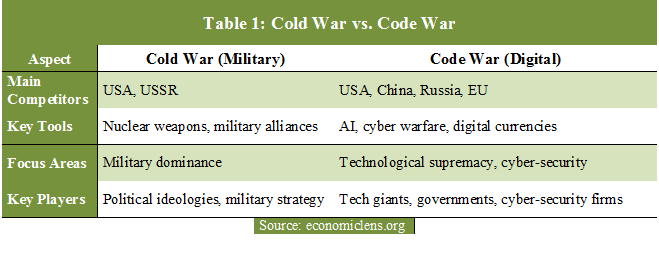
Data Source: Historical records from the Cold War, Global Politics Analysis (2025).
This table compares the Cold War period with the current digital arms race, highlighting the shift from military confrontation to technological competition. The comparison provides context for understanding how the digital arms race is now the driving force behind global power dynamics and economic strategy.
“The Cold War may be over, but the fight for global supremacy is more alive than ever. Now, it’s all about who controls the technology that powers economies.”
3. Global Competitors in the Technological Era: The Role of Major Players
The digital arms race has created a new class of competitors—technological giants and sovereign states—each vying for digital dominance in the global economy. These players aren’t just governments, but tech corporations like Google, Huawei, and Apple that are driving innovation, setting standards, and ultimately defining the future economic order. The race to dominate technologies like AI, 5G, and blockchain is not just about technological innovation, but about shaping future global economies.
For example, China’s aggressive investments in 5G networks, coupled with its Digital Yuan (e-CNY), are positioning the country as a formidable force in the global economic landscape. Meanwhile, the USA continues to lead in AI development and cybersecurity innovations, with Silicon Valley serving as the epicenter of technological power.
This technological competition has massive economic implications, as those who control the most advanced technologies control the future of global trade, economic policy, and financial systems.
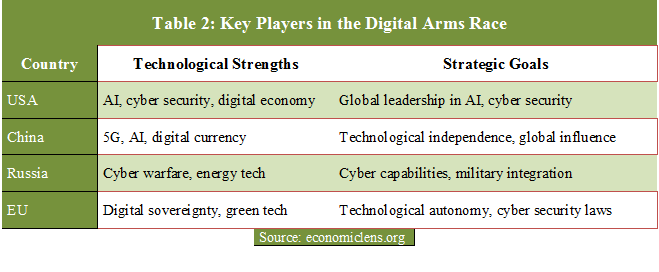
Data Source: National Technology Reports, International Digital Governance Review (2025).
This table highlights the key global players in the digital arms race. It shows how nations and corporations are strategically investing in technologies like AI, cybersecurity, and 5G to secure their position in the global economic hierarchy.
“In the digital arms race, it’s not just the nations that are vying for dominance—it’s the tech giants leading the charge.”
4. Securing the Future: The Importance of Cybersecurity in Global Power Dynamics
As nations invest in cybersecurity capabilities, it becomes clear that the future of global dominance will be shaped as much by the security of digital assets as it will be by military might. Cyberattacks have the potential to disrupt critical infrastructure, cause economic instability, and even bring entire nations to their knees economically (Adams, 2025).
In the digital arms race, cybersecurity is not just an issue of national security, but an issue of global economic power. Nations that can secure their digital infrastructure will not only safeguard their economic systems, but also control the future of global trade and financial systems.
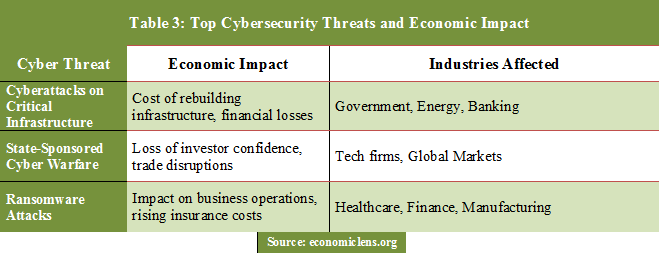
Data Source: Economic Impacts of Cybersecurity (2025), Global Cybersecurity Index (2025).
This table explores the economic consequences of the growing cybersecurity threats faced by nations, highlighting how these attacks affect global economies, industries, and markets. It underscores the financial risks involved in the digital arms race.
“Cybersecurity isn’t just about protecting data—it’s about securing economic control in a world of digital warfare.”
5. Artificial Intelligence: A Key Battleground in Global Economic Leadership
Artificial Intelligence (AI) is no longer just a tool—it is the key battleground in the digital arms race. The future of economic power will be determined by which country or entity controls the most advanced AI technologies. As nations push to lead the AI race, their economic and geopolitical power will rise proportionally.
China’s investment in AI surveillance, the USA’s leadership in AI military applications, and the EU’s focus on AI ethics represent just a few facets of the AI arms race.
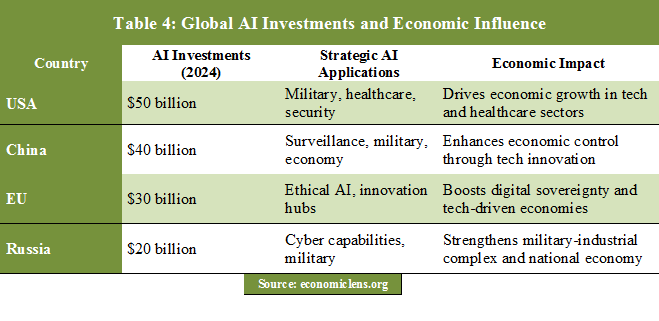
Data Source: AI Global Investment Report (2024), World AI Investments Tracker (2025).
This table presents the level of global investment in AI, alongside the strategic applications that will drive economic dominance. The USA and China are investing the most in AI, recognizing its critical importance in future economic growth and global influence.
“AI is the new weapon in the global economic battle. The AI arms race is as crucial for economic dominance as it is for military power.”
6. The Rise of Digital Currencies: Shaping the Future of Global Economics
The rise of digital currencies is a revolution. But who will control the future of global economic power through digital money? With the emergence of Central Bank Digital Currencies (CBDCs) and the rising adoption of cryptocurrencies globally, the world is witnessing a major shift in how global trade and economic policies are shaped. Countries like China with the Digital Yuan (e-CNY), and the USA, with its regulation of cryptocurrencies, are leading this new form of economic warfare (Miller, 2025).
With these digital currencies, nations now have the ability to control global trade and financial systems in ways never before possible. For instance, China’s launch of the e-CNY is not just a financial tool, but a strategic economic weapon to increase its global influence.
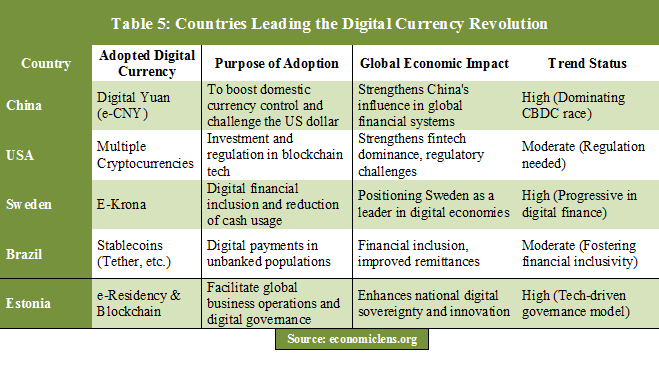
Data Source: Global Digital Currency Adoption Report (2025), Country-Specific Crypto Studies (2025).
This table highlights the global leaders in the digital currency revolution and outlines how CBDCs and cryptocurrencies are changing the way global economies interact, emphasizing their economic importance for future global power.
“The rise of digital currencies is a revolution. Who controls the future of digital money will control the global economy.”
7. Sustainable Innovation: The Path to Long-Term Technological Leadership
Tech dominance isn’t just about power; it’s about resilience. The future of global leadership will depend on sustainable innovation. As nations transition towards green technologies and AI-driven solutions, their ability to foster economic resilience will determine their long-term dominance.
Sustainable technologies like solar energy, electric vehicles (EVs), and AI for green tech are projected to fuel the next wave of global economic growth (Martin, 2025).
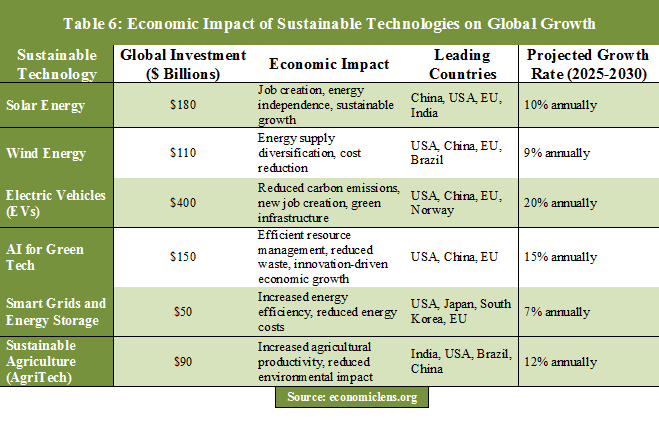
Data Source: Global Sustainable Technology Investment Outlook (2025), International Energy Agency (IEA), World Economic Forum (2025).
This table illustrates how sustainable technologies are driving economic growth and fostering resilient economies, with emerging economies particularly benefiting from investments in green technologies.
“The next battle for global dominance won’t be fought with weapons, but with sustainable technologies that will power the global economy.”
8. How Digital Technologies are Reshaping Global Trade and Diplomacy
As digital security becomes more integral to global trade, nations will have to navigate the intersection of technology and trade policy. Countries that are digitally sovereign will dictate the terms of international commerce in the coming decades (Thompson, 2025).
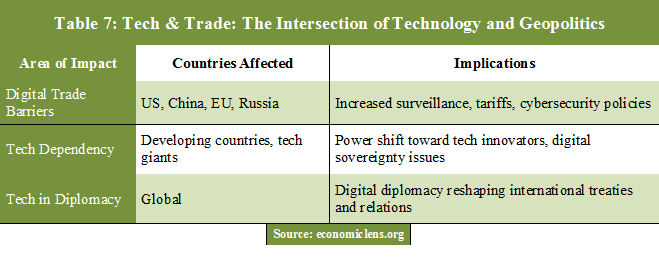
Data Source: Global Trade Technology Impact Study (2025), International Digital Relations Report (2025).
This table highlights how digital trade barriers and technology dependence will shape the future of global trade and the economic policies that govern it.
“As the world becomes more digital, the rules of trade and economic diplomacy will be rewritten by those who control the technology.”
9. Concluding Remarks: The Ongoing Battle for Technological Sovereignty
The Code War is just beginning. With each new technological advance, the balance of global power shifts. Technological sovereignty is now the key to economic and political dominance. Nations that secure their digital infrastructures will hold the future of global trade and economic governance.
“The Code War is just beginning. The future of global power isn’t defined by weapons, but by who leads the digital frontier.”