
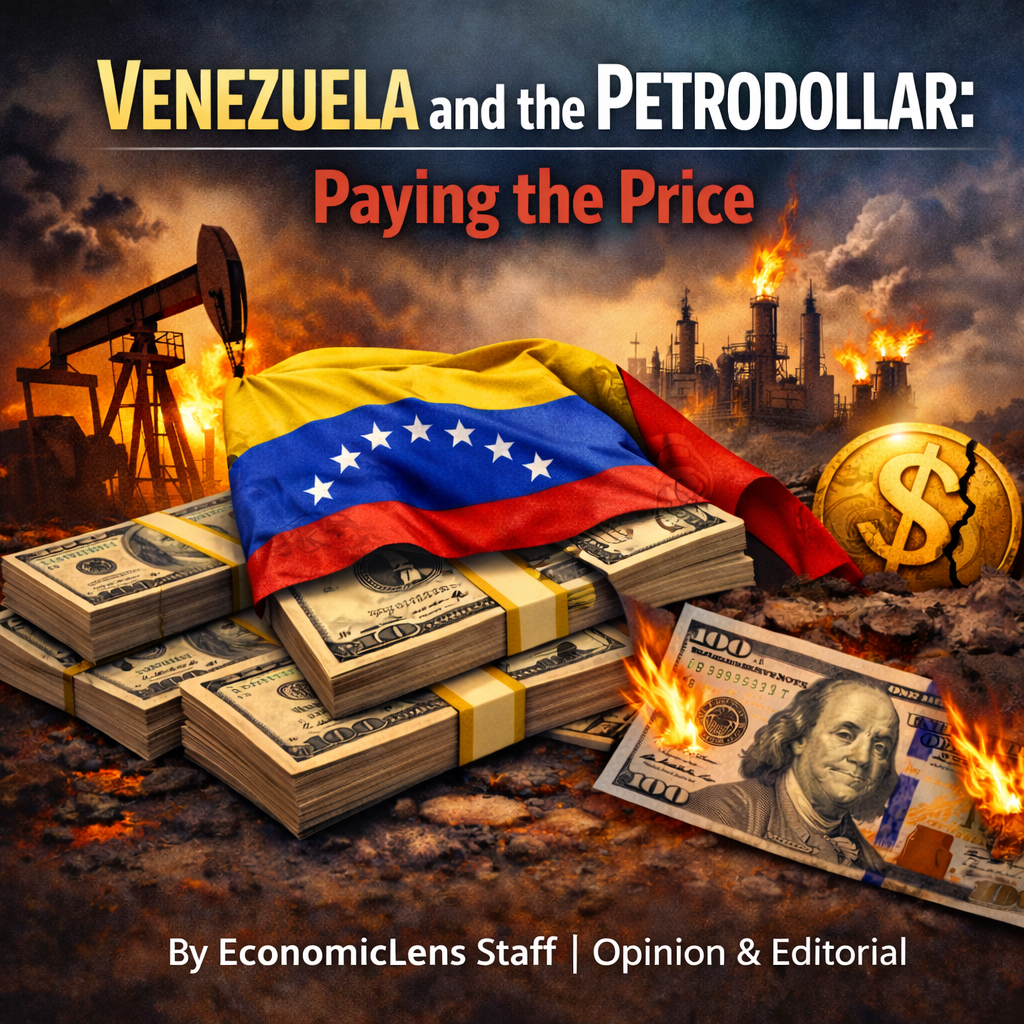
Venezuela and the petrodollar reveal how de-dollarization carries economic and political costs. This editorial examines oil pricing, dollar supremacy, sanctions, and coercive enforcement to explain why Venezuela emerged as a test case for defending the petrodollar system.
Introduction
Debate surrounding Venezuela and the petrodollar often appears fragmented in mainstream commentary. Many analysts emphasize governance failures, sanctions compliance, or humanitarian concerns. Such explanations, however, fail to explain the persistence and intensity of external pressure placed on Venezuela.
At its core, Venezuela and the petrodollar represents a story about monetary power and enforcement. When a state with systemically important oil resources challenges dollar dominance, responses rarely remain neutral. Historical experience instead points toward economic isolation, political destabilization, and sustained regime pressure.
From an EconomicLens perspective, Venezuela’s experience reflects a structural feature of the global monetary order rather than an isolated policy failure.
The Petrodollar System and U.S. Monetary Supremacy
The petrodollar system emerged in the 1970s through strategic arrangements between the United States and major oil producers. Under this framework, global oil trade became overwhelmingly dollar-denominated. As energy demand expanded, global demand for dollars rose alongside it.
This arrangement delivered unique advantages to the United States. Persistent current-account deficits became manageable without immediate currency crises. External financing costs declined. Financial infrastructure also evolved into a powerful enforcement tool through sanctions and payment restrictions. Institutions such as the International Monetary Fund operate within this dollar-centered system, reinforcing its reach across global governance (https://www.imf.org).
Over time, monetary dominance embedded itself structurally rather than remaining confined to markets. As a result, the petrodollar system remains a living pillar of U.S. supremacy rather than a historical artifact.
Why De-Dollarization Is Treated as a Strategic Threat
In theory, de-dollarization reflects rational diversification. States seek to limit currency risk. Firms pursue more efficient settlement mechanisms. Payment systems evolve naturally. In practice, reduced dollar usage weakens the mechanisms sustaining U.S. influence.
Lower reliance on the dollar constrains sanctions effectiveness and narrows the reach of U.S.-controlled financial channels. For this reason, policymakers rarely interpret de-dollarization as a neutral adjustment. Instead, it is framed as strategic defiance. Once that framing takes hold, responses shift from economic pressure toward coercive containment.
These dynamics are increasingly visible in debates surrounding currency experimentation and financial fragmentation, as examined in EconomicLens analysis on de-dollarization momentum and global finance (https://economiclens.org/de-dollarization-momentum-brics-currency-experiments-and-the-fragmentation-of-global-finance/).
Venezuela and the Petrodollar Red Line
Venezuela holds the world’s largest proven oil reserves, estimated at roughly 303 billion barrels according to OPEC data (https://www.opec.org). This scale alone grants Venezuela global significance within energy markets.
Strategic tension intensified when Venezuela reduced exclusive reliance on dollar-based oil trade. By exploring alternative settlement currencies and strengthening ties with China and Russia, the country moved beyond the discipline of the petrodollar system.
From that point onward, Venezuela and the petrodollar became inseparable in policy discourse. Sanctions escalated. Financial access narrowed. Regime change shifted from implicit threat to explicit discussion. Economic consequences followed rapidly. Inflation accelerated, imports collapsed, and living standards deteriorated. Venezuelan society absorbed these costs directly.
Historical Enforcement and Monetary Discipline
Venezuela’s experience aligns with earlier enforcement episodes that illustrate how monetary discipline is maintained. In 2000, Iraq announced plans to sell oil in euros. Three years later, invasion and regime change followed, after which oil exports returned to dollar pricing.
A similar sequence unfolded in Libya. The proposal for a gold-backed African currency in 2009 preceded NATO intervention in 2011. The monetary project disappeared alongside the Libyan state.
Together, these cases reveal a recurring pattern. Monetary defiance often precedes political collapse. While each episode reflects distinct political circumstances, the underlying economic logic remains strikingly consistent.
Who Bears the Cost of Dollar Supremacy and Oil Politics
Defending the petrodollar rarely imposes costs on global financial markets. Traders adjust positions. Capital reallocates. Reserve managers diversify quietly. The burden instead falls on societies subjected to sanctions and isolation.
In Venezuela, de-dollarization coincided with shortages, unemployment, currency collapse, and long-term development loss. Dollar supremacy survived, but its defense shifted costs onto a vulnerable population.
This reality raises a deeper question for the global economy. A system that relies on punishment to enforce compliance signals fragility rather than strength.
Monetary Power and Oil Trade Beyond Venezuela
Iran increasingly occupies a position similar to Venezuela’s within the global monetary system. Energy trade outside the dollar framework continues. Resistance to U.S. financial control persists. Economic ties with alternative power centers deepen.
Iranian media now describe U.S. pressure as regime change rather than policy disagreement. This interpretation reflects accumulated evidence rather than ideology. For broader context on how these alignments reshape global finance, EconomicLens coverage of BRICS expansion and shifting monetary power offers additional insight (https://economiclens.org/brics-expansion-de-dollarization-and-the-shift-in-global-finance/).
When states anticipate punishment for monetary independence, diversification accelerates rather than retreats.
The Strategic Paradox of the Petrodollar System
Aggressive defense of the petrodollar creates a strategic paradox. Coercion preserves dominance in the short term. Over time, however, legitimacy erodes.
Across much of the Global South, the dollar increasingly appears as an enforcement instrument rather than a neutral medium. This perception fuels experimentation with alternative currencies, settlement systems, and regional arrangements.
Venezuela’s collapse did not halt de-dollarization. Instead, it exposed its costs while reinforcing its perceived necessity.
Conclusion
Venezuela and the petrodollar is not simply a debate about governance or sanctions. It stands as a case study in how monetary supremacy is defended and who ultimately bears its cost. Venezuela paid the price of de-dollarization by challenging the system directly.
The petrodollar survived, but only by transferring its defense costs onto a sanctioned economy. History suggests that such systems face limits. When enforcement replaces consent, resistance grows.
Dollar dominance remains intact. Yet Venezuela has shown what that dominance demands, and the world is drawing its conclusions.