
De-dollarization momentum is reshaping global finance as BRICS countries expand local currency trade, diversify reserves, and test alternative payment systems. This analysis explains why these shifts signal financial fragmentation rather than the end of dollar dominance.
Introduction
De-dollarization momentum has moved rapidly from academic debate to global headlines. Discussions now span BRICS summits, bilateral trade agreements, reserve diversification, and alternative payment systems. Some narratives predict the collapse of the US dollar, while others dismiss the trend as symbolic politics.
However, the reality is more nuanced.
De-dollarization momentum does not imply the sudden replacement of the dollar. Instead, it reflects the gradual fragmentation of global finance, driven by geopolitical risk, sanctions exposure, and strategic autonomy goals. As highlighted in EconomicLens’ earlier assessment of BRICS expansion and financial realignment (https://economiclens.org/brics-expansion-de-dollarization-and-the-shift-in-global-finance/), these shifts are evolutionary rather than revolutionary.
This article explains what de-dollarization momentum actually means, how BRICS currency experiments work in practice, and why fragmentation, not dollar collapse, defines the current phase of global finance.
1. What De-Dollarization Momentum Really Means
De-dollarization momentum refers to a measured reduction in dependence on the US dollar, not its elimination. This process unfolds across three interconnected domains.
First, trade invoicing and settlement are gradually diversifying. Second, central banks are adjusting reserve compositions. Third, countries are experimenting with alternative payment infrastructure.
Despite these changes, the dollar remains dominant. It accounts for roughly half of global trade invoicing and nearly 60 percent of reported foreign exchange reserves according to IMF COFER data. Moreover, dollar-denominated debt continues to anchor global capital markets.
Therefore, de-dollarization momentum reflects risk diversification, not monetary replacement.
Evidence from the Data
Importantly, empirical indicators show gradual adjustment rather than abrupt transition.
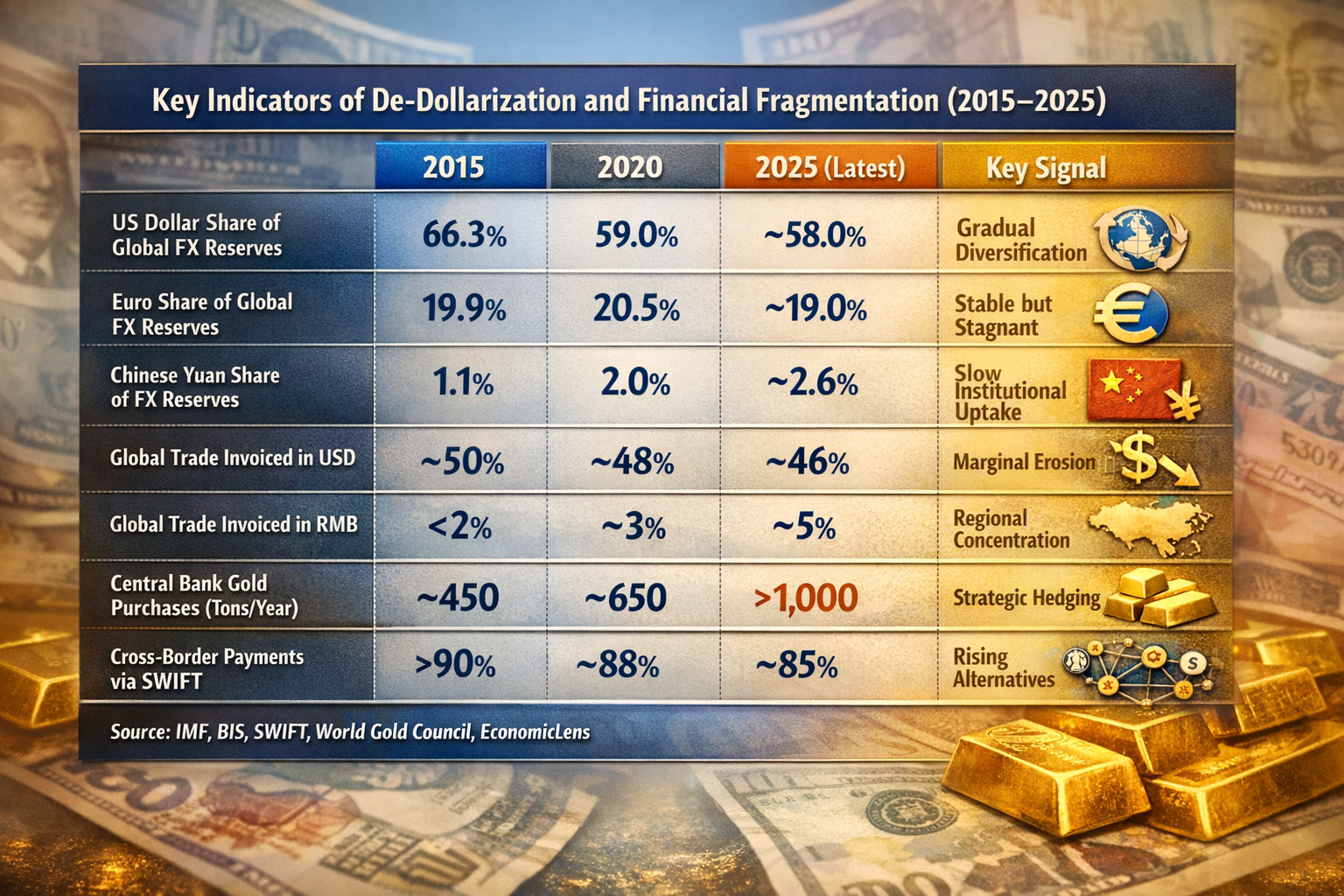
Taken together, these indicators show that de-dollarization momentum is real but uneven. The sharpest shift is not toward another currency, but toward gold accumulation and payment system optionality, consistent with BIS assessments of reserve management behavior (https://www.bis.org).
2. Why De-Dollarization Momentum Is Accelerating
Several structural forces explain why de-dollarization momentum has intensified since 2022.
Sanctions Risk and Financial Sovereignty
The freezing of Russia’s foreign exchange reserves in 2022 fundamentally altered perceptions of reserve safety. For many emerging economies, this event demonstrated that dollar assets carry geopolitical exposure.
As a result, reserve policy has shifted from yield optimization toward sovereignty protection. This concern has been explicitly discussed in IMF policy notes on sanctions and reserve assets (https://www.imf.org).
Global Economic Fragmentation
At the same time, geopolitical rivalry is reshaping trade, investment, and finance. As EconomicLens has argued, fragmentation is no longer episodic but structural (https://economiclens.org/fragmentation-is-now-the-default-setting-of-the-global-economy/).
Consequently, financial systems are evolving along bloc lines rather than converging globally.
South–South Trade Expansion
Moreover, emerging economies now trade more with each other than with advanced economies. This shift increases the economic logic for local currency settlement, even if network effects still favor the dollar.
3. BRICS De-Dollarization Strategy in Practice
Despite frequent speculation, there is no operational BRICS currency. Instead, BRICS de-dollarization strategy relies on decentralized experimentation.
Local Currency Trade Mechanisms
China has expanded yuan settlement in trade with Russia and Brazil. India has promoted rupee settlement arrangements with selected partners. Brazil and China now allow bilateral trade settlement without dollar intermediation.
Although these mechanisms reduce transaction costs, they remain limited in scale.
Alternative Payment Systems
China’s Cross-Border Interbank Payment System and Russia’s SPFS are often framed as SWIFT replacements. In practice, they complement existing infrastructure. Their strategic relevance lies in redundancy, not dominance.
This competitive dynamic is examined in EconomicLens’ analysis of the digital yuan and global payment architecture (https://economiclens.org/digital-yuan-vs-swift-the-race-to-redefine-global-finance/).
Reserve Diversification
BRICS central banks have increased gold holdings while marginally expanding exposure to non-dollar currencies. According to World Gold Council data, this trend accelerated sharply after 2022 (https://www.gold.org).
4. Why a Common BRICS Currency Remains Unlikely
Although politically appealing, a common BRICS currency faces structural barriers.
BRICS economies differ sharply in inflation credibility, capital account openness, fiscal capacity, and institutional design. There is no shared central bank, no fiscal transfer mechanism, and no consensus on governance.
Even the euro required decades of institutional convergence. For BRICS, monetary unification would require integration far beyond current arrangements.
Thus, de-dollarization momentum within BRICS operates without monetary union.
5. The Enduring Role of the US Dollar
Despite de-dollarization momentum, the dollar retains decisive advantages.
US financial markets offer unmatched liquidity. Treasury securities remain the world’s primary safe asset. During global crises, dollar demand often rises rather than falls, as documented by Federal Reserve liquidity operations (https://www.federalreserve.gov).
Paradoxically, fragmentation often strengthens the appeal of a trusted anchor currency.
6. Fragmentation as the Core Outcome
The defining outcome of de-dollarization momentum is financial fragmentation, not currency replacement.
Trade finance is becoming regional. Payment systems are multiplying. Reserve strategies prioritize resilience over efficiency.
As a result, transaction costs rise and global risk sharing weakens. This marks a shift from deep globalization toward managed interdependence.
7. Implications for Emerging Economies
For emerging economies, de-dollarization momentum creates both opportunities and constraints.
Local currency trade can reduce dollar shortages. Reserve diversification can enhance resilience. However, premature de-dollarization can increase volatility, raise borrowing costs, and trigger capital flight.
Therefore, policy sequencing remains critical.
Conclusion
De-dollarization momentum is reshaping global finance, but it is neither sudden nor transformative. BRICS currency experiments reflect defensive adaptation rather than an assault on dollar dominance.
The global system is not moving toward a post-dollar world. It is moving toward a more fragmented and less efficient monetary order.
The dollar will remain central. What is changing is the willingness of states to rely on it without safeguards.
Understanding this distinction is essential for separating financial reality from political rhetoric.




1 thought on “De-Dollarization Momentum: BRICS Currency Experiments and the Fragmentation of Global Finance”
Wow! Thank you! I constantly needed to write on my blog something like that. Can I include a part of your post to my site?