
China Digital Yuan vs SWIFT critically examines why SWIFT has become a slow, costly and politicized system, how the digital yuan payment system offers faster and cheaper alternatives, how BRICS and Global South partners are adopting yuan based settlement networks and why this signals the rise of a new Beijing anchored financial order.
Introduction: China Digital Yuan vs SWIFT as a Turning Point
China Digital Yuan vs SWIFT is not a neutral technical debate. It is a battle between a slow, politicized legacy network and a programmable digital architecture that promises speed, control and inclusion for countries outside the Western core.
For decades SWIFT operated as the central nervous system of global finance. However, it now looks like a rigid mainframe in a cloud based world. It is slow, opaque, expensive and increasingly used as a geopolitical weapon. Iran’s exclusion in 2012, Russia’s partial cutoff in 2022 and growing threats against other states turned a messaging system into a coercive tool.
In contrast, the digital yuan payment system offers something different. It embeds settlement, data and policy control into a single programmable layer. For governments that are tired of dollar dependence and sanctions risk, this is not a curiosity. It is a survival strategy.
This blog argues that the digital yuan is no longer a peripheral experiment. It has become the backbone of a new financial architecture that is reshaping trade, investment and power relationships across Eurasia, the Middle East and parts of Africa and Latin America.
“The fight is no longer SWIFT versus an experiment. It is SWIFT versus a parallel system that already works.”
1. How SWIFT Global Finance Became a Structural Liability
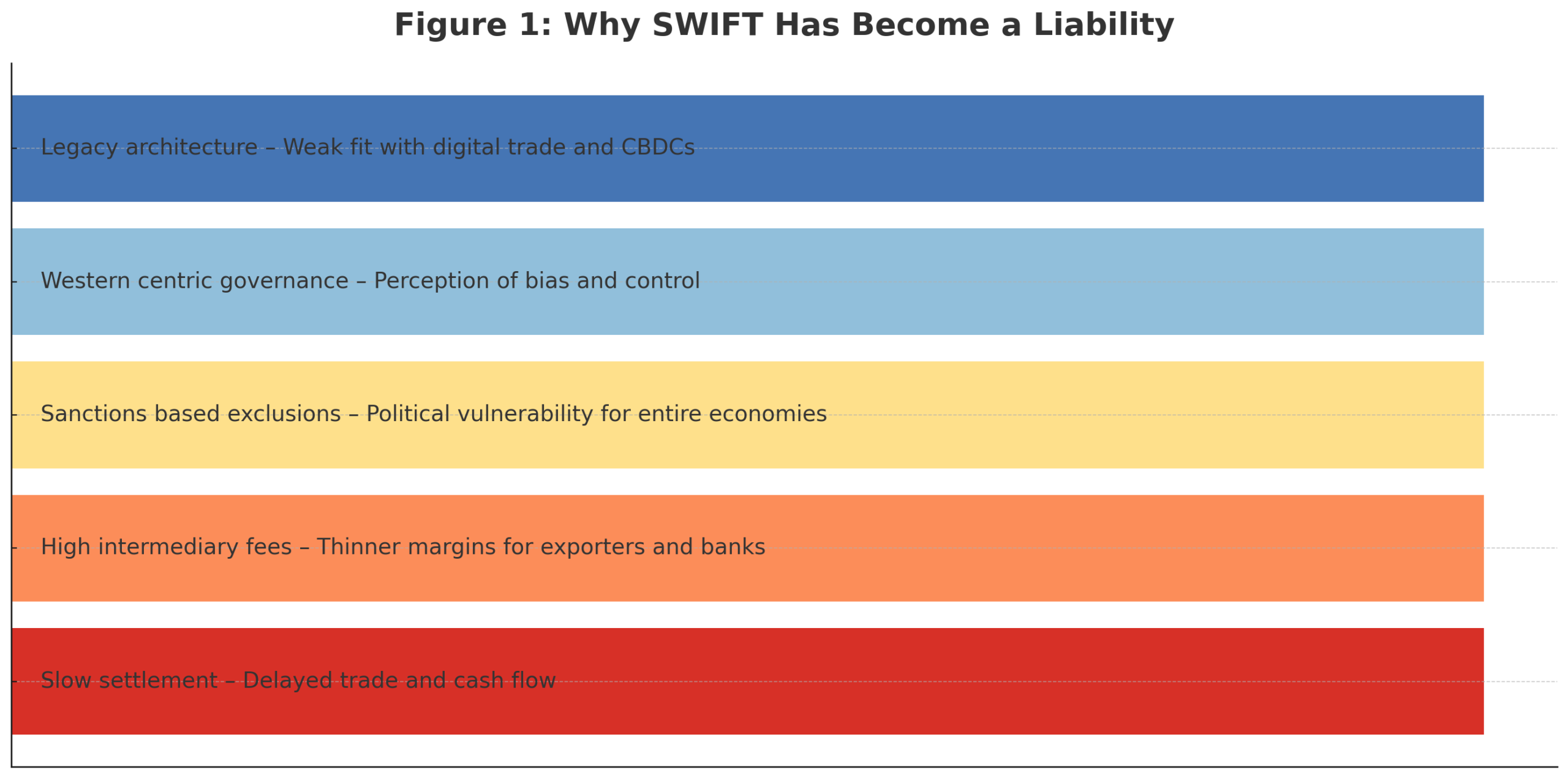
SWIFT global finance was built for the 1970s banking system, not for an instant digital economy. Messages move through long correspondent chains. Fees accumulate at every step. Settlement often takes days instead of seconds.
In a world of e-commerce, real time supply chains and instant retail payments, this is a structural mismatch. Yet SWIFT has moved cautiously and slowly. Its partial upgrades still sit on top of a fragmented banking network that remains costly and fragile.
Russia’s exclusion from SWIFT in 2022 exposed another problem. It showed that access to global payments can be turned off by a small group of states. Therefore banks and governments outside that circle now treat SWIFT not as neutral infrastructure but as a risk factor.
Politicized Infrastructure and Sanctions Weaponization
The more SWIFT is used as a sanctions tool, the less legitimate it looks to those on the receiving end. Iran, Russia, Venezuelan banks and even smaller players have become examples of financial isolation. As a result, many Global South countries quietly ask the same question. If political winds shift, could they be next?
Consequently, diversification away from SWIFT is not just about efficiency. It is about sovereignty.
Expert Insight & Global Report Signals on SWIFT Risk
The Bank for International Settlements Annual Economic Report 2024 (https://www.bis.org) confirms that over 90 percent of cross border interbank messages still depend on SWIFT, which concentrates risk in a single hub. The IMF Global Financial Stability Report 2024 (https://www.imf.org/en/publications) warns that financial sanctions and payment cutoffs create fragmentation that pushes countries toward alternative networks. The European Network on Sanctions and Extraterritoriality (https://www.globalsanctions.org) has highlighted how SWIFT based restrictions on Iran and Russia accelerated the search for alternative payment rails outside the Western sphere.
These findings point in one direction. The more SWIFT is weaponized, the more it erodes its own authority.
“A payment system that frightens its users invites its own replacement.”
2. Digital Yuan Payment System as a Blueprint for a New Order
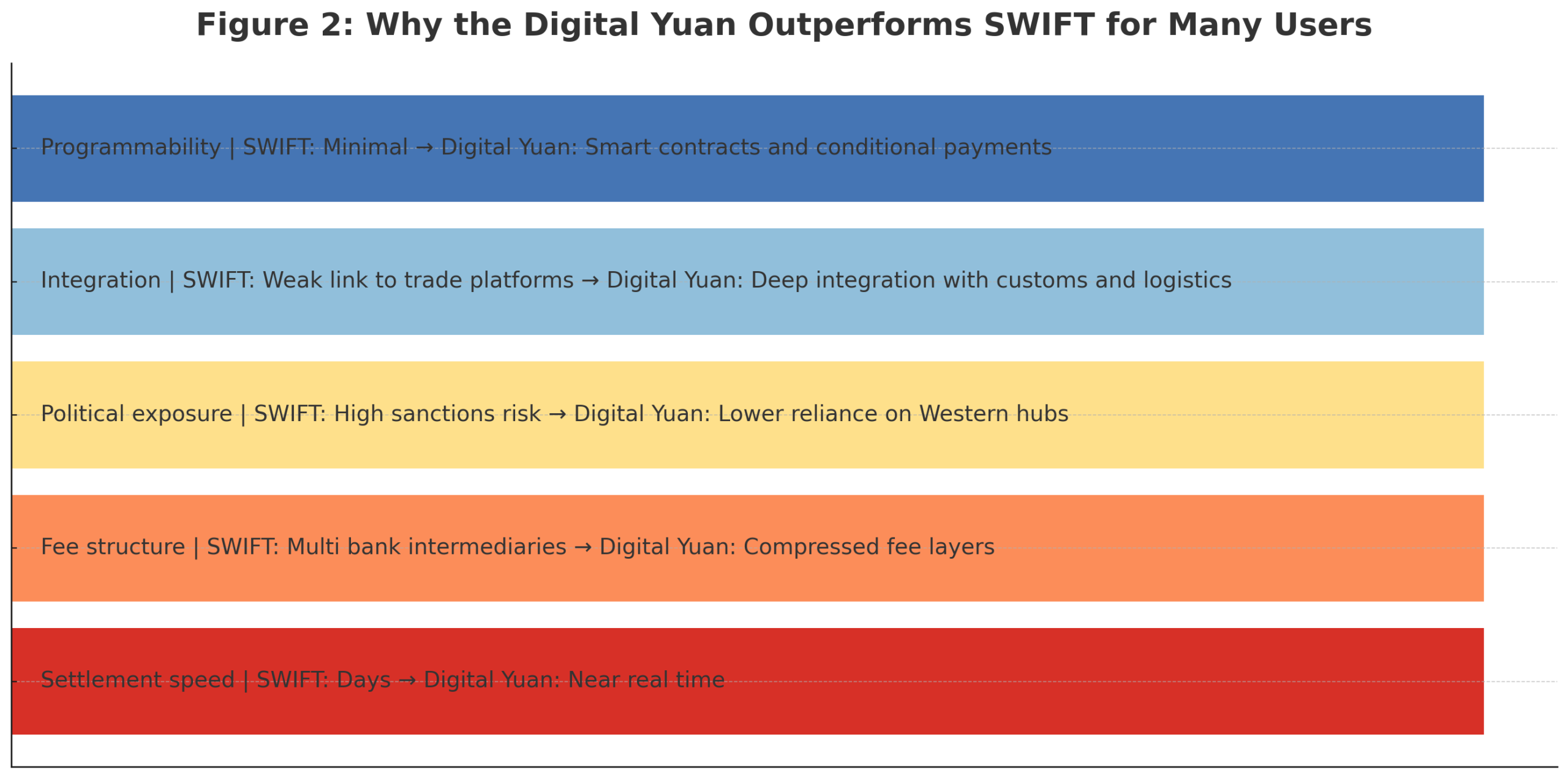
The digital yuan payment system does not simply copy SWIFT in a new format. It fuses currency, data, identity and policy rules into a programmable layer. As a result, cross border settlement can be instant, conditional and deeply integrated with trade platforms.
For exporters in Indonesia, Russia or Saudi Arabia, this means faster payments with lower fees when dealing with Chinese buyers. For governments, it means less dependence on New York or Brussels to clear essential transactions.
Russia’s rapid migration to yuan invoicing after 2022, Saudi China oil contracts explored in yuan, and rail and port projects under the Belt and Road Initiative that test e-CNY payments all show the same pattern. Once a digital alternative works, there is little incentive to return to a slow and politicized system.
China CBDC and Global Finance as Strategic Infrastructure
China CBDC and global finance are increasingly intertwined. The digital yuan is not just a domestic tool. It anchors cross border pilots in Hong Kong, Thailand, UAE and other economies. CIPS and digital yuan experiments together form the backbone of a Beijing centered network.
In parallel, Western debates on CBDCs remain stuck in privacy and political disputes. This delay gives China first mover advantage in setting standards for programmable cross border money.
Expert Insight & Global Report Signals on Digital Yuan
The BIS Innovation Hub mBridge project (https://www.bis.org) shows that multi CBDC platforms with strong Chinese participation can cut cross border settlement times from days to seconds. The IMF Fintech Notes on CBDCs and cross border payments (https://www.imf.org/en/publications) argue that large economies that move early can set technical and legal standards for digital settlement networks.
The Atlantic Council CBDC Tracker (https://www.atlanticcouncil.org) documents that China is one of the few major economies that has moved from pilots to significant real world use, while others still debate design choices. This transformation is part of a wider contest over digital monetary power. Our related analysis (https://economiclens.org/currency-wars-in-the-digital-economy-how-ai-and-cbdcs-redefine-global-finance/) explains how countries using programmable currencies gain influence over trade data, settlement standards and future financial architecture rather than merely reducing transaction costs.
These signals suggest that China is not just experimenting. It is building and exporting a working template.
“For many governments, the digital yuan is not simply cheaper. It is safer.”
3. Yuan Based Settlement Networks and the Shrinking Dollar Perimeter
De-dollarization in trade rarely arrives through dramatic announcements. It advances through shipping contracts, pipeline deals and commodity payments that quietly switch currency.
After 2022, Russia shifted the bulk of its energy exports to yuan and ruble settlement. Saudi Arabia signaled openness to accepting yuan for part of its oil exports to China. Brazil and China expanded local currency trade, while ASEAN partners increased the share of local currency settlement in regional flows.
Each individual transaction seems small. However, together they shrink the perimeter where the dollar is unavoidable. At the core, dollar finance remains powerful. At the edges, yuan based settlement networks steadily bite into market share.
How China Digital Yuan vs SWIFT Changes Power Balance
China Digital Yuan vs SWIFT is not a technical tie. It is a strategic mismatch. SWIFT locks countries into a system where Washington and Brussels can decide access. The digital yuan moves those same countries into a system anchored in Beijing, where their trade relationship with China provides leverage and security at the same time.
In this emerging map, a yuan zone forms along Belt and Road corridors, energy exporters tied to China and manufacturing hubs in Asia and beyond. The more trade flows into this zone, the more natural digital yuan use becomes.
Expert Insight & Global Report Signals on De-Dollarization
The IMF World Economic Outlook 2025 (https://www.imf.org/en/publications) notes a visible increase in non dollar invoicing among some emerging markets, especially for China related trade. The World Bank Global Economic Prospects 2025 (https://www.worldbank.org) highlights a gradual but persistent shift toward local currency trade settlement within BRICS and regional blocs.
The UNCTAD Trade and Development Report (https://unctad.org) shows that sanctions on Russian banks accelerated Russia’s pivot to yuan for energy exports, strengthening the yuan’s role in commodity pricing. This quiet erosion of dollar dependence is explained in detail in our in-depth analysis (https://economiclens.org/brics-expansion-de-dollarization-and-the-shift-in-global-finance/) which shows how trade settlement, commodity pricing and regional banking alignment steadily weaken dollar centrality without provoking abrupt market disruption.
These trends describe a world where the dollar still dominates, yet no longer dominates unchallenged.

“The new order appears first in trade contracts, not in summit speeches.”
4. BRICS, Alternative Payment Rails and the Weakening of SWIFT
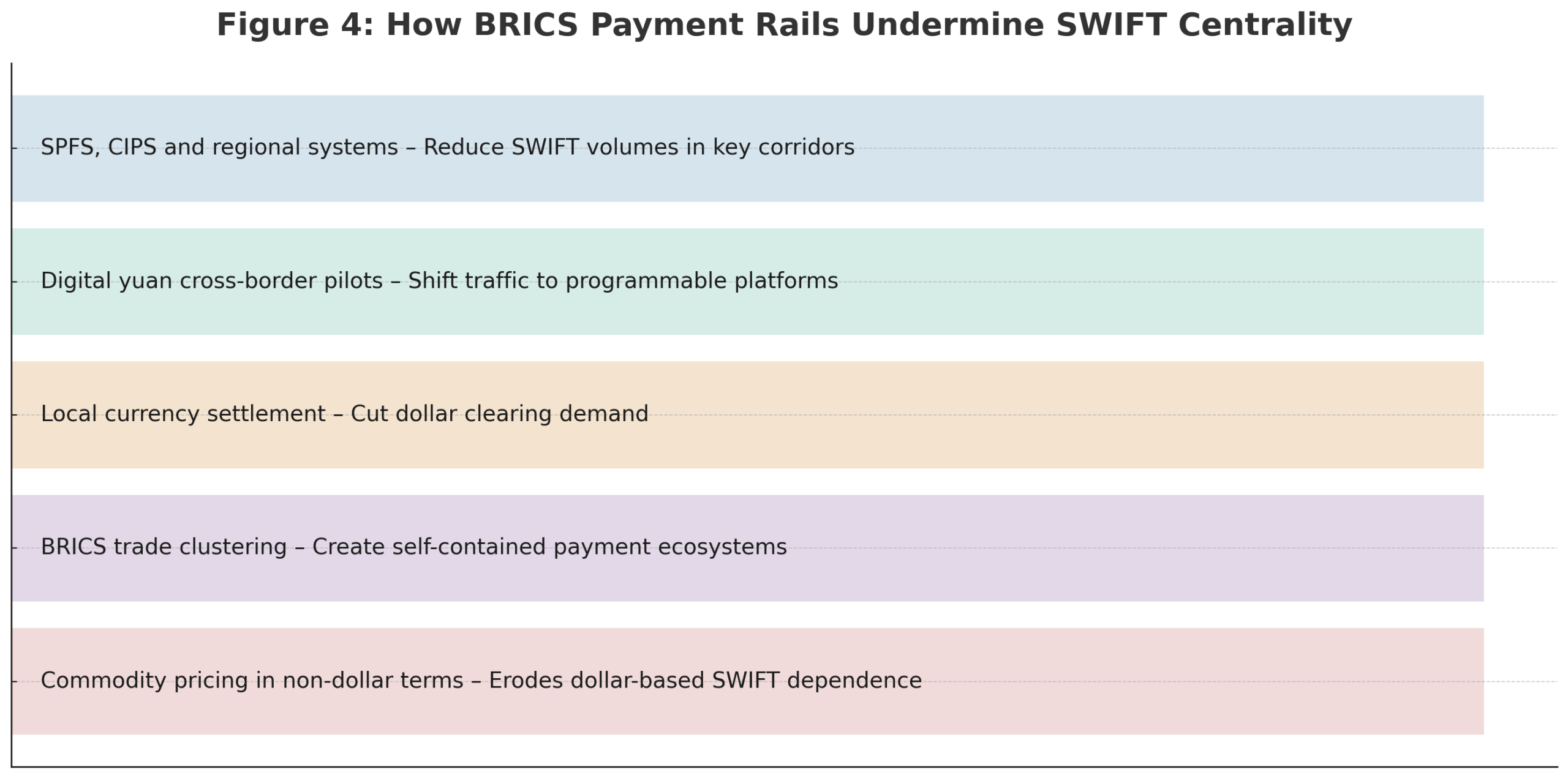
BRICS states view SWIFT not as a service provider but as a vulnerability. Therefore they invest in alternative payment rails, from Russia’s SPFS to India’s domestic networks and China’s CIPS and digital yuan ecosystem.
Recent BRICS expansion, including Saudi Arabia, UAE and other energy exporters, aligns key commodity suppliers with the emerging yuan centered rails. As they coordinate settlement in local currencies and digital channels, SWIFT loses relevance in entire regional clusters.
Alternative Payment Rails and the End of SWIFT Monopolies
Alternative payment rails reduce the network effect that once protected SWIFT. As long as SWIFT was the only viable option, governments tolerated its weaknesses. Once digital yuan and other systems prove reliable, that tolerance disappears.
Consequently, banks in Africa, Latin America and Central Asia now see value in connecting to CIPS and digital yuan pilots in addition to SWIFT. Over time, the “in addition to” easily becomes “instead of” for trade with China and other BRICS states.
Expert Insight & Global Report Signals on Alternative Rails
The BIS Global Payments Report (https://www.bis.org) observes growing fragmentation of payment networks and a rise in regional alternatives. The BRICS New Development Bank analysis (https://www.ndb.int) has argued for strengthening local currency settlement to reduce external vulnerability. The UN ESCAP reports (https://www.unescap.org) show that Asian regional payment connectivity initiatives increasingly bypass traditional Western hubs and align with Chinese infrastructure.
These signals confirm that alternative payment rails are no longer marginal workarounds. They are foundations.
“Once entire trade blocs can clear without SWIFT, the monopoly is finished.”
5. World Trade Under a Beijing Anchored Digital Payment Order
The future payment system will not eliminate the dollar. However, it will no longer revolve around it. Instead, world trade is moving toward a multi rail order where the dollar, euro and yuan each anchor different spheres.
In this configuration, the yuan centered network has a unique advantage. It is the only major currency already paired with a large scale live CBDC and a cross border settlement infrastructure designed for digital trade from day one.
As energy exporters, manufacturing hubs and Global South partners connect to this network, a Beijing anchored financial corridor emerges that does not need SWIFT to function.
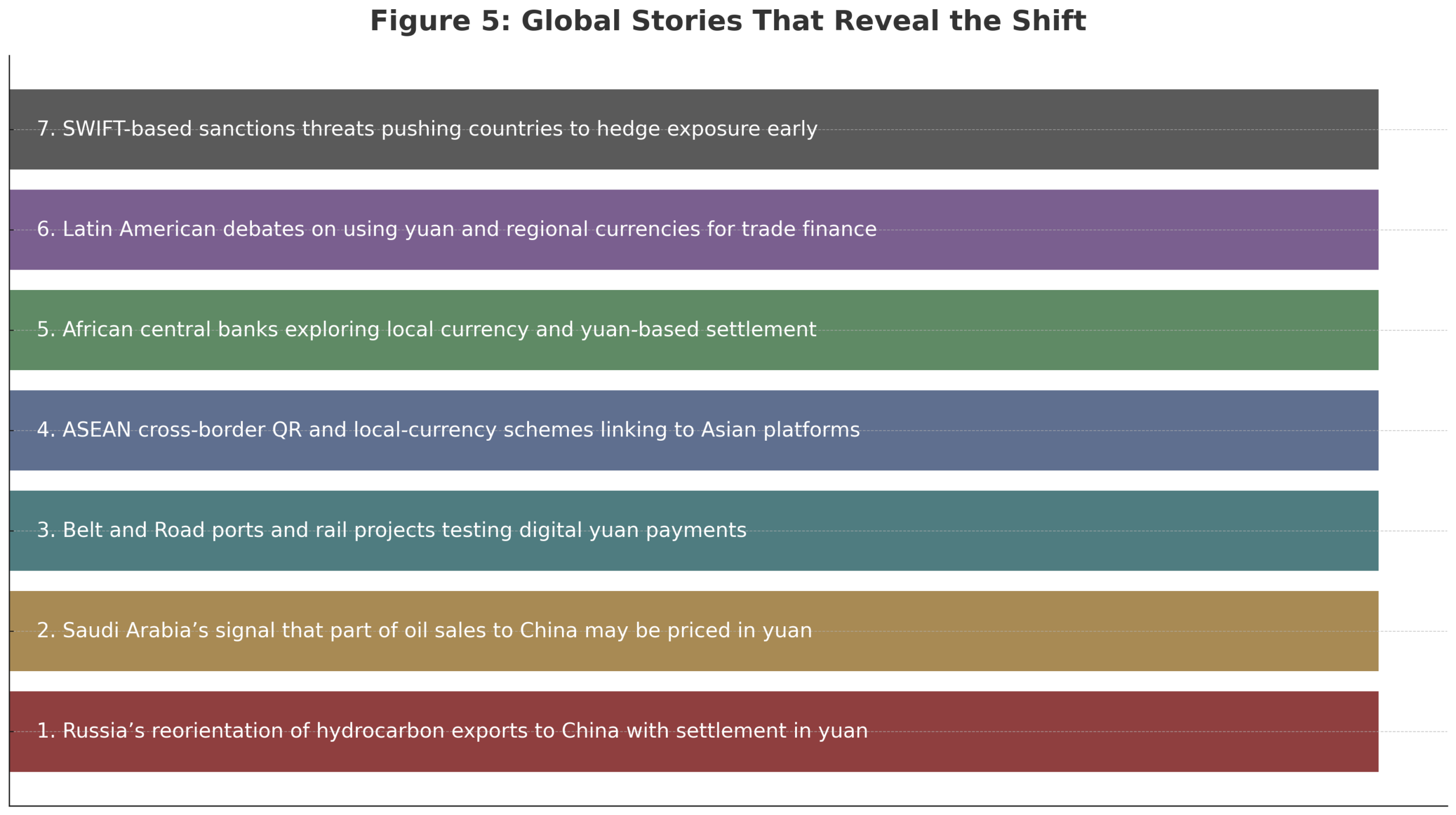
Each case shows SWIFT losing terrain where the digital yuan and regional platforms provide credible alternatives.
Expert Insight & Global Report Signals on Fragmentation
The WTO World Trade Outlook 2025 (https://www.wto.org) describes a world of slower global growth but sharper regional concentration, which fits digital yuan anchored corridors. The OECD Economic Outlook 2025 (https://www.oecd.org) warns that payment fragmentation adds complexity, yet it also notes that digital networks can lower costs for emerging markets.
Together, these outlooks suggest that fragmentation does not mean chaos. It means reordering.
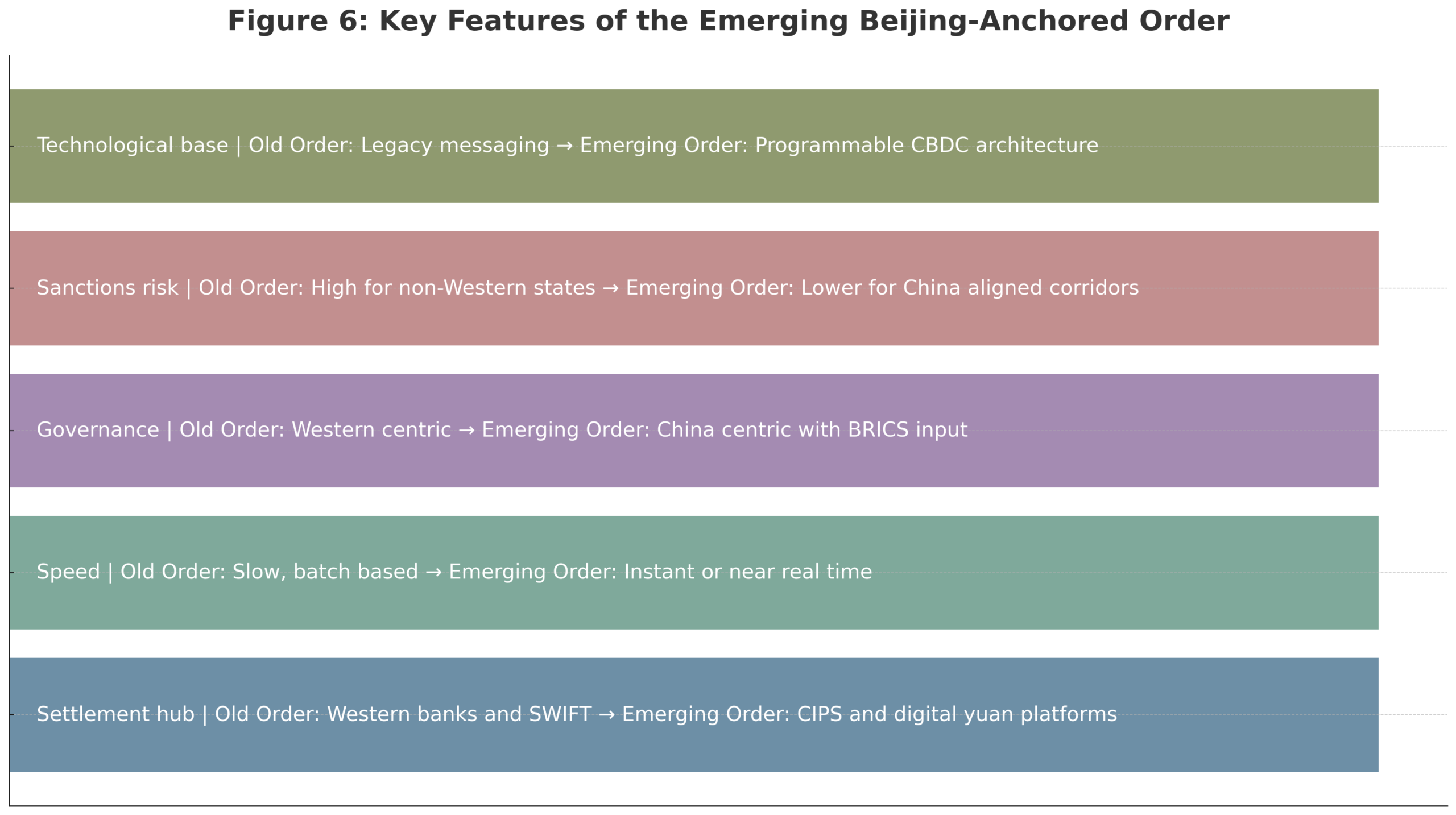
“In the new map of payments, the central question becomes not who issues the currency, but who controls the rails.”
6. Final Verdict and Strategic Call to Action
China Digital Yuan vs SWIFT is not a balanced contest. It is a clash between an aging system and an ambitious digital architecture that already organizes large parts of Eurasian trade. SWIFT still matters, yet its centrality is broken. The digital yuan has moved from pilot to platform and from experiment to backbone.
SWIFT is now clearly exposed as slow, expensive and politicized. Every use of SWIFT as a sanctions lever convinces more governments to accelerate their exit strategy. At the same time, every successful digital yuan transaction deepens confidence in a parallel order.
The emerging global financial system will still include the dollar. However, the axis of change now runs through Beijing. The digital yuan payment system, CIPS and BRICS linked rails together form the skeletal structure of a new financial order that is already visible in energy trade, infrastructure payments and regional supply chains.
For policymakers in the Global South, the strategic question is no longer whether they should join these networks. It is how quickly they can secure access before terms harden. For businesses, the priority is to build treasury, risk and technology capabilities that operate fluently across both SWIFT and digital yuan ecosystems.
“The era of a single Western gatekeeper for global payments is ending. The age of a Beijing anchored, multi rail financial order has begun.”
Analysis Note: This blog is based on independent analysis of publicly available information and data.