
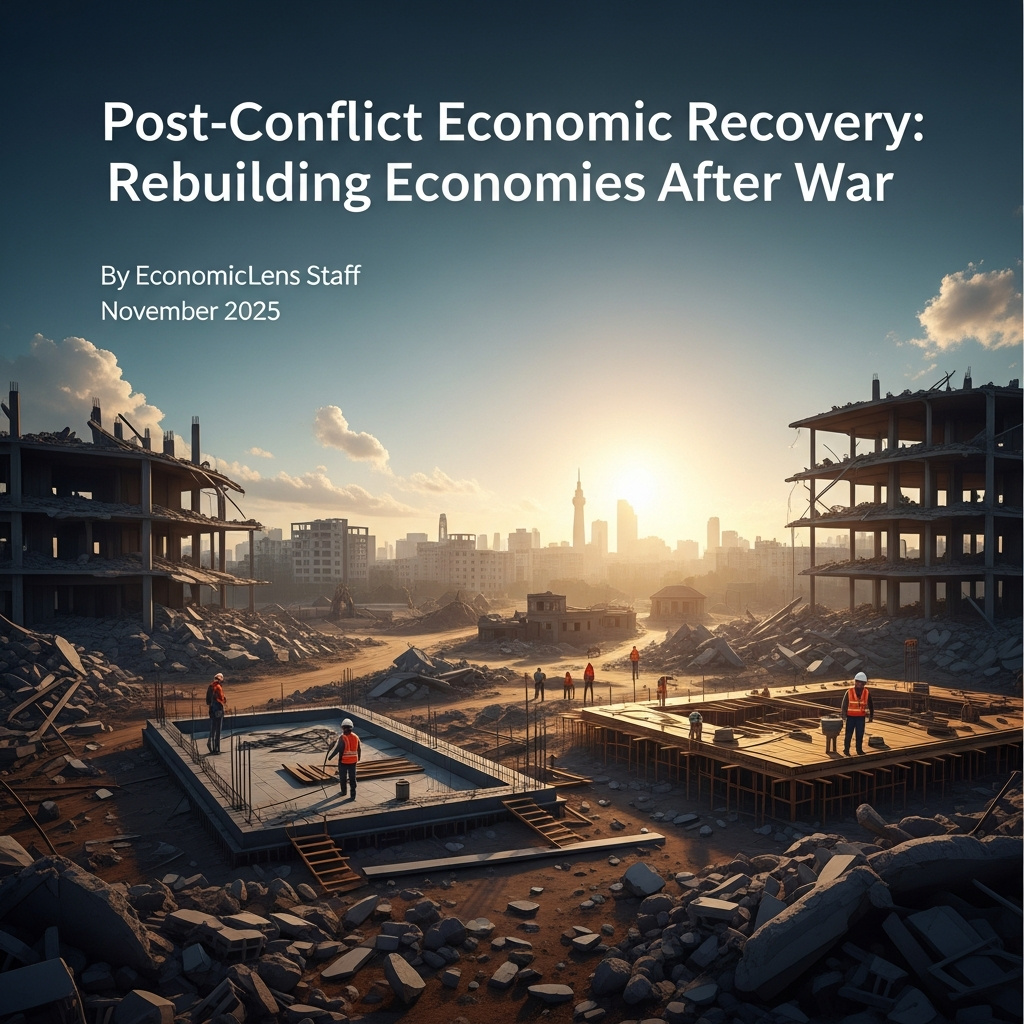
Explore how Post-Conflict Economic Recovery rebuilds nations after war through finance, human capital, infrastructure, and sustainable policy.
Executive Summary
Post-Conflict Economic Recovery examines how nations rebuild their economies and societies after war through fiscal discipline, transparent governance, and human-centered development. The analysis highlights that true recovery extends beyond reconstruction of infrastructure — it involves restoring confidence, employment, and national identity.
Using historical examples from Europe, Japan, Rwanda, Bosnia, and Ukraine, the blog shows that economies rebound faster when local accountability complements global aid. Tables and data reveal how targeted investments in transport, energy, and education can double GDP growth within five years, provided corruption is contained and governance remains inclusive.
The blog emphasizes the growing role of technology and sustainability in modern rebuilding efforts. Green infrastructure, renewable energy, and digital governance are helping war-torn nations transition toward long-term resilience and independence. The central message is clear: economic recovery after conflict is not a short-term project but a generational mission, demanding leadership, innovation, and cooperation between states and global partners.
Ultimately, the piece argues that rebuilding after war is an act of both economics and humanity — a process that turns survival into sustainability and loss into opportunity.
1. Introduction: The Economics of Rebuilding After War
“War ends in silence, but rebuilding begins with courage.”
When conflict stops, the harder battle begins — rebuilding livelihoods, trust, and economic stability. Post-Conflict Economic Recovery captures that transition from survival to renewal. Every destroyed bridge or abandoned factory represents both a loss and a possibility: the chance to design systems stronger than before.
The World Bank (2025) estimates that reconstruction often costs up to twice a country’s pre-war GDP. Yet nations such as Japan, Germany, and Rwanda have proven that recovery, while slow, is achievable when leadership, finance, and social unity align. Their experiences reveal that rebuilding after war isn’t about returning to the past; it’s about building a sustainable future.
2. Historical Lessons in Post-Conflict Economic Recovery
To understand modern recovery, we must look back. History shows that countries recover fastest when aid is strategic and institutions remain accountable. After World War II, Europe thrived under the Marshall Plan because governance and policy reforms accompanied funding. Rwanda’s agricultural and social programs after 1994 followed a similar logic — homegrown vision guided by global partnership.
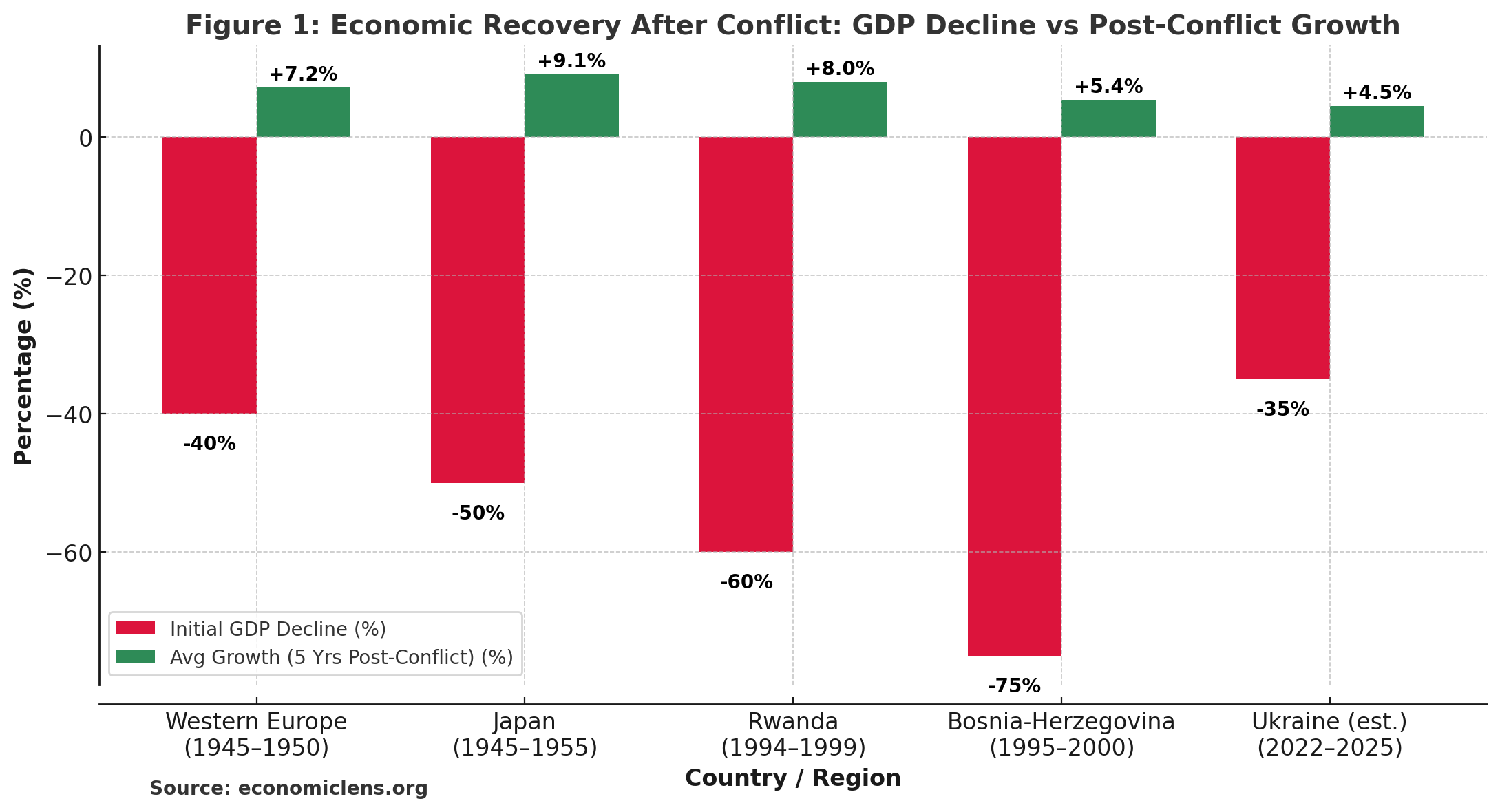
The following figure compares growth trends across major recovery cases, illustrating how well-structured plans transformed destruction into long-term expansion.
Source: IMF & World Bank Reconstruction Reports (2025)
The main recovery drivers across regions are as follows: Western Europe’s recovery post-1945 was driven by the Marshall Plan aid and export revival. Japan’s post-war growth was fueled by infrastructure reform and technological adoption. Rwanda’s recovery focused on inclusive governance and agricultural development. Bosnia-Herzegovina saw recovery through EU integration and foreign direct investment (FDI). Ukraine’s projected recovery is expected to stem from energy transition and digital reform.
“Reconstruction isn’t nostalgia; it’s the art of turning what was lost into what can endure.”
3. Economic Shock and Structural Damage
The first visible legacy of war is economic collapse. Inflation surges, exports vanish, and national budgets crumble. Post-conflict governments must perform economic triage — restoring banking systems, controlling prices, and rebuilding public trust in currency.
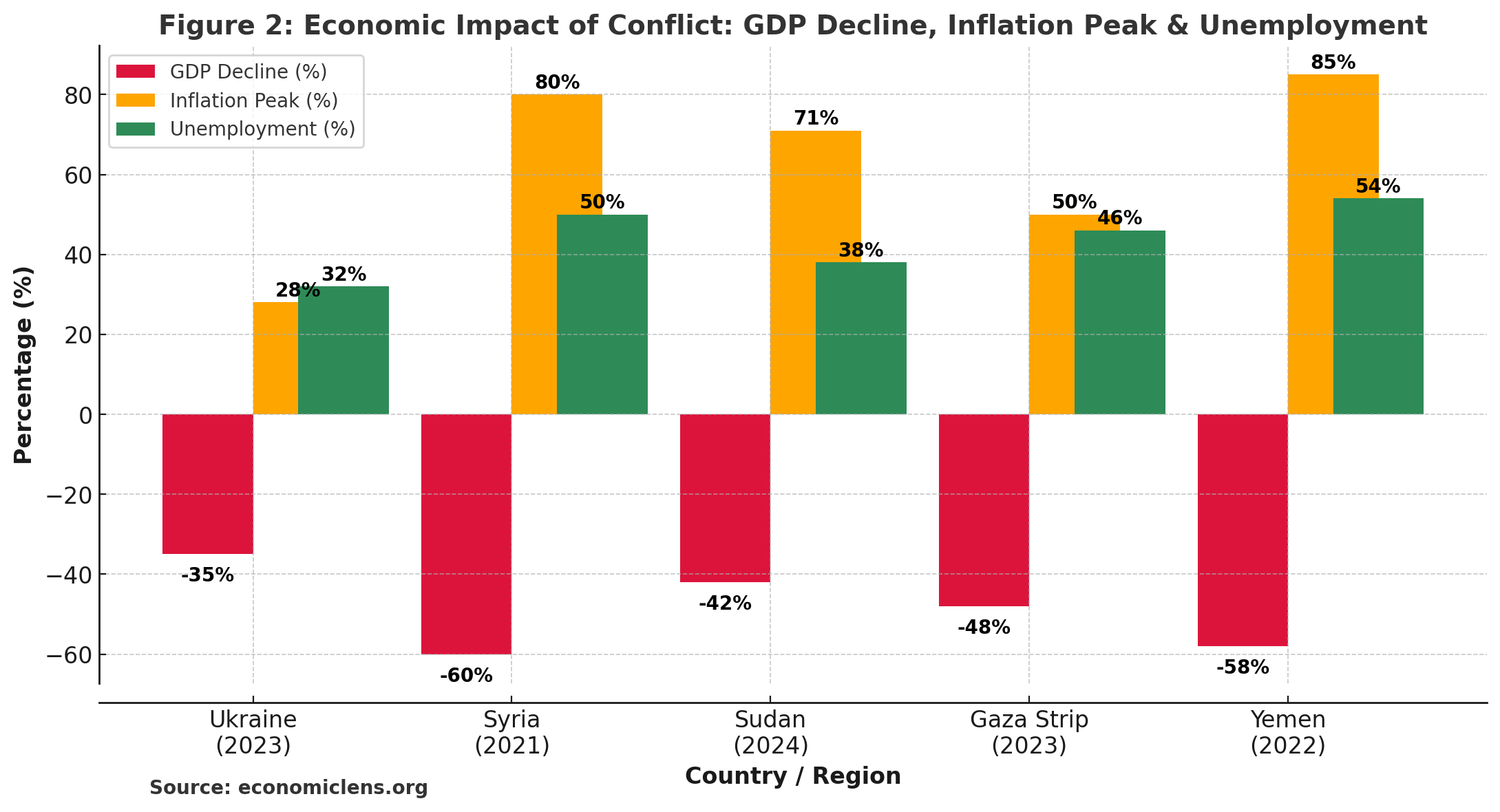
The next figure highlights how recent wars have affected output and employment. It underlines the urgency for stabilization measures such as fiscal discipline and immediate infrastructure repair.
Source: World Bank Conflict Economics Database (2025)
The primary shocks that contributed to the economic downturn in these regions are as follows: Ukraine faced infrastructure collapse and trade blockades, leading to significant economic challenges. Syria’s industrial destruction and sanctions severely impacted its economy. Sudan grappled with currency depreciation and a food crisis, exacerbating economic instability. The Gaza Strip experienced economic setbacks due to import restrictions and widespread housing damage. Yemen’s economy was deeply affected by energy and food shortages, driving its severe decline.
“The first act of peace is to give people back the means to work.”
4. Financing the Future: Who Pays for Recovery?
Financing reconstruction is always political. Should donors lead, or should domestic taxation rise? Experience shows that blended models — foreign loans combined with private-sector partnerships — achieve balance. Transparent budgeting encourages investor trust, while inclusive participation ensures funds reach communities that need them most.
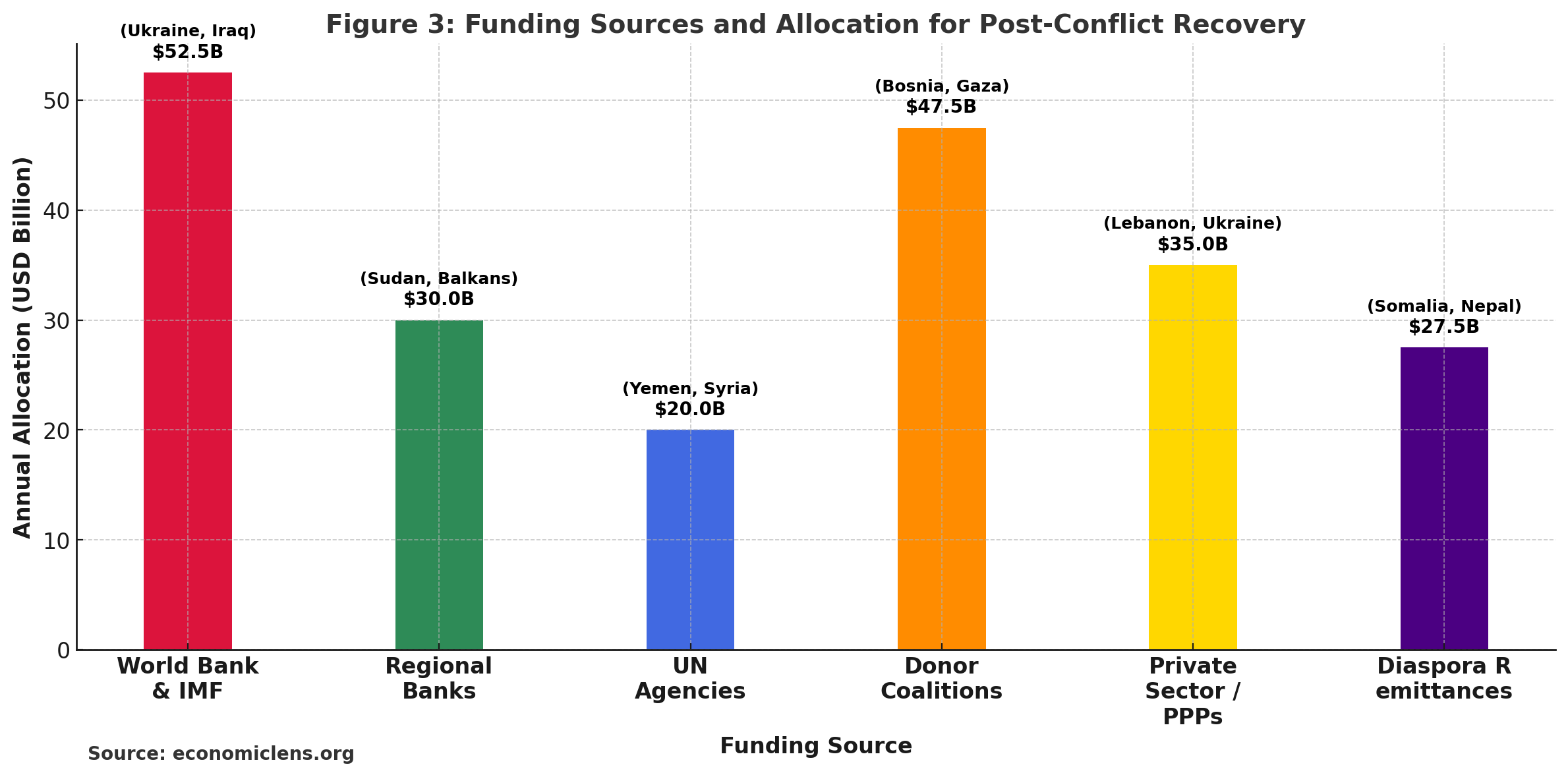
The figure below summarizes the primary sources of global reconstruction financing and the roles they play in turning relief into development.
Source: OECD Reconstruction Finance Report (2025)
Funding sources play key roles in post-conflict recovery: The World Bank and IMF provide policy loans and infrastructure finance (e.g., Ukraine, Iraq). Regional banks focus on energy and transport rebuilding (e.g., Sudan, Balkans). UN agencies support health, education, and governance (e.g., Yemen, Syria). Donor coalitions drive institutional reform (e.g., Bosnia, Gaza). Private sector/PPPs fund telecom and housing projects (e.g., Lebanon, Ukraine). Diaspora remittances support micro-enterprises (e.g., Somalia, Nepal).
“Money alone cannot rebuild a nation—but without it, peace cannot stand.”
5. Infrastructure and Industrial Renewal
Reconstruction begins where the roads and power lines once stood. Without logistics, trade, and energy, even the best-funded reforms falter. Prioritizing connectivity and clean power also generates employment, helping demobilized workers transition back into the economy.
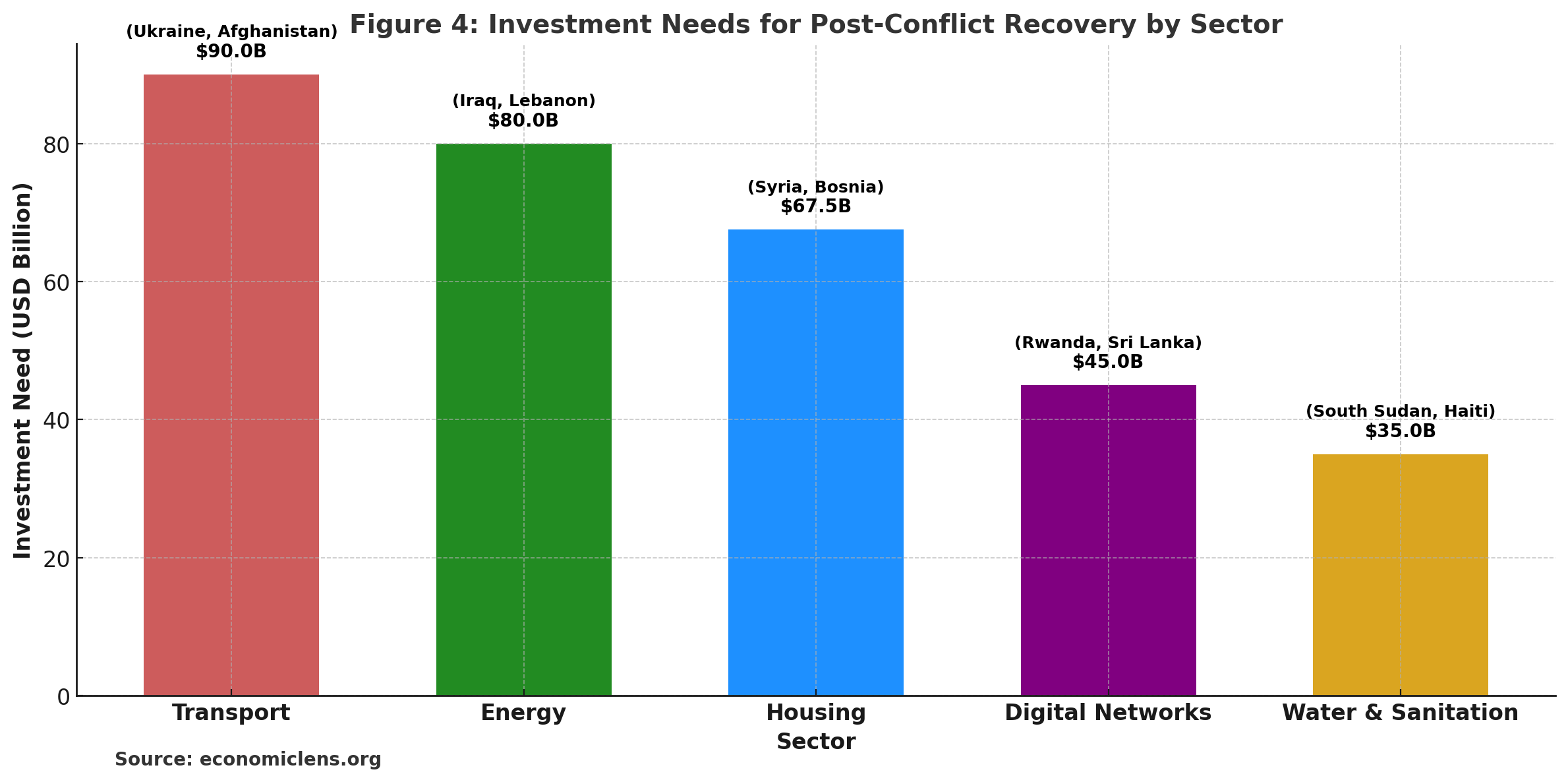
The next figure lists investment priorities by sector, illustrating how physical rebuilding supports industrial revival and social stability.
Source: Global Infrastructure Facility (2025)
The recovery functions across sectors are as follows: Transport investments revive trade corridors, as seen in Ukraine and Afghanistan. Energy funding powers homes and factories, crucial for Iraq and Lebanon. Housing investments provide shelter and create construction jobs, important for Syria and Bosnia. Digital networks support governance and innovation, exemplified by Rwanda and Sri Lanka. Water and sanitation investments protect public health, seen in South Sudan and Haiti.
“Each bridge rebuilt is a bridge toward peace.”
6. Human Capital and Institutional Reform
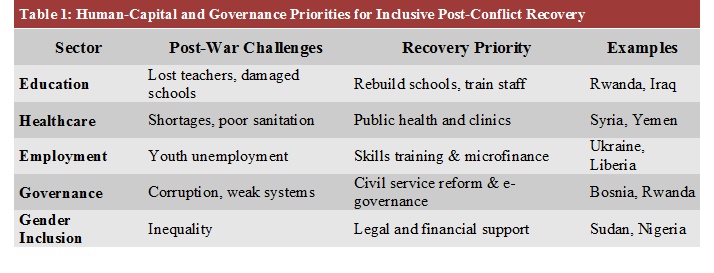
Physical structures alone cannot sustain peace. Post-Conflict Economic Recovery relies on people — teachers, doctors, entrepreneurs, and civil servants — who translate policy into progress. Education and healthcare investments nurture trust, while strong institutions prevent corruption and renew legitimacy.
The following table identifies human-capital and governance priorities crucial for inclusive recovery.
Source: UNDP Human Capital Outlook (2025)
“A nation recovers when its citizens start believing the system serves them, not itself.”
7. Global Cooperation and Policy Frameworks
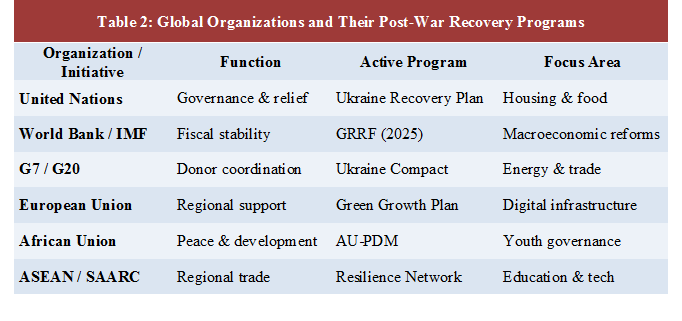
No single country can rebuild in isolation. Donors, regional blocs, and financial institutions coordinate through frameworks that prevent duplication and ensure accountability. Effective cooperation aligns humanitarian relief with long-term economic planning.
The table below maps leading organizations and their current post-war programs, showing how shared governance turns global solidarity into measurable results.
Source: UNDP and WEF (2025)
“Reconstruction is no longer charity—it’s shared security.”
8. Technology, Sustainability, and Green Reconstruction
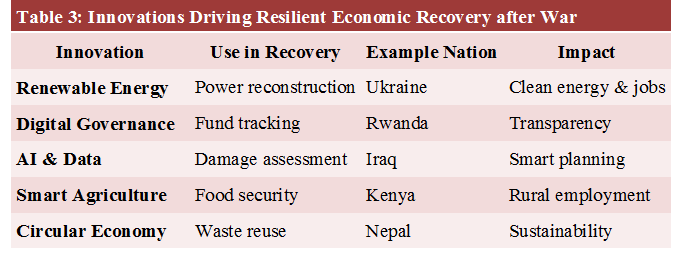
Today’s rebuilding is greener and smarter than ever before. Solar grids, AI-based logistics, and digital public services cut costs and corruption. Integrating sustainability ensures that post-war growth doesn’t recreate the vulnerabilities that caused conflict in the first place.
The following table highlights innovations transforming economic rebuilding after war into a more resilient process.
Source: UNEP Digital Reconstruction Report (2025)
“Rebuilding isn’t just about survival—it’s about evolution.”
9. Case Studies Snapshot
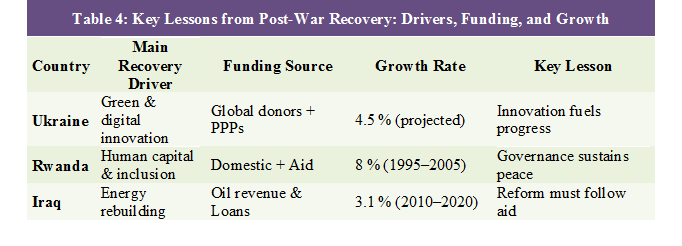
Behind each statistic lies human persistence. Comparing nations side-by-side reveals that innovation and governance often outweigh raw aid volumes. Countries like Rwanda and Ukraine prove that strategic investment in people and technology yields faster, fairer growth.
The table below summarizes these examples and distills their central lessons.
Source: UNDP Recovery Reports (2025)
“Rebuilding after war is not about restoring the past—it’s about preparing for a better future.”
10. Research Insights
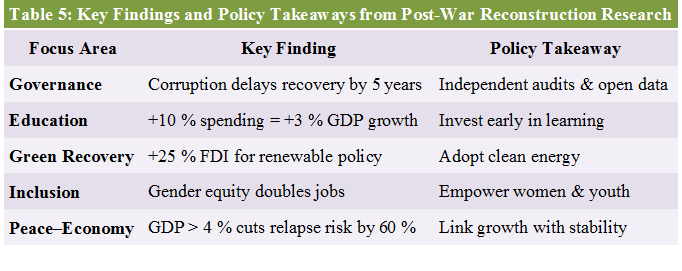
Long-term peace depends on data-driven policy. Studies reveal measurable links between education spending, GDP growth, and relapse prevention. Governments that invest early in governance reforms and inclusive growth enjoy both stability and investor confidence.
The next table distills key findings from recent research on the economics of reconstruction.
Source: World Bank Growth Drivers Study (2025)
“A strong economy doesn’t just survive war; it prevents the next one.”
11. Policy Guidelines
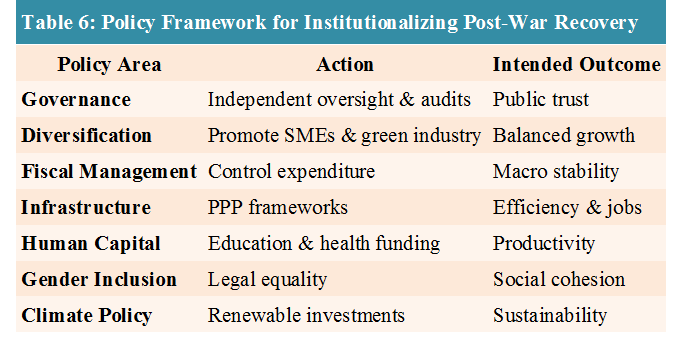
Experience translates research into action. Effective post-conflict recovery strategies combine fiscal responsibility, human-capital investment, and environmental foresight. Clear rules for debt management, diversification, and inclusion keep momentum once aid fades.
The following policy framework outlines practical steps governments can institutionalize.
Source: UNDP Policy Framework (2025)
“The ultimate victory in rebuilding after war is not measured in GDP—it’s measured in trust restored.”
12. Concluding Remarks
“Wars destroy nations in months; rebuilding them takes decades — and faith.”
The road from conflict to prosperity is long but navigable. Post-Conflict Economic Recovery requires transparent governance, citizen participation, and innovation that serves peace. Each school rebuilt, each power line restored, represents a commitment to future generations.
From Europe’s Marshall Plan to Ukraine’s modern green recovery, success stories share three constants: strong institutions, empowered people, and sustainable vision. When nations rebuild with these values, they don’t merely recover—they redefine progress.
“Reconstruction is not the end of war; it is the beginning of a wiser peace.”



4 thoughts on “Post-Conflict Economic Recovery: Rebuilding Economies After War”
can You Guide me about ai and tech
thanks for your comment
read the following two blogs for information and guidance
1. https://economiclens.org/digital-arms-race-technological-supremacy-in-global-politics/
2. https://economiclens.org/currency-wars-in-the-digital-economy-how-ai-and-cbdcs-redefine-global-finance/
Ok Thank You VERY much
thanks for your comment
read the following blogs for information
1. https://economiclens.org/ai-and-automation-navigating-job-displacement-economic-inequality-in-2026/
2. https://economiclens.org/digital-arms-race-technological-supremacy-in-global-politics/