Red Sea shipping disruptions are reshaping global trade as security risks force rerouting, reduce effective shipping capacity, and reset freight costs higher, amplifying food, energy, and consumer inflation across import-dependent economies.
How geopolitical risk is reshaping trade, prices, and inflation
Suez Canal shipping shock have evolved into a structural shock for global trade. What began as a regional security threat now affects freight costs, supply chains, and inflation worldwide. As a result, shipping markets are adjusting to a higher and more persistent cost environment.
This shift builds on earlier analysis of the Red Sea shipping crisis and global trade fallout, where rising insecurity first translated into supply chain stress and inflation pressure (Read: https://economiclens.org/red-sea-shipping-cost-surge-reshapes-global-freight-markets/, https://economiclens.org/red-sea-shipping-crisis-global-trade-fallout-inflation-pressure-and-supply-chain-turmoil/)
Red Sea Trade Disruption and the Security Shock
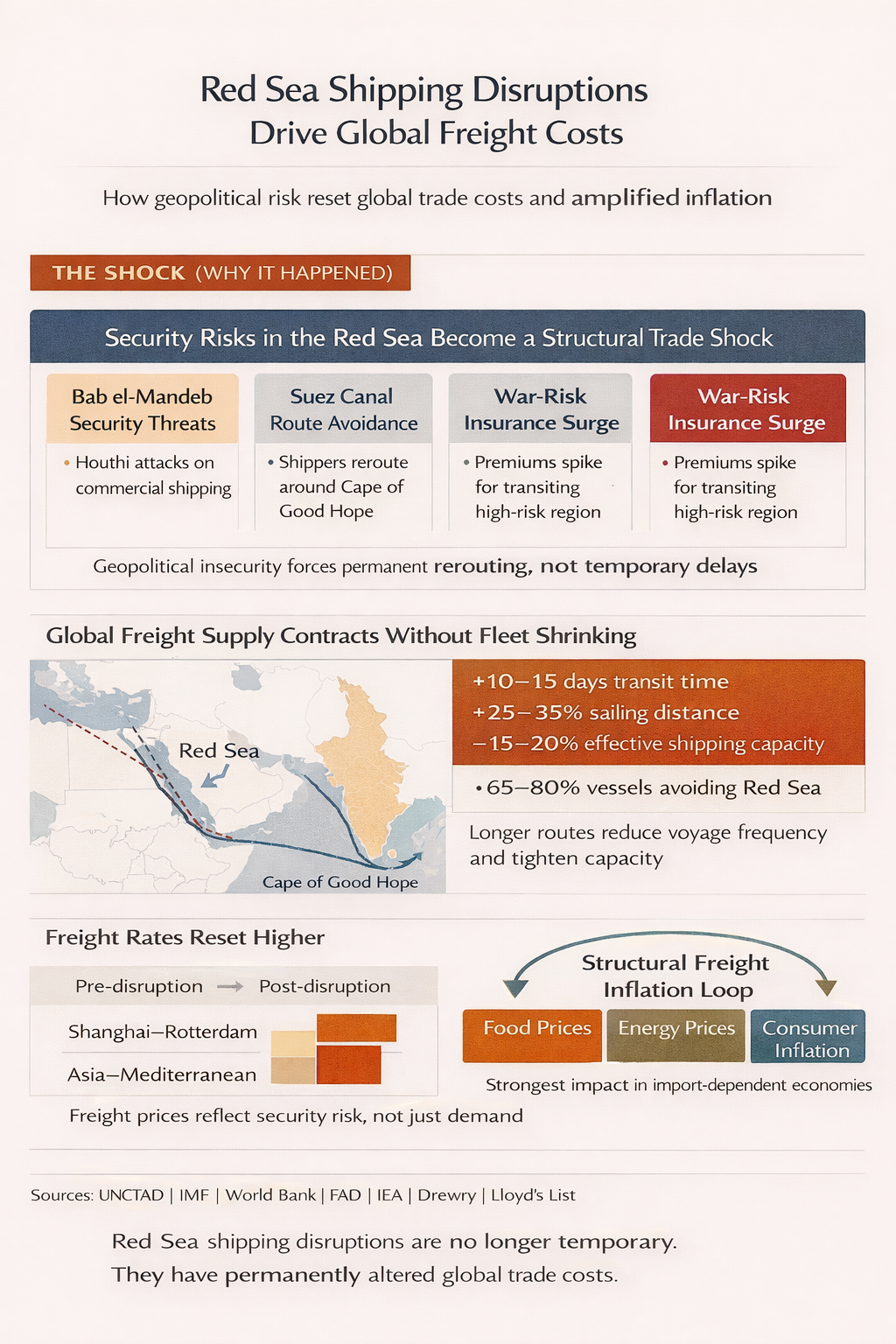
The core driver of Red Sea shipping disruptions is maritime insecurity around the Bab el-Mandeb Strait. Attacks on commercial vessels have raised both operational and financial risks. Consequently, shipping lines have reassessed route safety rather than focusing on speed or efficiency.
This escalation has triggered a broader Suez Canal shipping shock, as detailed in our analysis of Red Sea turmoil and global shipping routes (https://economiclens.org/red-sea-turmoil-suez-canal-disruptions-and-the-global-shipping-shock/)
Moreover, war-risk insurance premiums for Red Sea transit have surged. According to UNCTAD, elevated insurance and security costs now materially affect freight pricing and route decisions https://unctad.org/
Maritime Security Risk Forces Permanent Rerouting
As security risks persist, maritime security risk has become a structural constraint. Most major carriers now divert vessels around the Cape of Good Hope. This choice prioritizes safety, even though it significantly increases distance and time.
Suez Canal shipping shock therefore result in longer voyages rather than temporary delays. Transit times rise by up to two weeks. Sailing distances expand by more than a quarter. Effective shipping capacity tightens, even without fleet reductions.
This mechanism mirrors other chokepoint stresses seen globally, including climate-driven canal bottlenecks explored in our analysis of global water stress and supply chain risk
https://economiclens.org/global-water-stress-2025-canal-bottlenecks-hydropower-losses-supply-chain-risk/
Global Freight Cost Inflation Takes Hold
Global freight cost inflation is the most visible outcome of Suez Canal shipping shock. Freight rates now reflect security risk instead of pure demand cycles. This represents a clear regime shift.
Key routes illustrate this reset clearly. Asia to Europe freight rates remain elevated. Asia to Mediterranean routes face even stronger pressure due to Suez dependence. According to the World Bank, higher transport costs are feeding directly into global price levels https://www.worldbank.org/
Importantly, this is not a short-term spike. Freight markets are repricing risk on a longer horizon.
Spillovers Into Food, Energy, and Consumer Inflation
The spillover effects of Red Sea shipping disruptions extend well beyond shipping markets. Higher freight costs pass directly into food prices. Grain, edible oil, and fertilizer imports become more expensive.
Energy markets also feel the impact. Longer routes raise shipping costs for oil and LNG. The International Energy Agency has warned that transport bottlenecks can amplify energy price volatility https://www.iea.org/
As a result, consumer inflation rises. Import-dependent economies face the strongest pressure. Logistics now acts as an inflation multiplier rather than a neutral channel.
Outlook: Why Red Sea Shipping Disruptions Will Persist
Red Sea shipping disruptions are unlikely to reverse quickly. Even if regional tensions ease, risk perception has permanently shifted. Insurers, shipping lines, and cargo owners now price security risk into long-term decisions.
As discussed in our broader outlook on global trade resilience under shipping stress, this implies structurally higher trade costs and persistent inflation pressure
https://economiclens.org/red-sea-shipping-crisis-global-trade-fallout-inflation-pressure-and-supply-chain-turmoil/
Therefore, the global economy is adjusting to a new logistics equilibrium. Efficiency is no longer the sole priority. Security now defines trade routing.
Final Takeaway
Red Sea shipping disruptions have reset global freight economics. Permanent rerouting, higher insurance costs, and reduced effective capacity have lifted trade costs structurally. These pressures spill into food prices, energy markets, and consumer inflation.
The visual story makes one conclusion clear. Red Sea shipping disruptions are no longer temporary shocks. They are a lasting feature of the global trade landscape.